Description
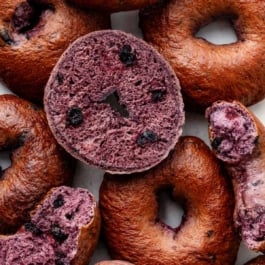
These homemade blueberry bagels are wonderfully chewy on the outside, soft and dense on the inside, and packed with real blueberries. The dough is flavored with a quick stovetop blueberry sauce and chewy dried blueberries. Made completely from scratch with simple ingredients and unbeatable flavor! Make-ahead and freezing instructions included below.
Ingredients
- 1 and 1/2 cups (about 200g) fresh or frozen blueberries
- 1/4 cup (50g) granulated sugar, divided
- 1 cup (240g/ml) warm water (between 100–110°F/38–43°C)
- 1 Tablespoon instant or active dry yeast*
- 1 teaspoon pure vanilla extract
- 3/4 cup (120g) dried blueberries
- 3 and 3/4 cups (488g) bread flour (spooned & leveled), plus more as needed*
- 2 teaspoons salt
- for coating the bowl: nonstick spray or 2 teaspoons butter or olive oil
For Boiling & Topping
- 2 quarts (1.9L) water
- 1/4 cup (85g) honey or barley malt syrup
- egg wash: 1 egg white beaten with 1 Tablespoon water
Instructions
- Cook the blueberries: Place the blueberries and half of the sugar (2 Tbsp/25g) in a small saucepan over medium-low heat. Cook, stirring with a silicone spatula, until you have a blueberry sauce, a little thinner than a jam, about 10 minutes. You should have around 1/2 cup of sauce, or about 130g. Pour into a heat-proof bowl and let cool slightly (to about 110°F or cooler). Feel free to speed it up by placing it in the refrigerator while you continue.
- Prepare the dough: In the bowl of a stand mixer fitted with a dough hook attachment, whisk the warm water, remaining 2 Tablespoons of sugar, and yeast together. Cover and allow to sit for 5-10 minutes until foamy and frothy on the surface. *If you don’t have a stand mixer, use a large mixing bowl and mix the dough with a wooden spoon or silicone spatula in the next step.*
- To the yeast mixture, add 1/2 cup (130g) of the slightly cooled blueberry sauce (do not exceed that amount), followed by the vanilla extract, dried blueberries, 1 cup of the bread flour, and the salt, then beat on medium speed until incorporated. Add the remaining flour and beat on medium speed for 2 minutes, until the dough comes together and pulls away from the sides of the bowl. If it seems too sticky and clings to the sides of the bowl instead of forming a rough mass around the dough hook or spoon, add more flour, 1 tablespoon at a time, and continue to mix until the dough pulls away from the sides of the bowl. The dough should be stiff. If it is dry or crumbly and breaks off in pieces, add more water, 1 teaspoon at a time, mixing well after each addition.
- Knead the dough: When the dough has reached the proper consistency, beat on low speed with the dough hook for an additional 6–8 minutes, or knead by hand on a lightly floured surface for 6–8 minutes, until the dough feels smooth and elastic. (If you’re new to bread-making, my How to Knead Dough video tutorial can help here.) If the dough becomes too sticky during the kneading process, sprinkle 1 teaspoon of flour at a time on the dough or on the work surface/in the bowl to make a soft, slightly tacky dough. Do not add more flour than you need because you do not want a dry dough.
- Lightly grease a large bowl with nonstick spray, butter, or oil. Place the dough in the bowl, turning it to coat all sides in the oil. Cover the bowl with plastic wrap or a clean kitchen towel. Allow the dough to rise at room temperature for 2 hours, or until doubled in size.
- Line two large baking sheets with parchment paper or silicone baking mats.
- Shape the bagels: When the dough is risen, punch it down to release the air. On a lightly floured surface, divide the dough into 8 equal pieces, about 130g each. Shape each piece into a ball. Press your index finger through the center of each ball and stretch to create a bagel shape with a hole about 1.5–2 inches in diameter. Arrange the shaped bagels on the prepared baking sheets. Loosely cover the shaped bagels with a kitchen towel or plastic wrap and let them rest for 5–10 minutes as you prepare the water bath.
- Preheat the oven to 425°F (218°C).
- Water bath: Fill a large, wide pot with 2 quarts (1.9L) of water. Whisk in the honey or barley malt syrup. Bring to a boil over high heat, then reduce heat to medium-high. Drop 2 or 3 bagels in at a time, making sure they have enough room to float around. Boil the bagels for 1 minute, then use a spatula to flip each bagel over and boil for 1 minute more. Using a slotted metal spatula, lift the bagels out of the water, letting the excess water drain off. Place the bagels back on the lined baking sheets. Repeat with remaining bagels.
- Using a pastry brush, brush the egg wash on top and around the sides of each bagel.
- Bake for 26–30 minutes, rotating the pans halfway through, until the bagels have lightly browned. Allow the bagels to cool on the baking sheets for 20 minutes, then transfer to a cooling rack to cool completely.
- Slice, toast, top, whatever you want! Cover leftover bagels tightly and store at room temperature for up to 2 days or in the refrigerator for up to 5 days. You can freeze them for up to 3 months.
Notes
- Overnight Make-Ahead Instructions: Prepare the dough through step 5, but allow the dough to rise overnight in the refrigerator instead of at room temperature. The slow rise gives the bagels wonderful flavor! In the morning, remove the dough from the refrigerator and let the dough rise for 45 minutes at room temperature. Continue with step 6. I don’t recommend shaping the bagels the night before as they will puff up too much overnight.
- Freezing Make-Ahead Instructions: Baked bagels freeze wonderfully! Freeze them for up to 3 months, thaw overnight in the refrigerator or at room temperature, then warm to your liking. You can also freeze the bagel dough. After punching down the dough in step 7, wrap the dough tightly in plastic wrap, then a layer of aluminum foil—or seal it tightly in a freezer bag. Freeze for up to 3 months. Thaw overnight in the refrigerator, then punch the dough down again to release any air bubbles. Continue with the rest of step 7.
- Special Tools (affiliate links): Small Saucepan | Stand Mixer | Baking Sheets | Parchment Paper or Silicone Baking Mats | Food Scale | Large Pot (such as a 5- or 6-quart Dutch oven) | Pastry Brush
- Yeast: Use instant or active dry yeast. If using active dry yeast, the rise time may be slightly longer. 1 standard packet is about 2 and 1/4 teaspoons, so you will need a little more than 1 packet of yeast. Reference my Baking with Yeast Guide for answers to common yeast FAQs.
- Dried Blueberries: Look for the kind that are chewy, like raisins or dried cranberries. You can skip them if needed, but they add concentrated blueberry flavor and chewy texture. Without them, the bagels will be milder in flavor. We haven’t tested these bagels with freeze-dried blueberries.
- Bread Flour: Bagels require a high-protein flour. Bread flour is a must. Here are all my recipes using bread flour if you want more recipes to use it up. All-purpose flour can be used in a pinch, but the bagels will be flimsy and not nearly as chewy.
- Bread Machine: Place the dough ingredients into the pan of the machine. Program the machine to dough or manual, then start. After 9–10 minutes, the dough will be quite stiff. Allow the machine to complete its cycle, then continue with the recipe.
- Halve or Double: You can halve this dough recipe by simply halving all of the dough ingredients (do not halve the water or honey for the boiling step). No changes to the recipe instructions. For best taste and texture and to not overwhelm your mixer with excess heavy dough, I do not recommend doubling this dough recipe. Instead, make separate batches of dough.