Description
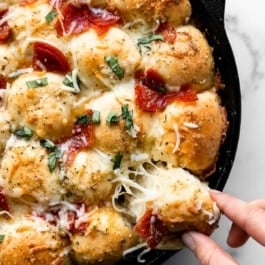
Soft, buttery garlic herb yeast rolls are topped AND stuffed with mozzarella cheese and pepperoni, and finished with garlic herb butter. Take your time with this recipe because there are a few particular steps for shaping, topping, and finishing the rolls.
Ingredients
Dough & Filling
- 2 teaspoons Platinum Yeast from Red Star*
- 1 Tablespoon granulated sugar
- 3/4 cup (180ml) whole milk
- 3 Tablespoons (43g) unsalted butter, melted
- 1 large egg
- 1 teaspoon salt
- 1 teaspoon garlic powder
- 1 teaspoon Italian seasoning blend
- 2 and 3/4 cups (360g) bread flour (spooned & leveled), plus more as needed*
- 1 and 1/2 cups (135g) shredded mozzarella cheese
- 1/2 cup (60g) chopped pepperoni (or more cheese)
Topping
- 1/2 cup (45g) shredded mozzarella cheese
- 1/4 cup (30g) chopped pepperoni (or more cheese)
- optional: 4 ounces (113g) uncooked ground Italian sausage
- optional: 1/3 cup (50g) chopped green pepper
- optional: 2 Tablespoons (20g) sliced black olives
Garlic Herb Butter for Brushing
- 2 Tablespoons (28g) butter, melted
- 1/2 teaspoon Italian seasoning
- 1/2 teaspoon garlic powder
- optional, for serving: pizza sauce, chopped fresh basil, crushed red pepper flakes
Instructions
- Make the dough: Place the yeast and sugar in the bowl of a stand mixer fitted with a dough hook or paddle attachment. Or, if you do not own a stand mixer, a regular large mixing bowl. Heat the milk on the stove or in the microwave until warm to touch, about 110°F (43°C). Pour warm milk on top of yeast/sugar. Whisk gently to combine, then loosely cover with a clean kitchen towel and allow to sit for 5—10 minutes. The mixture will be frothy after 5—10 minutes.
- If you do not have a mixer, you can mix the dough together with a wooden spoon or silicone spatula in this step. Add the melted butter, egg, salt, garlic powder, and Italian seasoning and about 1 cup of the bread flour. Beat on low speed for 1 minute to combine ingredients, then add the remaining flour and beat on medium speed until the dough comes together and pulls away from the sides of the bowl, about 2 minutes. If the dough seems too wet to a point where kneading (next step) would be impossible, beat in more flour 1 Tablespoon at a time until you have a workable dough. Dough should be soft and a little sticky, but still manageable to knead with lightly floured hands.
- Knead the dough: Keep the dough in the mixer and beat for an additional 5 full minutes, or knead by hand on a lightly floured surface for 5 full minutes. (If you’re new to bread-baking, my How to Knead Dough video tutorial can help here.) If the dough becomes too sticky during the kneading process, sprinkle 1 teaspoon of flour at a time on the dough or on the work surface/in the bowl to make a soft, slightly tacky dough. Do not add more flour than you need because you do not want a dry dough. After kneading, the dough should still feel a little soft. Poke it with your finger—if it slowly bounces back, your dough is ready to rise. You can also do a “windowpane test” to see if your dough has been kneaded long enough: tear off a small (roughly golfball-size) piece of dough and gently stretch it out until it’s thin enough for light to pass through it. Hold it up to a window or light. Does light pass through the stretched dough without the dough tearing first? If so, your dough has been kneaded long enough and is ready to rise. If not, keep kneading until it passes the windowpane test.
- Place the dough in a greased bowl (I use nonstick spray to grease) and cover with plastic wrap or aluminum foil. Place in a slightly warm environment to rise until doubled in size, around 60—90 minutes. (If desired, use my warm oven trick for rising. See my answer to Where Should Dough Rise? in my Baking with Yeast Guide.)
- As the dough rises, grease a 9-inch square pan, a 9-inch springform pan, a 9×13-inch baking pan, or a 10-inch oven-safe cast iron skillet; if using a cast iron skillet that’s already seasoned, no need to grease it. A 9-inch round cake pan or pie dish is too small for this recipe. See Notes for other baking pan options.
- Prepare the filling: Mix together 1 and 1/2 cups (135g) shredded mozzarella and 1/2 cup (60g) chopped pepperoni in a bowl.
- Shape the rolls: When the dough is ready, punch it down to release the air. Pinch off a piece of dough about 1 and 1/2 Tablespoons in size (1 ounce/30g). With your hands, form into a ball and make an indent in the center. Pinch a bit of cheese and pepperoni (a scant Tablespoon, about 7–8g) with your fingers and stuff into the middle of the dough. Press the dough around it to seal the filling inside, and place the stuffed dough ball into the prepared pan. Repeat with remaining dough and filling until you’ve filled the pan (you should have about 20–24 balls).
- Cover the pan with plastic wrap or aluminum foil and allow to rise once again in a slightly warm environment until puffy, about 30–45 minutes.
- Prepare the toppings: In a small bowl, mix together 1/2 cup (45g) mozzarella cheese and 1/4 cup (30g) pepperoni. If you’re making the supreme-style option, heat a skillet over medium heat. Add sausage and chopped green pepper. Cook, stirring and breaking up the sausage into bite-size pieces with a wooden spoon or rubber spatula, until sausage is cooked through, about 6–7 minutes. Transfer the mixture to a plate lined with paper towels, to drain. Combine with the sliced olives.
- Adjust the oven rack to the lower third position, then preheat oven to 350°F (177°C).
- Bake for 20 minutes. After 20 minutes, remove the rolls from the oven and sprinkle on the cheese and pepperoni topping; plus the cooked sausage, peppers, and olives, if making supreme style. Loosely tent with foil, then return to oven and bake for another 12–15 minutes, or until lightly browned on top. For a more accurate test of doneness, the rolls are done when an instant read thermometer reads 195°F (90°C). Remove from the oven and let cool for a few minutes as you prepare the topping.
- Make the garlic herb butter: Melt 2 Tablespoons of butter and stir in the garlic powder and Italian seasoning. Brush on warm rolls before serving. Serve with a side of pizza sauce, and any other additional pizza toppings such as fresh chopped basil or crushed red pepper flakes.
- Cover leftover rolls tightly and store in the refrigerator for up to 5 days.
Notes
- Freezing Instructions: Prepare the recipe through step 7. Place shaped rolls in a greased baking pan, cover tightly, and freeze for up to 3 months. Once frozen, the dough balls won’t stick together anymore and you can place them in a freezer bag if needed. On the day you serve them, arrange the dough balls in a greased baking pan, cover tightly, then let them thaw and rise for about 4–5 hours. Bake as directed. You can also freeze the baked rolls. Allow them to cool completely and then freeze for up to 3 months. Thaw in the refrigerator or at room temperature. Reheat as desired. If reheating the whole pan, loosely cover with foil and reheat in a 300°F (149°C) oven for about 10 minutes or until warm.
- Overnight Instructions: Prepare the recipe through step 7. Cover the shaped rolls tightly and refrigerate for up to about 15 hours. At least 3 hours before you need them the next day, remove the rolls from the refrigerator, keep covered, and allow to rise on the counter for about 1–2 hours before baking. Alternatively, you can let the dough have its 1st rise in the refrigerator overnight (step 3). Cover the dough tightly and place in the refrigerator for up to about 15 hours. Remove from the refrigerator and allow the dough to fully rise for 2 more hours. Continue with step 4.
- Special Tools (affiliate links): Stand Mixer or Glass Mixing Bowl | 10.25-inch Oven-Safe Cast Iron Skillet, 9-inch Square Baking Pan, 9-inch Springform Pan, or 9×13-inch Baking Pan | Pastry Brush
- Yeast: I always use Platinum Yeast from Red Star, an instant yeast. If using active dry yeast, the rise times could be slightly longer. Reference my Baking with Yeast Guide for answers to common yeast FAQs.
- Flour: I recommend bread flour for extra chewy and flaky rolls. You can use all-purpose flour if needed instead. Either flour is fine and there are no other changes to the recipe if you use one or the other.
- Italian Seasoning: Italian seasoning is a store-bought herb blend and you can make your own homemade Italian seasoning if desired. Or substitute with the same amount of your favorite dried herb.
- Make Them Vegetarian: You can leave out the pepperoni and just include more cheese for the filling and topping, or use a plant-based pepperoni instead.
- Baking Pans (affiliate links): If baking in a skillet, make sure it’s oven-safe. I always use this 10.25-inch skillet. You can also bake these rolls in a 9-inch square baking pan, a 9-inch springform pan, or a 9×13-inch baking pan. A 9-inch round cake pan or pie dish is too small for this recipe. You could also arrange and bake them on a lined or greased baking sheet; make sure the rolls are touching.