Description
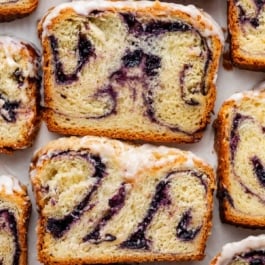
A summery take on a bakery-favorite bread, this lemon blueberry babka looks impressive but is completely doable in your home kitchen. A rich lemon-hinted dough is beautifully swirled with a homemade blueberry jam filling, and topped with buttery lemon crumbles. Creamy lemon icing brings it all together, but is totally optional.
Ingredients
Dough
- 2/3 cup (160g/ml) whole milk, warmed to about 110°F (43°C)
- 2 and 1/4 teaspoons (7g) Platinum Yeast from Red Star (1 standard packet)*
- 6 Tablespoons (75g) granulated sugar, divided
- 5 Tablespoons (71g) unsalted butter, sliced into 1 Tbsp-size pieces and softened to room temperature
- 1 teaspoon lemon zest
- 1 large egg, at room temperature
- 1 teaspoon pure vanilla extract
- 1/2 teaspoon salt
- 2 and 3/4 (358g) bread flour or all-purpose flour (spooned & leveled), plus more as needed
Blueberry Filling
- 1 and 1/4 cups (170–180g) fresh blueberries (do NOT use frozen)
- 6 Tablespoons (75g) granulated sugar
- 1 teaspoon lemon juice
Crumble Topping
- 3 Tablespoons (24g) bread flour or all-purpose flour
- 3 Tablespoons (38g) packed light or dark brown sugar
- 2 Tablespoons (28g) unsalted butter, cold and cubed
Brush on Assembled Loaf
- 1 egg white, beaten
Lemon Icing (Optional)
- 1 cup (120g) confectioners’ sugar
- 1 and 1/2 Tablespoons fresh lemon juice
- 1 Tablespoon whole milk, heavy cream, or half-and-half
Instructions
- Prepare the dough: Whisk the warm milk, yeast, and 1 Tablespoon of sugar together in the bowl of your stand mixer fitted with a dough hook or paddle attachment. Cover and allow to sit for 5 minutes, until foamy and frothy on top. *If you don’t have a stand mixer, mix the dough by hand using a silicone spatula or wooden spoon.*
- Add the remaining sugar, butter, lemon zest, egg, vanilla, salt, and 1 cup (130g) of bread flour. Beat on low speed for 30 seconds, scrape down the sides of the bowl with a silicone spatula, then add another 1 cup of flour. Beat on medium speed until relatively incorporated (there may still be chunks of butter). Scrape down the sides of the bowl with a silicone spatula. Add 1/2 cup of flour and beat on medium speed until the dough begins to come together. As the mixer runs, add another 2–4 Tablespoons of flour (up to 2 and 3/4 cups total) depending on how wet the dough looks. This should be a very soft and almost creamy-feeling dough. Do not add more flour than you need.
- Knead the dough: Keep the dough in the mixer (and switch to the dough hook if using the paddle) and beat on low speed for an additional 6–8 full minutes, or knead by hand on a lightly floured surface for 6–8 full minutes. (If you’re new to bread-baking, my How to Knead Dough video tutorial can help here.) If the dough becomes too sticky during the kneading process, sprinkle 1 teaspoon of flour at a time on the dough or on the work surface/in the bowl to make a soft, slightly tacky dough. Do not add more flour than you need because you do not want a dry dough. After kneading, the dough should still feel a little soft. Poke it with your finger—if it slowly bounces back, your dough is ready to rise.
- 1st rise: Lightly grease a large bowl with nonstick spray or butter. Place the dough in the bowl, turning it to coat all sides. Cover the bowl tightly and allow the dough to rise in a relatively warm environment until nearly double in size, about 3–4 hours. This dough is rich with fat, so it takes longer than other doughs to rise. Do not be alarmed if it takes around 4 hours. (If desired, use my warm oven trick for rising. See my answer to Where Should Dough Rise? in my Baking with Yeast Guide.)
- While the dough is rising, make the blueberry filling: Combine blueberries, sugar, and lemon juice together in a small saucepan with tall sides over medium heat. Stir constantly with a wooden spoon or silicone spatula, pressing the blueberries against the sides of the pan (stand back in case they splatter!). Once the blueberries are mostly smashed and the sugar has dissolved, stop stirring and allow to come to a boil. Boil, stirring occasionally, until the mixture is slightly reduced, about 10 minutes. (If you have a candy or instant-read thermometer, the mixture should reach about 215–220°F.) You should have about 1/2 cup (around 160g). Remove from heat and allow to cool completely. The filling will thicken as it cools. You can transfer it to a shallow heat-safe dish and place it in the refrigerator to cool down quicker. Set aside.
- Grease a 9×5-inch loaf pan with nonstick spray or butter.
- Shape the dough: When the dough is ready, punch it down to release the air. Flour a work surface, your hands, and a rolling pin. Roll the dough out to a 9×15-inch rectangle. *Note: Should it run over the sides of the dough, the blueberry filling can stain a work surface. If needed, transfer the rolled-out dough to a piece of parchment paper or silicone baking mat.* Gently spread the blueberry filling mixture on top, leaving a 1/2-inch border uncovered. Using floured hands, tightly roll up the dough to form a 15-inch-long log. Place the log on its seam. Fold in half, then twist it to form a figure 8. Pinch the ends together. Place in the prepared loaf pan. Visuals for this step:


- 2nd rise: Loosely cover the shaped babka. Allow to rise until it’s puffy and nearly reaches the top of the loaf pan, at least 1–1.5 hours.
- Make the crumble topping: Mix the brown sugar and flour together in a small bowl. Add the cold butter and, using a pastry cutter, two forks, or your fingers, cut the butter into the brown sugar mixture until pea-size crumbles form. Refrigerate or freeze until ready to use. (Cold crumbles are best!)
- Preheat oven to 350°F (177°C).
- Brush the surface of the babka with egg white. Using a toothpick, poke 10–12 holes all over the top of the loaf; this helps prevent an air bubble gap in the interior layers. Sprinkle with crumble topping. Visuals:

- Bake: Bake for 50 minutes or until golden brown on top. The surface of the bread browns quickly, so I recommend loosely tenting the pan with aluminum foil around the 30-minute mark. To ensure the bread is done at 50 minutes, give the warm bread a light tap. If it sounds hollow, it’s done. For a more accurate test, the bread is done when an instant-read thermometer reads the center of the loaf as 195°F (90°C).
- Remove from the oven and allow bread to cool in the pan for at least 30 minutes before icing (next step), slicing, and serving. A serrated knife is best for slicing.
- Make the lemon icing, if using: In a medium bowl or liquid measuring cup, whisk together confectioners’ sugar, lemon juice, and milk. Drizzle over the babka.

- Cover leftover babka tightly and store at room temperature for 2 days or in the refrigerator for up to 1 week.


Notes
- Freezing Instructions: Baked babka (without icing) freezes wonderfully. Wrap the cooled loaf in plastic wrap, then a layer of aluminum foil. Freeze for up to 3 months. Thaw wrapped loaf overnight in the refrigerator or at room temperature, then unwrap and warm to your liking. You can also freeze the dough. After punching down the dough in step 7, wrap the dough tightly in plastic wrap, then a layer of aluminum foil. Freeze for up to 3 months. Thaw overnight in the refrigerator, then punch the dough down again to release any air bubbles. Continue with the rest of step 7.
- Make-Ahead Instructions: Prepare the dough through step 3. Place into a greased bowl (use nonstick spray to grease). Cover tightly and place in the refrigerator for up to 24 hours. Remove from the refrigerator and allow the dough to come to room temperature, then let it rise until doubled in size, about 3 hours. Continue with step 6. You can prepare the blueberry filling and crumble topping ahead of time as well. Let the filling cool completely, then store in an airtight container in the refrigerator for up to 1 week. Refrigerate or freeze the topping for up to 1 week.
- Special Tools (affiliate links): Stand Mixer or Large Glass Mixing Bowl | Citrus Zester | Citrus Juicer | Silicone Spatula or Wooden Spoon | 9×5-inch Loaf Pan | Rolling Pin | Pastry Cutter | Pastry Brush
- Yeast: Platinum Yeast from Red Star is an instant yeast. Any instant yeast works. You can use a 1:1 substitution of active dry yeast instead with no changes to the recipe. Rise times will be slightly longer if using active dry yeast. Reference my Baking with Yeast Guide for answers to common yeast FAQs.