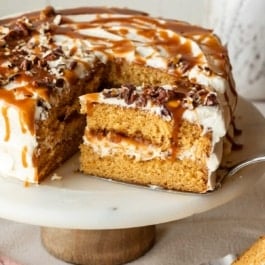
Description
The trick to burnt sugar cake is to use burnt sugar syrup as its main flavor. Make sure you prepare the burnt sugar syrup ahead of time so that it can properly cool and thicken. While you’re at it, prepare the salted caramel ahead of time too.
Ingredients
Burnt Sugar Syrup
- 1 cup (200g) granulated sugar
- 3/4 cup (180g/ml) boiling water
Cake
- 2 and 1/2 cups (285g) cake flour (spooned & leveled)
- 2 teaspoons baking powder
- 1/2 teaspoon baking soda
- 1 teaspoon salt
- 3/4 cup (12 Tbsp; 170g) unsalted butter, softened to room temperature
- 1 cup (200g) granulated sugar
- 4 large egg whites, at room temperature
- 1/2 cup (120g) sour cream, at room temperature
- 2 teaspoons pure vanilla extract
- 1/2 cup (120g/ml) whole milk, at room temperature
- 1/2 cup (120ml) cooled burnt sugar syrup
Burnt Sugar Frosting
- 1 cup (16 Tbsp; 226g) unsalted butter, softened to room temperature
- 4 cups (480g) confectioners’ sugar
- 1/4 cup (60g/ml) cooled burnt sugar syrup
- 1 teaspoon pure vanilla extract
- 2 Tablespoons (30g/ml) whole milk or heavy cream
- 1/4 teaspoon salt
For Assembly
- homemade salted caramel, cooled
- optional: 1/2 cup (60g) chopped toasted pecans*
Instructions
- For best success, read the recipe in full before starting.
- Prepare the burnt sugar syrup first so it has time to cool. Make sure you have boiling water at the ready. Place the sugar in a medium saucepan over medium heat. I recommend using a 3-quart heavy-bottomed quality saucepan. Stirring constantly with a wooden spoon, cook until the sugar has completely melted and is deep amber in color, about 8–10 minutes. If the sugar is clumpy, try to break up the lumps with the wooden spoon. A candy thermometer is not necessary, but if you’re using one, the sugar temperature should reach about 300°F (149°C) when it’s ready. Reduce the heat to low and very carefully and slowly drizzle in the boiling water, a little at a time. Stir after each addition and stand back, as the mixture will rapidly sizzle and bubble. After all of the boiling water is stirred in, cook the sugar syrup for 3 more minutes over low heat, stirring the entire time. Remove from heat and let it cool completely. You will have about 1 cup of syrup.
- Preheat the oven to 350°F (177°C). Grease two 9-inch round cake pans, line with parchment paper rounds, then grease the parchment paper. Parchment paper helps the cakes seamlessly release from the pans. (If it’s helpful, see this parchment paper rounds for cakes video & post.)
- In a medium bowl, whisk together the cake flour, baking powder, baking soda, and salt. Set aside.
- In a large bowl using a handheld or stand mixer fitted with a paddle attachment, beat the butter and sugar together on medium-high speed until light and creamy, about 3 minutes. Scrape down the sides of the bowl with a silicone spatula as needed. (Here’s a helpful tutorial if you need guidance on how to cream butter and sugar.) Add the egg whites and beat on medium-high speed until combined, about 2 minutes. Scrape down the sides and bottom of the bowl as needed. Add the sour cream and vanilla extract, and beat on medium-high speed until combined, about 1 minute. Add the dry ingredients and then, with the mixer running on low speed, slowly pour in the milk, followed by 1/2 cup (120g/ml) of the cooled burnt sugar syrup, and beat just until combined. Do not overmix. You may need to whisk it all by hand to make sure there are no lumps at the bottom of the bowl. The batter will be slightly thick. Divide the batter evenly between the prepared pans.
- Bake for 22–25 minutes or until the cakes are baked through. As a result of the burnt sugar syrup in the batter, the cakes will be a deep golden brown. To test for doneness, insert a toothpick into the center of the cake. If it comes out clean, it’s done. Allow cakes to cool completely in the pans set on a cooling rack.
- As the cakes cool, I suggest making the salted caramel. Let the salted caramel cool until it is no longer warm and has a thick, drizzleable consistency before using. If refrigerated caramel is too thick to drizzle, warm it in 5–10-second intervals, stirring between each, just until pourable. You can also toast the pecans during this time. See recipe Notes.
- Make the frosting: In a large bowl using a handheld mixer or stand mixer fitted with a paddle attachment, beat the butter on medium speed until creamy, about 1–2 minutes. Add confectioners’ sugar, 1/4 cup (60g/ml) of the cooled burnt sugar syrup, vanilla, milk/cream, and 1/4 teaspoon of salt. Beat on low speed for 30 seconds, then increase to high speed and beat until completely combined, about 2 minutes. Add more confectioners’ sugar if frosting is too thin or more milk/cream if frosting is too thick. Taste. Add more salt if desired. (Note: You will have some burnt sugar syrup left over. If desired, lightly brush a little onto the leveled cake layers before assembling.)
- Assemble and frost: (For additional help with this step, see this how to assemble a layer cake video & post.) First, using a large serrated knife or cake leveler, slice a thin layer off the tops of the cakes to create a flat surface. Discard (or crumble over ice cream!). Place one cake layer on your cake stand, cake turntable, or serving plate. Using a large icing spatula, spread 3/4–1 cup (180–240g) of the frosting in an even layer on top. Drizzle 1/4 cup (about 75g) of salted caramel on top of the frosting. Top with the second cake layer. Refrigerate the cake for at least 30–45 minutes to allow the caramel inside to set. After it has chilled, spread the remaining frosting all over the top and sides. Run a bench scraper around the cake to smooth out the sides, if desired. Garnish with another drizzle of salted caramel and toasted pecans, if using. Slice and serve.
- Cover leftover cake tightly and store in the refrigerator for up to 5 days. I like to use a cake carrier for storing and transporting.
Notes
- Make Ahead & Freezing Instructions: You can prepare the burnt sugar syrup up to 3 days ahead of time. Cover and store at room temperature until ready to use. You can also prepare the salted caramel up to 1 week ahead of time. Cover and store in the refrigerator until ready to use. You can prepare the cake layers ahead of time too. Wrap the individual baked and cooled cake layers tightly and refrigerate for up to 2 days or freeze up to 3 months. (See How to Freeze Cake for instructions.) Bring cake layers to room temperature, then prepare the salted caramel and continue with the frosting and assembly instructions. Frosted cake freezes well, up to 3 months. Thaw overnight in the refrigerator, then bring to room temperature before garnishing with caramel and pecans and serving.
- Special Tools (affiliate links): Heavy-Bottomed Saucepan | Wooden Spoon | Candy Thermometer (optional) | 9-inch Round Cake Pans | Glass Mixing Bowl | Whisk | Electric Mixer (Handheld or Stand) | Spatula | Cooling Rack | Cake Turntable | Large Icing Spatula | Bench Scraper | Cake Carrier (for storage)
- 3-Layer Cake or 9×13-Inch Cake: You can also prepare this cake as a 3-layer cake or 9×13-inch sheet cake, but the texture tastes best at the thickness of a 2-layer cake. I highly recommend sticking to a 2-layer cake. For a 3-layer cake, however, divide batter among three 8-inch round cake pans and bake for 20–22 minutes or until a toothpick inserted in the center comes out clean. For a 9×13-inch cake, pour the batter into a greased and lightly floured 9×13-inch pan and bake for 40 minutes or until a toothpick inserted in the center comes out clean. Top with a thick layer of frosting and drizzle salted caramel all over the top.
- Cupcakes: Recipe yields 30–36 cupcakes. Fill cupcake liners 2/3 full with batter. Bake for 20–22 minutes or until a toothpick inserted in the center comes out clean.
- Egg Whites: Egg whites (no yolks) are KEY to the cake’s fluffy texture. Here are recipes using leftover egg yolks.
- Why Room Temperature? All refrigerated items should be at room temperature so the batter mixes together easily and evenly. Read here for more information. Instead of sour cream, you can use plain yogurt. The cake won’t taste as rich, but it’s a fine substitute.
- Salted Caramel: No matter which size cake you make, or if you make cupcakes, you’ll have salted caramel leftover. Here are 50 ways to use salted caramel if you need inspiration for the leftovers. I don’t recommend halving the salted caramel recipe—make the whole recipe (1 cup).
- Toasted Pecans: Toasting the pecans is optional, but adds incredible flavor to the garnish. To toast, preheat the oven to 300°F (149°C). Spread chopped pecans on a parchment paper or silicone baking mat–lined baking sheet. Toast until slightly darkened, about 5–7 minutes. Cool before using as garnish.