

Making homemade glazed doughnuts is easier than you think, but requires a little patience. Ready in about 2.5 hours, these taste like doughnuts from your favorite bakery, but they’re made in the comfort of your own home. For doughnut success, follow my step-by-step photos, helpful success tips, and video tutorial. Using this same doughnut dough, you can create other flavored frosted doughnuts too!
I originally published this recipe in 2016 and have since added new photos, a video tutorial, and more helpful success tips.
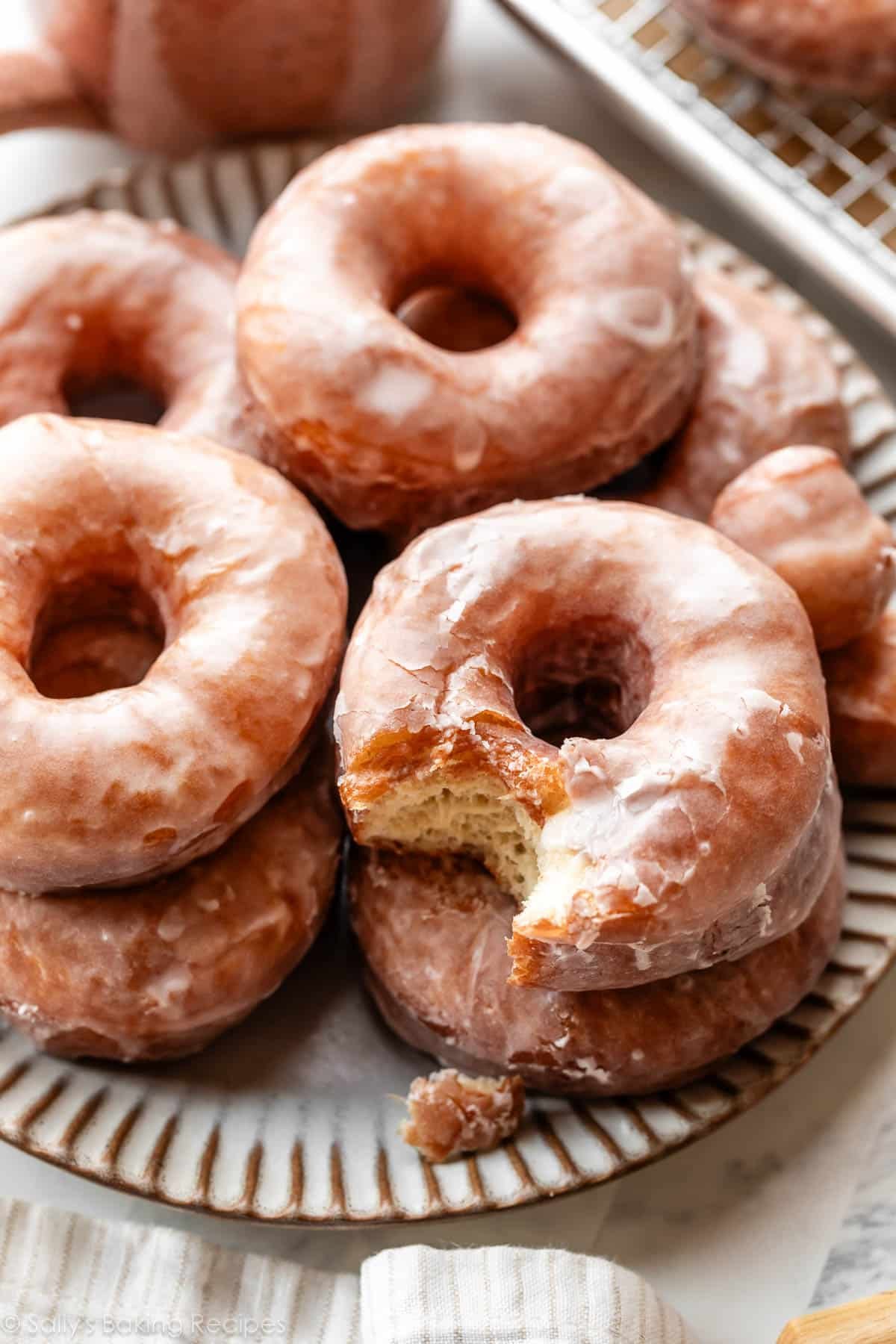
With that signature bakery taste and texture, doughnuts from a doughnut shop are incredibly delicious and indulgent. When you can’t pick up your favorite doughnuts, why not make them at home instead? They’ve always been a baking bucket list recipe for me, and today I’m taking you on a deep dive into homemade doughnuts—fried, sugary, old-fashioned, and comforting. I originally shared this recipe in 2016, and I now have more step-by-step photos and a video tutorial to guide you.
There’s a lot to cover today, so let’s get started!
These Homemade Glazed Doughnuts Are:
- Soft and sweet
- Flavored with a little nutmeg
- Completely from scratch
- Ready in about 2.5 hours (most of this is rise time!)
- A fun and delicious weekend project
- Perfect for sharing
One reader, Sue, commented: “I just made these doughnuts. I usually make my grandmother’s old fashioned doughnuts, but these may be my new favorite. These are absolutely perfect. Easy to make. They are a hit! Five stars all the way! ★★★★★“


Best Ingredients to Use for Homemade Doughnuts
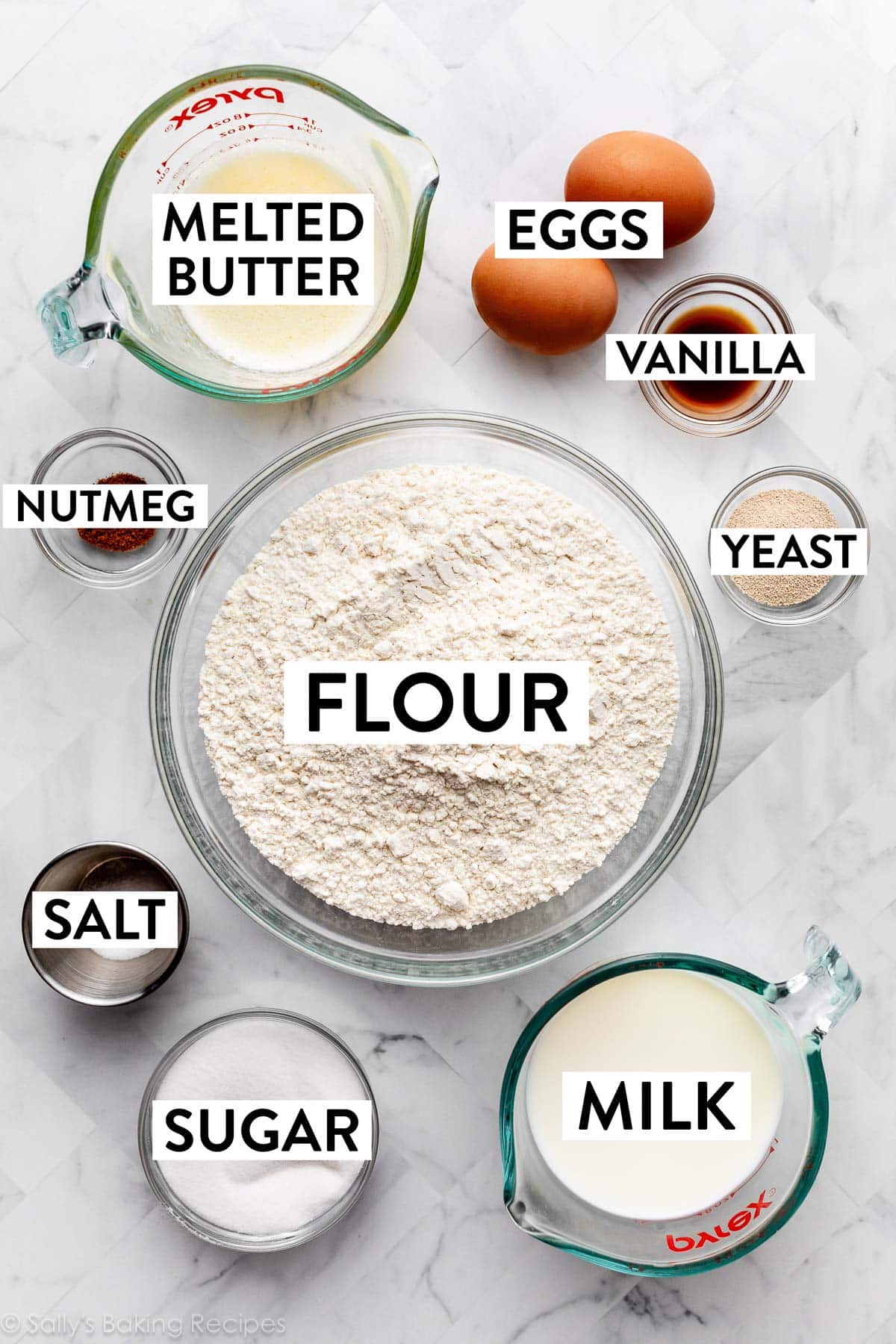
This is a straightforward, no-frills yeasted dough. You need just a few ingredients to begin:
- Milk: Liquid activates the yeast. Whole milk is a must for a super tender dough—or you can try buttermilk. Lower-fat or nondairy milks work in a pinch, but the doughnuts aren’t as flavorful or rich.
- Yeast: You can use active dry yeast or instant yeast. If using an instant yeast, your rise time will be a little shorter.
- Sugar: Sugar sweetens the doughnuts, but it also feeds the yeast, increases its activity, and tenderizes the dough.
- Eggs: Eggs provide structure and flavor.
- Butter: Melted butter promises enhanced flavor.
- Salt & Vanilla Extract: Both add flavor. You could even try using homemade vanilla extract!
- Nutmeg: A little nutmeg is the secret ingredient to that cozy, comforting bakery taste. If you’ve ever made my chocolate chip muffins, you know it adds a delicious pop of flavor!
- Flour: All-purpose flour is the dough’s structure. You’ll be tempted to add more and more flour as you mix the dough, but don’t. You want a very soft, pillowy dough for soft, pillowy doughnuts. The dough can still be slightly sticky. When kneading, use extra flour on your hands and work surface.
Are You a Yeast Beginner?
Reference this Baking with Yeast Guide whenever you work with baker’s yeast. I include practical answers to all of your common yeast questions.
Overview: How to Make Homemade Glazed Doughnuts
Let me walk you through the process so you understand what you’re doing. Homemade glazed doughnuts seem a little intimidating, but I assure you—they’re really not! I find they’re much easier than, say, homemade bagels and homemade English muffins.
Prepare the dough. The dough comes together with a mixer. You can also make the dough by hand, but it requires a bit of arm muscle. After the dough comes together in the mixing bowl, knead it for 5–7 minutes. If you’re new to yeasted doughs, my how to knead dough post and video can help with this step.
Let the dough rise. In a relatively warm environment, the dough rises in about 90 minutes.
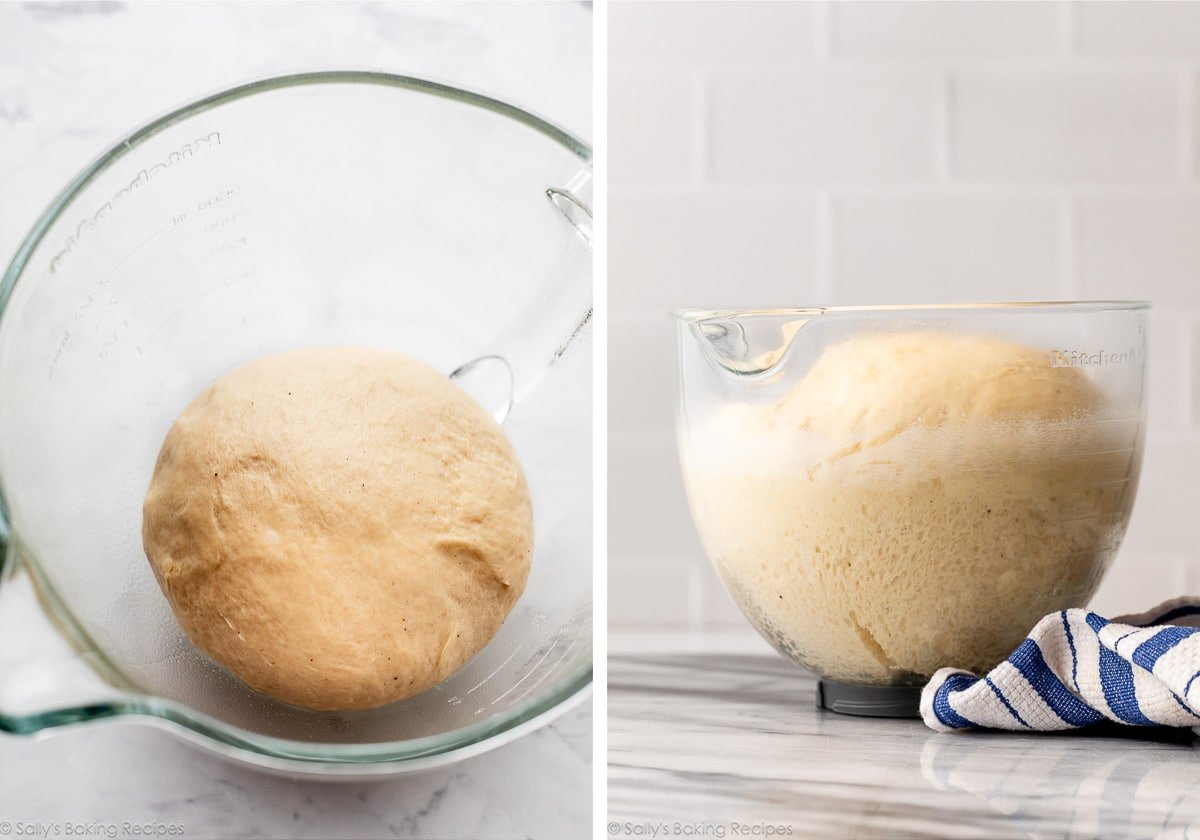
Punch down the dough to release the air.
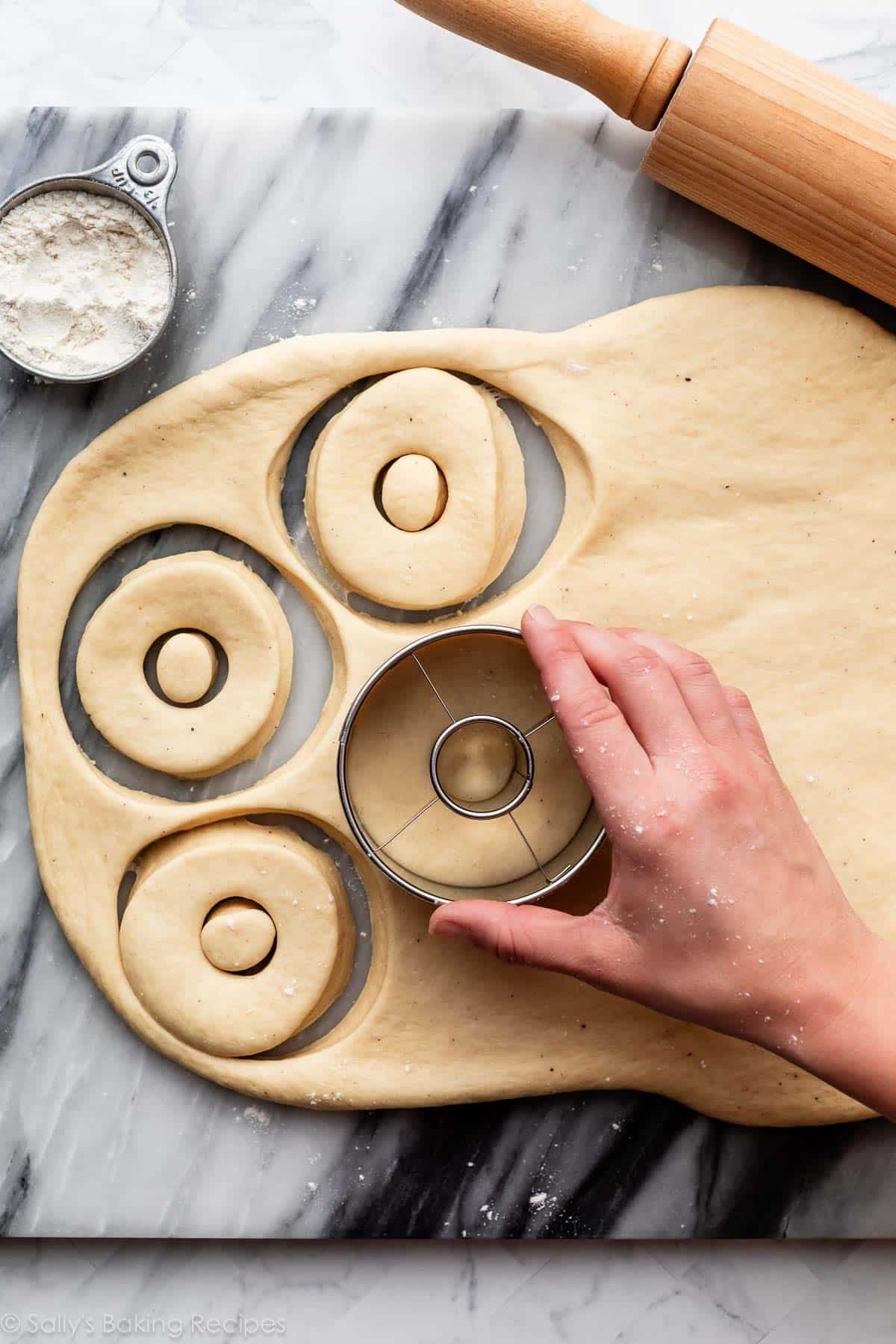
Roll & cut into doughnuts. Roll the dough out to 1/2-inch thickness. Cut the doughnuts using a 3–3.5-inch doughnut cutter. Line 1 or 2 baking sheets with parchment paper or a silicone baking mat. Place doughnuts (and doughnut holes!) onto the lined baking sheet(s), then lightly cover and allow to rest for 30 minutes as you heat the oil.
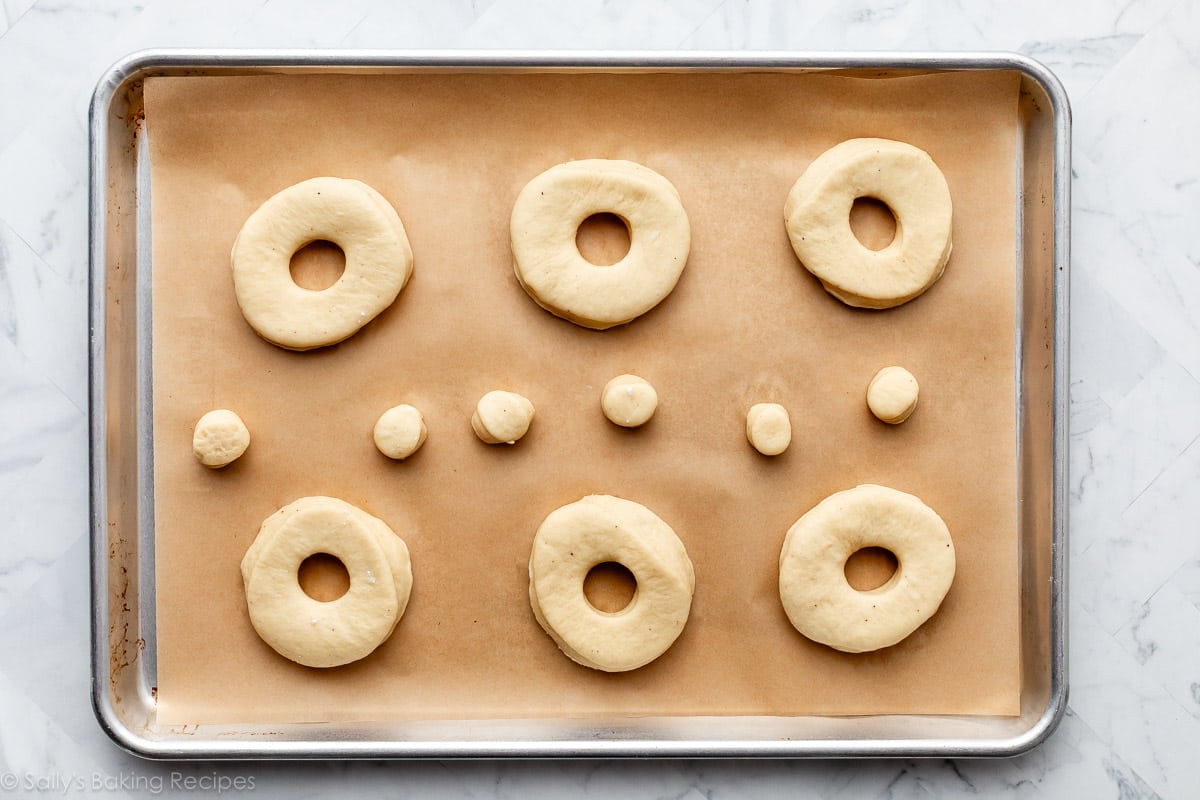
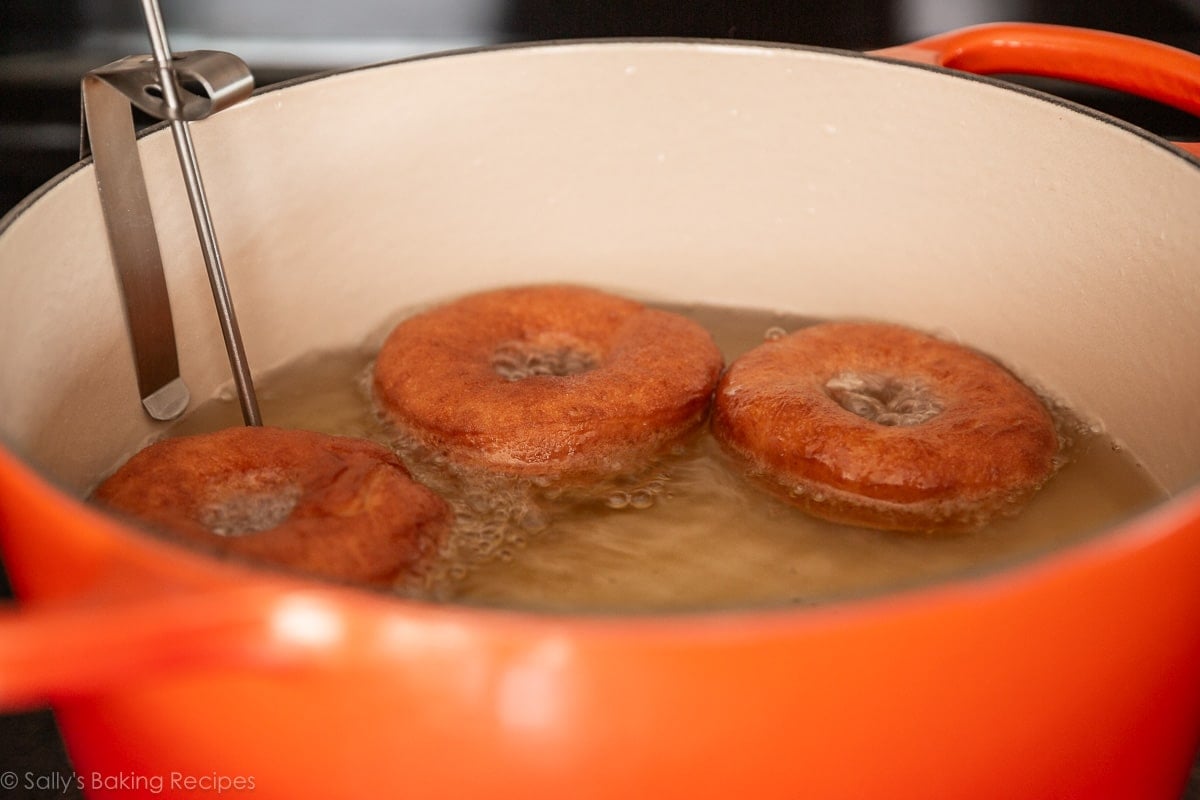
Prepare the oil. Using a heavy-bottomed pot or Dutch oven and an oil thermometer, heat vegetable oil to 375°F (191°C).
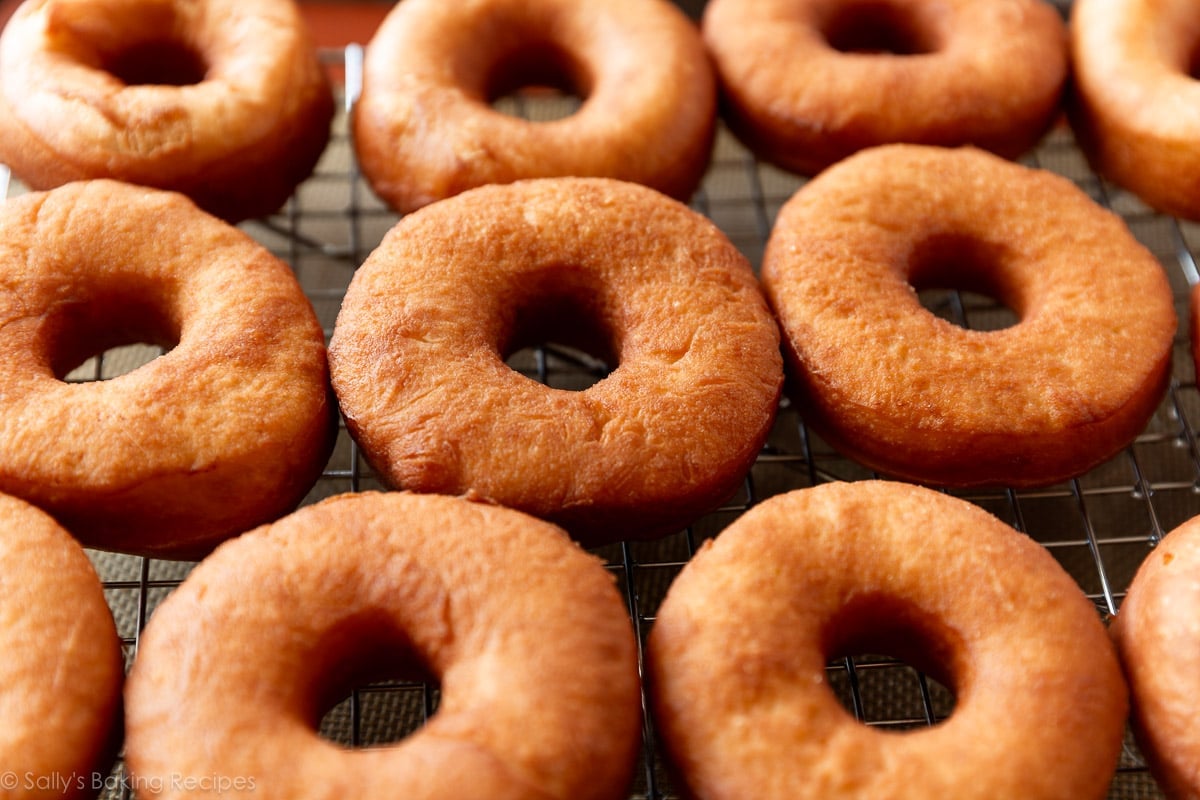
Fry the doughnuts. Working with 2–3 doughnuts at a time, cook for 1 minute on each side. Carefully remove from the oil and place onto prepared rack. Repeat with remaining doughnuts. (See my recipe note about making the doughnut holes.)
How to Make the Glaze for Donuts
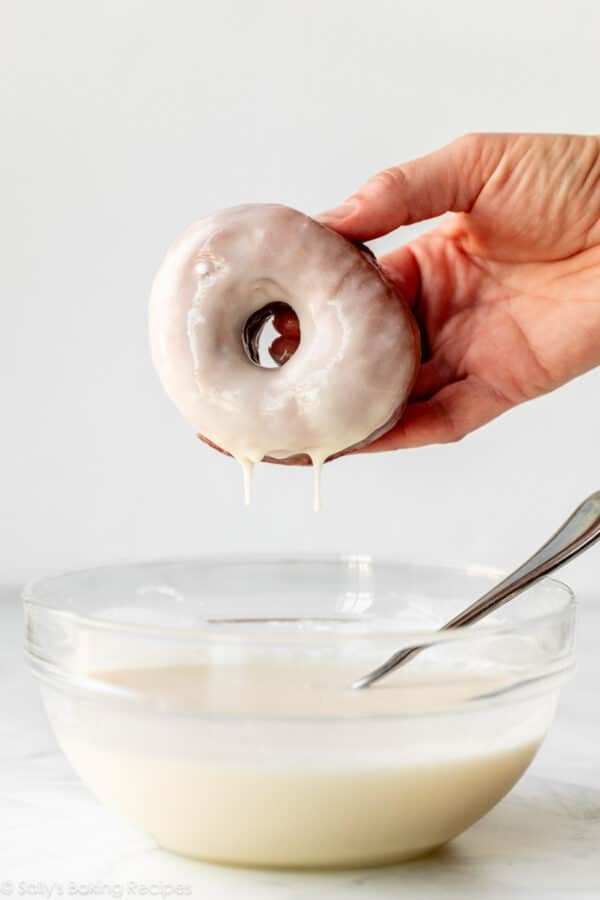
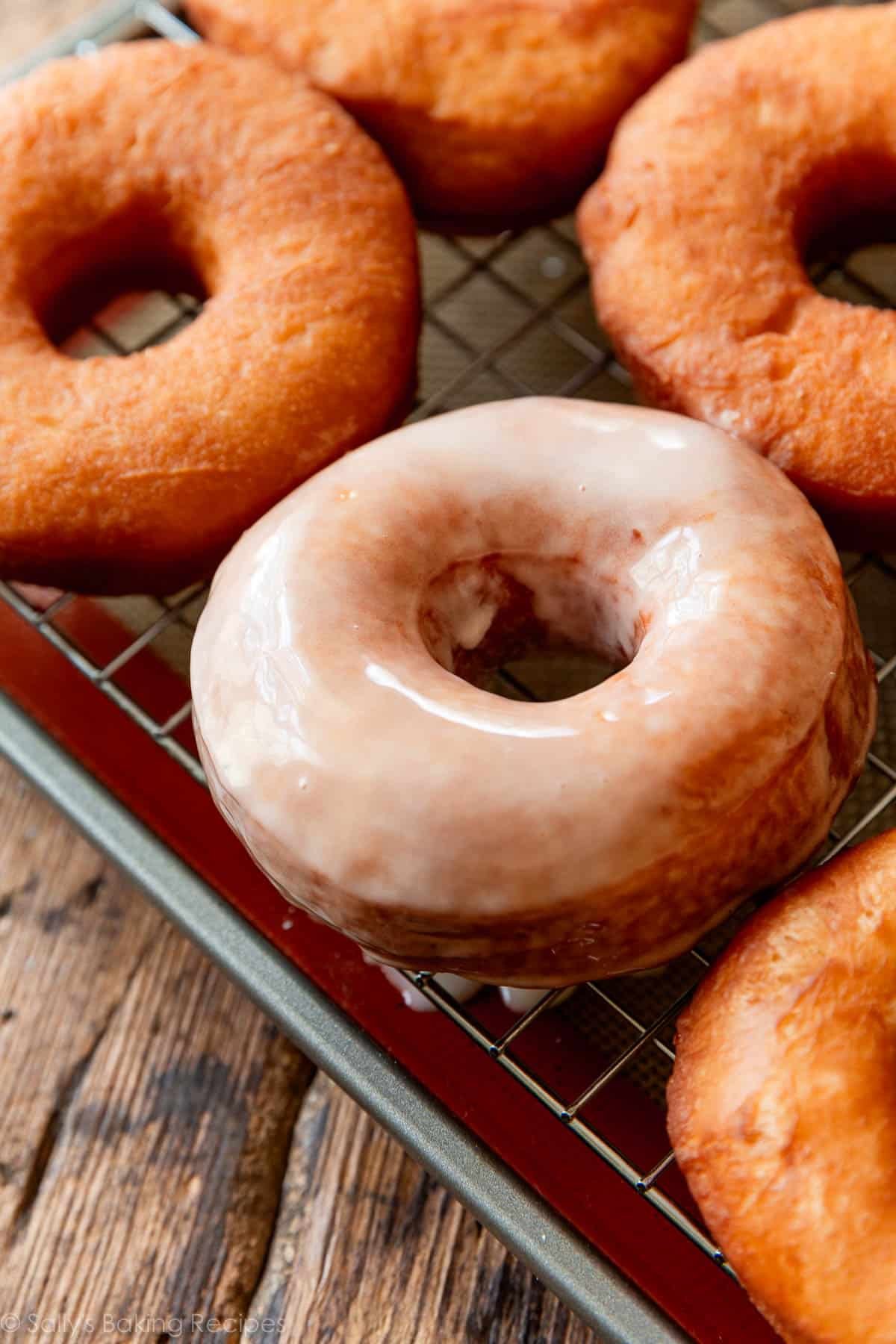
Make a simple 3-ingredient glaze: just milk or cream, confectioners’ sugar, and vanilla extract. This part couldn’t be easier; literally just whisk the 3 ingredients together. Dunk each side of the warm doughnuts into the glaze. The glaze will set in about 20 minutes.
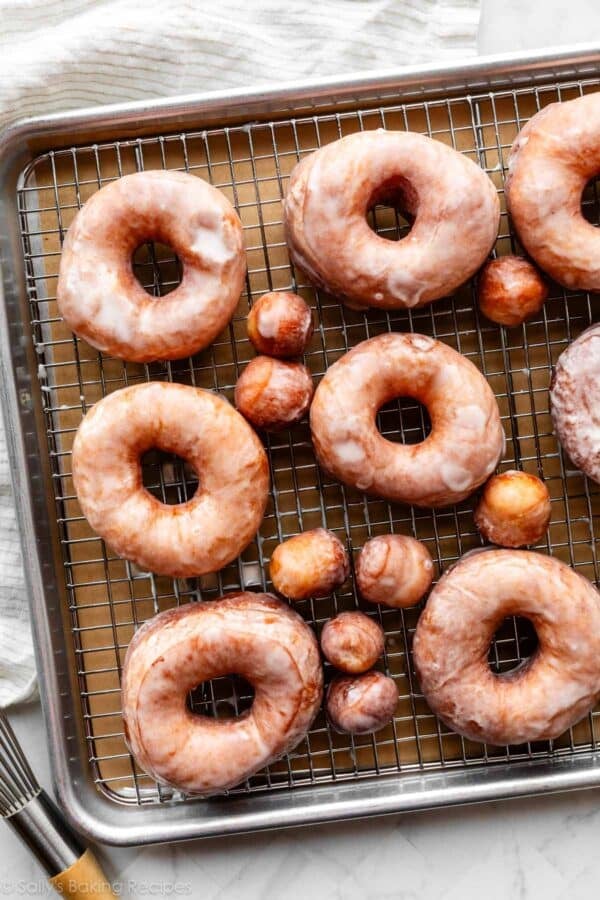
Looking for other flavors? Try my strawberry, chocolate, and vanilla donut frostings or you might enjoy my maple bacon doughnuts!
This Dough Is Best for Frying
I don’t recommend baking this dough—this dough is best for frying in oil. If you’re looking for a baked donut, try crumb cake donuts, pumpkin donuts, cinnamon sugar donuts, or lemon poppy seed donuts instead. Here are all of my donut recipes.
Yes, absolutely. You’ll need a 3-inch biscuit or doughnut cutter without a hole in the center. Use the dough recipe below. Reduce the oil temperature to 350°F (177°C). Fry doughnuts for 1.5–2 minutes on each side, making sure to lower the stove’s temperature if the oil starts to get too hot. Let doughnuts cool for 5–10 minutes before filling. Jams or pastry cream are excellent fillings! Add filling to a piping bag fitted with a long tip such as Ateco 230. Insert the piping tip into the doughnut and fill until the doughnut feels heavy.
This dough is best for frying in oil. You can try using the air fryer, but the donuts will taste more bread-like, and more like baked donuts. For ideal results, I strongly recommend following the recipe.

Homemade Glazed Doughnuts
- Prep Time: 2 hours, 10 minutes
- Cook Time: 10 minutes
- Total Time: 2 hours, 30 minutes
- Yield: 12 donuts and 12 holes
- Category: Breakfast
- Method: Frying
- Cuisine: American
Description
Making homemade glazed doughnuts is easier than you think, but requires a little patience. Ready in about 2.5 hours, these taste like doughnuts from your favorite bakery, but they’re made in the comfort of your own home. For doughnut success, follow my step-by-step photos, helpful success tips, and video tutorial below.
Ingredients
- 1 cup (240ml) whole milk, warmed to about 110°F (43°C)*
- 2 and 1/4 teaspoons (7g) instant or active dry yeast (1 standard packet)*
- 1/3 cup (65g) granulated sugar, divided
- 2 large eggs
- 6 Tablespoons (85g) unsalted butter, melted and slightly cooled
- 1 teaspoon pure vanilla extract
- 1/4 teaspoon ground nutmeg
- 1/2 teaspoon salt
- 4 cups (500g) all-purpose flour (spooned & leveled), plus more as needed
- 1–2 quarts vegetable oil*
Donut Glaze
- 2 cups (240g) confectioners’ sugar, sifted
- 1/3 cup (80ml) heavy cream, half-and-half, or whole milk
- 1/2 teaspoon pure vanilla extract
Instructions
- Prepare the dough: Whisk the warm milk, yeast, and 1 Tablespoon sugar together in the bowl of your stand mixer. Loosely cover and allow to sit for 5–10 minutes until foamy and frothy on top. *If you do not own a stand mixer, you can do this in a large mixing bowl, and in the next step, mix the dough together with a large wooden spoon/silicone spatula. It will take a bit of arm muscle. A hand mixer works, but the sticky dough repeatedly gets stuck in the beaters. Mixing by hand with a wooden spoon or silicone spatula is a better choice.*
- Add the remaining sugar, the eggs, butter, vanilla, nutmeg, salt, and 2 cups (about 250g) flour. Beat on low speed for 1 minute. Scrape down the sides of the bowl with a silicone spatula as needed. Add remaining flour and beat on medium speed until the dough comes together and pulls away from the sides of the bowl, about 2 minutes. If needed, add more flour, 1 Tablespoon at a time, until the dough pulls away from the sides of the bowl. Don’t add too much flour, though. You want a slightly sticky dough.
- Knead the dough: Keep the dough in the mixer and beat for an additional 5-7 full minutes, or knead by hand on a lightly floured surface for 5-7 full minutes. (If you’re new to bread-baking, my How to Knead Dough video tutorial can help here.) If the dough becomes too sticky during the kneading process, sprinkle 1 teaspoon of flour at a time on the dough or on the work surface/in the bowl to make a soft, slightly tacky dough. Do not add more flour than you need because you do not want a dry dough. After kneading, the dough should still feel a little soft. Poke it with your finger—if it slowly bounces back, your dough is ready to rise. You can also do a “windowpane test” to see if your dough has been kneaded long enough: tear off a small (roughly golfball-size) piece of dough and gently stretch it out until it’s thin enough for light to pass through it. Hold it up to a window or light. Does light pass through the stretched dough without the dough tearing first? If so, your dough has been kneaded long enough and is ready to rise. If not, keep kneading until it passes the windowpane test.
- Let Dough Rise: Lightly grease a large bowl with oil or nonstick spray. Place the dough in the bowl, turning it to coat all sides in the oil. Cover the bowl and allow the dough to rise in a relatively warm environment for 1.5–2 hours or until double in size. (For a tiny reduction in rise time, see my answer to Where Should Dough Rise? in my Baking with Yeast Guide.)
- Shape Doughnuts: When the dough is ready, punch it down to release the air. Remove dough from the bowl and turn it out onto a lightly floured surface. Using a rolling pin, roll the dough out until it is 1/2 inch thick. Using a 3–3.5-inch doughnut cutter, cut into doughnuts. Re-roll the scraps and cut more. *If you don’t have a doughnut cutter, you can use 1 large + 1 smaller circle cookie cutter (large should be about 3 and 1/2 inches).
- Line 1 or 2 baking sheets with parchment paper or silicone baking mats. Place doughnuts and doughnut holes on each. Loosely cover and allow to rest for 30 minutes as you heat the oil. They will rise a bit as they rest. Place a cooling rack over another baking sheet.
- Pour oil into a large heavy-duty pot fitted with an oil thermometer. Turn stove on to medium heat. Heat oil to 375°F (191°C). Add 2–3 doughnuts at a time and cook for 1 minute on each side. Carefully remove with a metal slotted spatula or metal slotted spoon. Be sure to lower stove’s temperature if oil temperature is rising; you want it to stay at 375°F (191°C). Wear kitchen gloves if oil is splashing. Place fried doughnuts onto prepared rack. Repeat with remaining doughnuts, then turn off heat.* (See Note for doughnut holes.)
- Make the glaze: Whisk all the glaze ingredients together. Dip each warm doughnut (don’t wait for them to cool!) into the glaze, making sure to coat both sides. Place back onto prepared rack, as excess glaze drips down. After about 20 minutes, the glaze will set.
- Doughnuts are best enjoyed the same day. You can store leftover doughnuts in an airtight container at room temperature or in the refrigerator for another day or two.
Notes
- Freezing Instructions: Prepare recipe through step 5. Freeze shaped doughnuts for up to 3 months. On the day you serve them, let the doughnuts thaw and rest at room temperature for about 4–5 hours. Fry as directed. You can also freeze the fried doughnuts (unglazed). Allow them to cool completely, then freeze for up to 3 months. Thaw in the refrigerator or at room temperature, then reheat as desired (microwave is great) and dunk in freshly made glaze.
- Overnight Instructions: Complete dough through step 3. Instead of allowing to rise in a warm environment in step 4, place the covered dough in the refrigerator overnight (8–12 hours). The next morning, remove from the refrigerator and allow to rise in a warm environment until doubled. The dough will lightly rise in the refrigerator overnight, so the rise the next morning won’t take too long. After rising, continue with step 5.
- Special Tools (affiliate links): Electric Stand Mixer | Large Heavy Bottomed Pot or Dutch Oven | High-Heat Thermometer (I love this thermometer, too) | 3–3.5-inch Doughnut Cutter (I like this one and this one) | Baking Sheets | Silicone Baking Mats or Parchment Paper | Metal Slotted Spatula | Cooling Rack | Glass Mixing Bowl | Whisk
- Doughnut Holes: Add holes to hot oil and fry until golden, about 30 seconds, on each side.
- Milk: Whole milk is a must for the most tender dough—or you can try buttermilk. Lower-fat or nondairy milks work in a pinch, but the doughnuts aren’t as flavorful or rich.
- Yeast: If using an instant yeast, your rise time will be a little shorter. Reference my Baking with Yeast Guide for answers to common yeast FAQs.
- Oil: The amount of oil really depends on how wide or tall your pot is. You want oil to fill about 1/3 of the pot. I use a little more than 1 quart for my 4 and 1/2-quart Dutch oven.
- Leftover Oil: Do not pour used oil down the sink drain. Allow to cool, then pour into an empty container (a funnel is useful here) and discard in the trash or reuse it.
- Adapted from Mark Bittman and Top Pot Doughnuts












Reader Comments and Reviews
This is one of the worst recipes I have EVER had the displeasure of making.
The instructions are absolutely unclear. When writing instructions you have to assume people do not know what you are talking about, we do not have access to the information in your head.
I will never use your website again. I can only imagine what your other recipes look like.
I almost threw away very expensive ingredients because your unclear instructions made the ingredients come together in such a way that I was for sure that I had wasted my ingredients and time on this recipe. I wished I had chosen a different recipe but it was too late I had already started and could not turn back. I went through with following the steps as best I could and completed the steps only to end up with something that was not expected but edible. The only thing that turned out well was the icing. This is not truly your recipe so this is probably why. I feel upset thinking about how ridiculous this recipe is and how it almost wasted my ingredients.
Hi Pauline, sorry to head this. Can you give me more feedback about what was unclear? There are step photos and a video tutorial to guide you along. My website is known for clear, detailed information and I’m really sorry you found otherwise with this recipe.
I feel upset thinking about how ridiculous people like you are
It’s unfortunate you had such a terrible experience with this recipe, because these donuts truly are incredible. I would be interested in knowing what wasn’t clear. I am a relatively new from-scratch baker, and I just used the ingredients that I had in my kitchen.
Hey Sally, can I bake the doughnuts with this recipe ?
Hi Ann, This doughnut dough is best fried. You can browse our baked donut recipes here.
These were sooo good!! I didn’t have whole milk and used 2% milk and they came out so well. Next time I’ll definitely get whole milk and use that to see the difference. I separated the donuts in two batches. One batch I fried like the recipe, the other batch I baked because I was curious. I left them in the oven a bit too long and they hardened, but the inside was still soft. This was definitely a case of too much curiosity and user error. Great recipe, 10/10!
Hey sally! I want to make this recipe healthier for my grandpa so can I bake these instead of frying?
Hi Emma, this doughnut dough is best fried. You can browse our baked donut recipes here.
Hi Sally
I’m thinking of making some donuts .
When we were kids. There was a nun who was a gourmet chef. Her donuts were huge and they melted in your mouth. Did she double raise them. What do you think was her secret.
My dad made our bread. Only my sister can get it right. I know the secret. And so does she. Maybe you do too ….. Thanks dave
Made your recipe. It came out totally fantastic!
The only change I made, due to lack, not otherwise, was I used powdered milk verses whole etc…Only cause I didn’t have any. But otherwise completely unmodified.
Great recipe, thanks.
Made these this morning. Used the overnight option and was awesome! I filled mine with mock cream and they vanished super quick. I was even asked to go make some more by someone who missed out!
I struggled a bit to find a ‘warm place’ first thing in the morning to let them rise once shaped but used a trick i saw somewhere else which was to heat the oven to 100ish deg C then turn it off. Put the doughnuts into the oven while the oil is heating. Warm enough to help the rise but not too hot that they start to bake. It worked a treat! I also found that some hadn’t quite cooked through but I think that’s due to my oil temperature. I tried to maintain the 191 deg but it was too hot and my doughnuts got brown too fast.
Thanks Sally for another great recipe. You are my go to and I’ve had success with all your recipes… well except the banana cake (banana cake recipes in general dont like me)
Yummmmmmmmmmmmmmy
Would it be easy to make these as blueberry donuts?
Hi Megan, you can see how we used fruit with a yeasted dough in these berry fritters. Let us know if you give them a try!
Hello!!!
So I am wanting to make a doughnut bar with these doughnuts. My goal is to make the doughnuts a night ahead of time and the next morning to have the party kiddos frost their own doughnuts. I understand I can’t do that with the glaze but if I plan on doing frostings like strawberry, will that work?
Hi Odessey, you can make strawberry icing ahead of time and then frost at your party. Hope they’re a hit!
Can these be baked instead of fried?
Thank you!
Hi Sarah, no, this dough is best for fried doughnuts. Here are all of our donut recipes—most are baked.
These doughnuts were incredibly easy and SO delicious and soft!! Will definitely make again!
Sadly mine came out dense. And I had to turn them at 30 seconds instead of a minute or they would have burned for sure. I did have a thermometer so maybe it was because of the texture of the dough. I thought I let it rise enough but I must have done something wrong.
Hi Jessica! Sounds like your oil was too hot. Have you calibrated your thermometer?
Thanks for the recipe! I also had this issue and confirmed my thermometer. I had to choose between good color but raw middle, or cooked through but burnt. Do you think I could have made a mistake with the dough that would have this impact? Or just need to dial in the oil temperature better?
Hi Hayden, did the dough seem dense? We wonder if you used a bit too much flour. You want a very soft, pillowy dough for the softest doughnuts. The dough will be slightly sticky, but instead of adding more flour just flour your hands so that you can work with it. We hope this helps for next time!
My first time making raised donuts. Beautiful recipe and not hard at all. Very light. I used Horizon Organic 2% milk, and they’re still nice and light and flavorful.
I have made them several times by now, amazing recipe
Still searching for a good recipe. This one tasted flat. Not enough sugar or salt. Texture was wrong.
I have made these donuts so many times and they always turn out perfectly so thank you for such a brilliant recipe. I made donuts today and couldn’t find this recipe so made another one and omg they were terrible i have learnt my lesson now and i will write it into my recipe book!
I made these donuts this evening and they were very good!! My brother said, ” These are really good! I’d give them a 10.6 out of 10!” And believe me, coming from him, that IS A COMPLIMENT!!
They were a real treat for us!! Thank you!
I can’t fully express how much I love this recipe. You are always so clear and concise in your directions, and these donuts came out PERFECT. My boyfriend ate half the batch and took the rest to his work just to show me off. Thank you for being the best! I’m making more today haha!
Can I use cake flour?
Hi Ella, we fear cake flour would lead to a very flimsy dough.
I just made these and I love them so much!!! So delicious! I made three kind: glazed, jelly, and cinnamon sugar. For the glazed i just melted vanilla frosting until liquid and it looked and tasted nearly the same! I didn’t have a thermometer so i just made some munchkins to test the temp and ensure they were cooked on the inside. I also made around 18 donuts instead of 12 bigger ones. My family said they tasted amazing! Sally, your recipes never fail!!
So glad they turned out for you, Jaymie!
I’ve been kneading my dough by hand for over 20 minutes…it still will not pass the windowpane test. Is my dough just a dud?
Hi Kayla! Did you do the poke test? Poke it with your finger—if it slowly bounces back, your dough is ready to rise. Sometimes the windowpane test can be unnecessary.
I find that sometimes kneading makes my doughs too firmed up to stretch for a window pane test. If your dough is not elastic enough let it rest covered for 10 minutes and try again. This also works before shaping if the dough is snapping back to its original size or shape.
Great recipe. I’ve made them a few times now and turned out awesome. I’ve had to add quite a lot of extra flour everytime. I’ve also made them dairy free with coconut milk(tinned) and Nuttlex spread. Turned out perfectly. I usually roll them in sugar and cinnamon and fill with jam and whipped cream.
i love this recipe thankss
These were delicious! Made them as a New Year’s treat. My family loved them 🙂 . If I make them again I will let them raise a little bit longer, I definitely rushed them a bit, but still so yummy!
These were so flipping good!!! Huge hit! Thanks Sally!
Can I make the dough at night before. Can I leave in the fridge overnight to rise?
I made the dough overnight and made them this morning and they were wonderful!!
Great recipe they were delicious. So much better than than the ones I normally buy at markets. Will be making them again soon.
Hiya! Would this recipe also work for filled donuts?
Definitely.
She didn’t even say how many it yielded. I wanted to do this for a project!
Hi Jamie, On top of the gray box with the actual recipe in it, you will find pre time, cook time, yield, etc. This recipe yields 12 doughnuts and we hope you enjoy them.
Can I use this recipe with a donut pan instead of cutters? Thank you!
Hi Diana, this recipe is specifically for frying. These baked apple cider donuts and baked pumpkin donuts both are baked in a donut pan and are favorites this time of year.