

Light as air, delicately crisp on the outside, and soft and marshmallowy within, this homemade meringue roulade is a show-stopping dessert worthy of a special occasion. It’s naturally gluten free, endlessly customizable, and tastes even better than it looks.
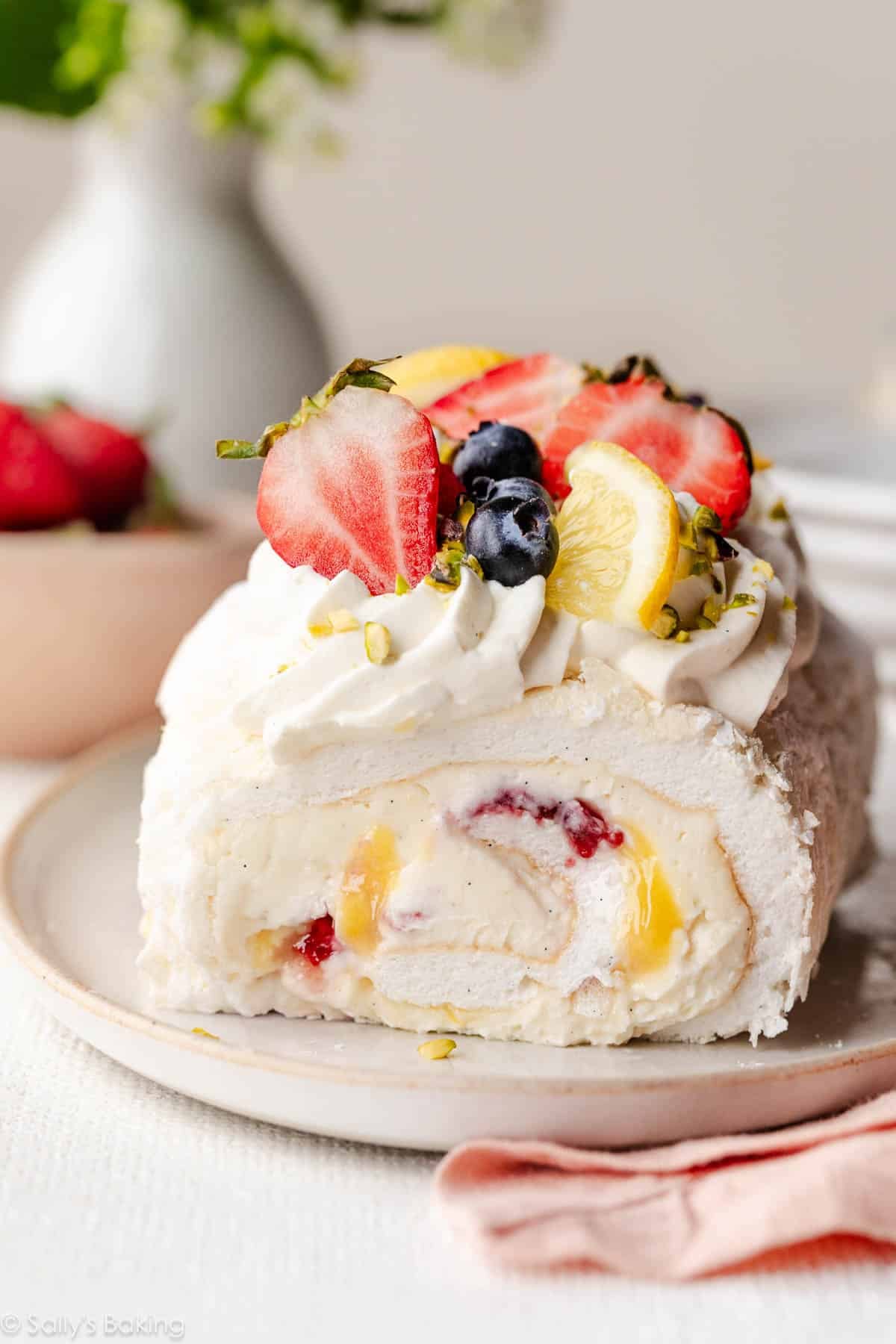
Think of this meringue roulade as pavlova‘s soft, flexible cousin—the kind you can roll up with clouds of cream filling, tangy lemon curd, or your favorite jam. The texture is what makes this dessert unforgettable: delicately crisp on the outside, soft and marshmallowy inside, and melt-in-your-mouth creamy.
I’ll walk you through every step, including all my best tips for preventing cracks and getting that beautiful swirl, so you can feel confident in giving it a try.
Why You’ll Love This Meringue Roulade
- Light and airy, not overly sweet
- Endless filling and topping variations
- A naturally gluten-free recipe
- A challenging recipe worthy of your baking bucket list. It’s been on mine for a long time!
One reader, Kalani, commented: “I was so excited to make this for Easter! As instructed, I read all the way to the end and followed the directions exactly. It was SO good and such a beautiful dessert. It was light and lovely. I also made the lemon curd as suggested, and those were our favorite bites! ★★★★★“
Another reader, Jordan, commented: “This is a slightly challenging yet rewarding recipe! Definitely something different that will surprise guests and so customizable as well! Some skill involved, but Sally’s instructions are so helpful and specific, it’s hard to go wrong! ★★★★★“
Another reader, Amy, commented: “I never thought I could make such an elegant dessert. It was time consuming but so worth it. It looked good and tasted great! Made my own lemon curd, too! Next time I will try a mocha filling. Thanks for another great recipe and for making me go out of my comfort zone! ★★★★★”

A meringue roulade is one of those desserts that looks effortlessly elegant, but in reality, it requires precision, patience, and a careful hand. From properly whipped egg whites to perfectly judged bake time and a confident (but gentle) roll, every stage matters.
But that’s exactly what makes it so rewarding. Just like when making French macarons, if you take the time to thoroughly read through all the instructions and success tips before you begin, you’ll be rewarded with a meringue roulade with a delicately crisp exterior, a soft, marshmallow-like interior, and a beautiful spiral of cream and fruit.
Let’s walk through it thoroughly so you can approach it with confidence… and realistic expectations!
Ingredients You Need for Meringue Roll & Why
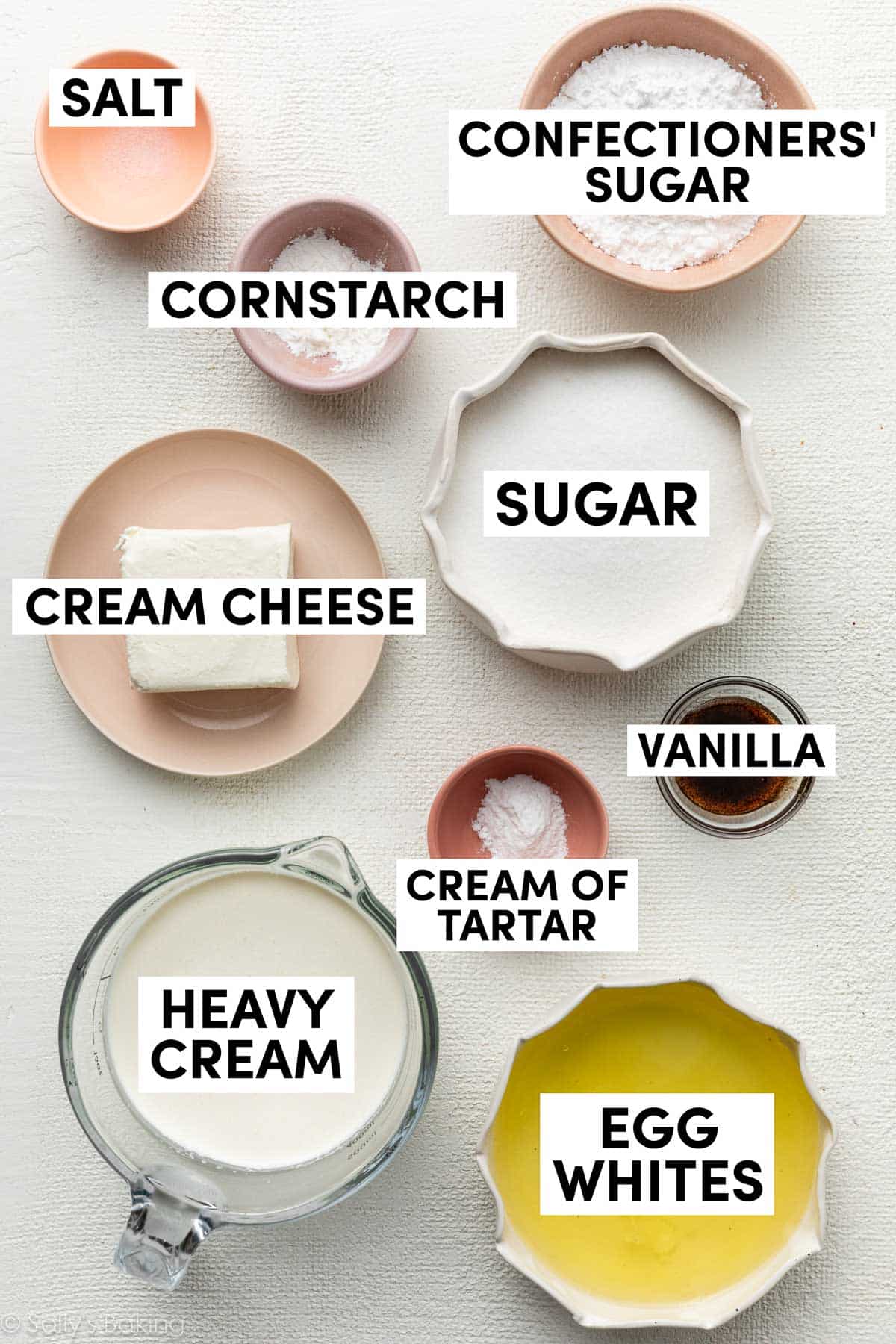
Meringue relies on just a handful of ingredients, so each one has an important job to do:
- Egg Whites: Use room-temperature eggs for maximum whipped volume. Tip: Separating eggs is easier to do when the eggs are cold (less chance of the yolks breaking), so separate them right after taking them out of the refrigerator, and then let the whites come to room temperature before using in the recipe.
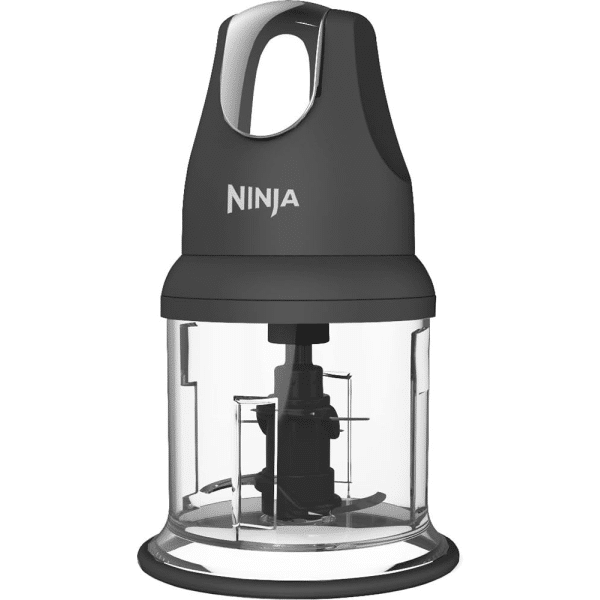
- Sugar: Stabilizes and sweetens the meringue. You need superfine sugar, which is quick to make from granulated sugar. Simply pulse it in a food processor to break the crystals down finely. This is crucial for ensuring the sugar will fully dissolve in the meringue.
- Cream of Tartar: You need an acid to help the egg whites hold onto air and, like the sugar, prevent the egg whites from collapsing. If you don’t have cream of tartar, you can substitute white vinegar instead (you won’t be able to taste it).
- Cornstarch: Keeps the inside soft and marshmallowy. While corn is naturally gluten free, some brands may be processed on shared equipment with wheat, so checking for a “gluten-free” label is best practice if you need this dessert to be gluten free.
- Vanilla & Salt: Both for flavor.
Before You Begin: Read This First
If you’re new to meringue, expect a learning curve. My team and I had many meringue roulade fails along the way. Don’t get discouraged, and don’t throw out your hard work. Never underestimate the power of garnishes like whipped cream, white chocolate shavings, or fresh fruit to camouflage cracks. It will still taste incredible. 😉
This is not a “set it and forget it” recipe.
Here are the critical factors:
- Humidity matters: Moist air can prevent proper crisping
- Mixing precision is key: Under- or over-whipped egg whites will fail
- Bake time is nuanced: Even 2–3 extra minutes can make rolling difficult
- Timing the roll is crucial: Too hot = fragile; too cool = cracking
The goal is a meringue that is:
- Firm and glossy before baking
- Lightly crisp on the outside
- Soft and flexible inside (so it rolls)
Step by Step: How to Make a Meringue Roulade
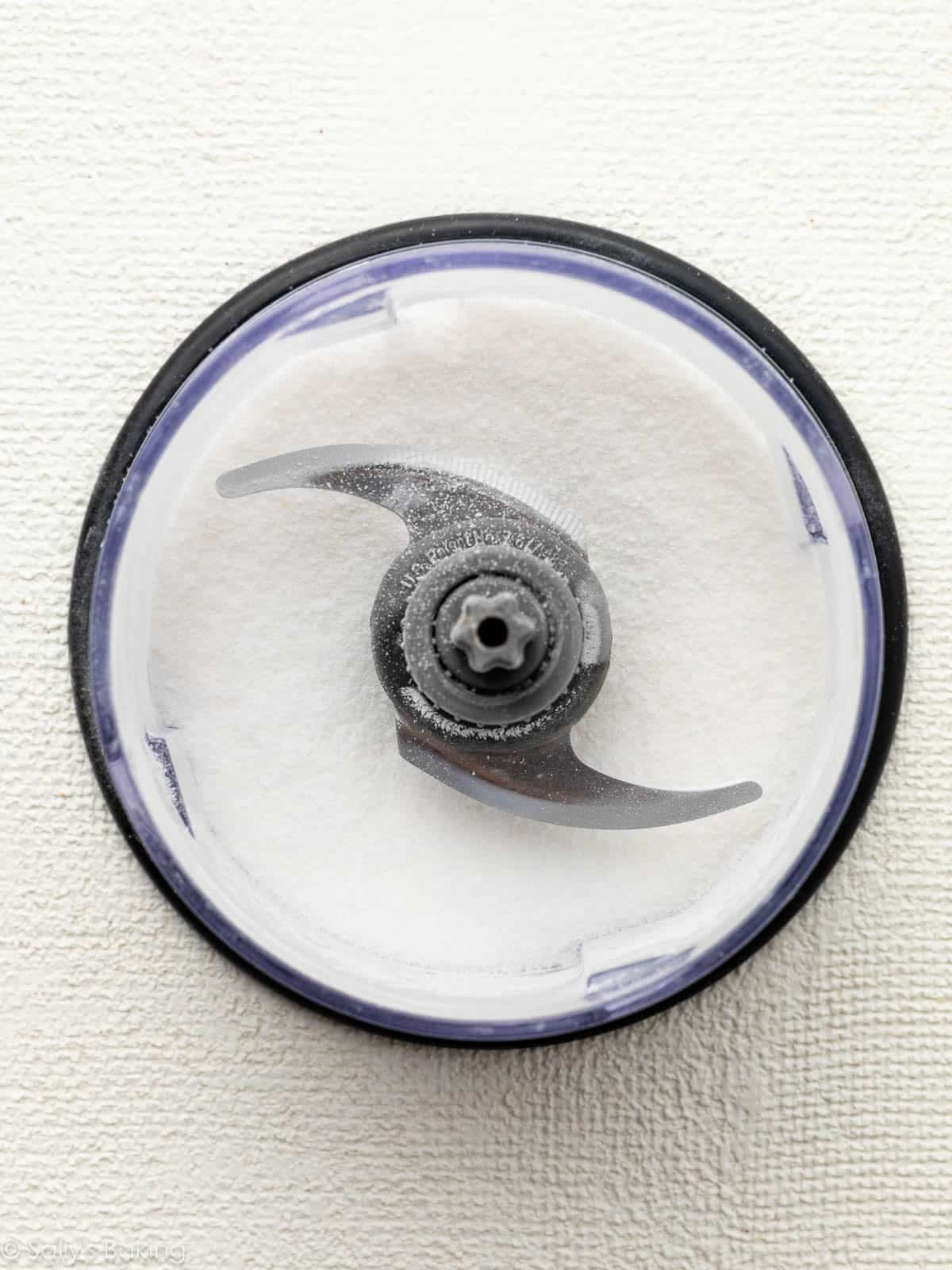
Unless you happen to have superfine or caster sugar on hand, the first step is to pulse granulated sugar in a food processor to reduce the size of the sugar crystals:
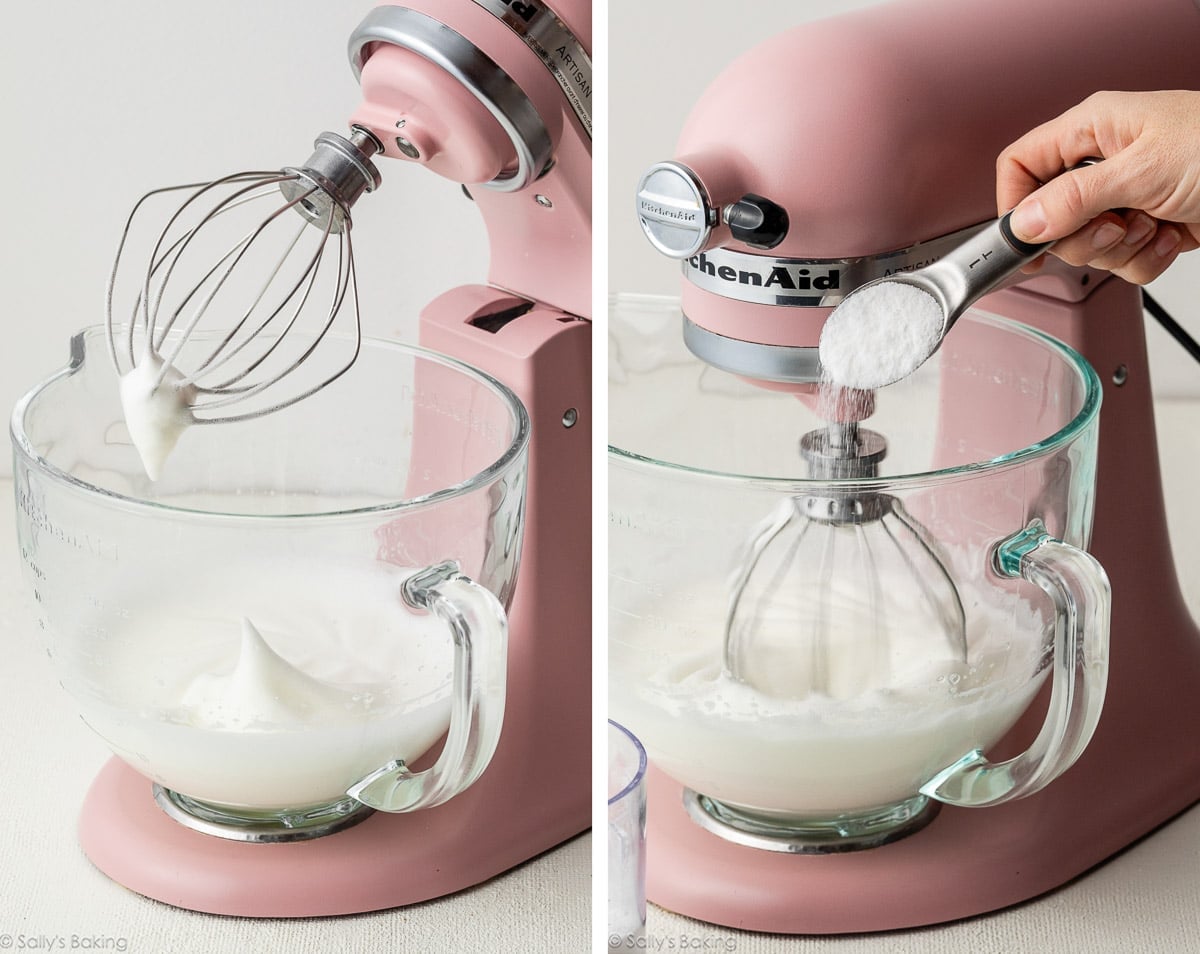
Then go ahead and start whipping the egg whites. Once they’re foamy and have increased in volume, add the cream of tartar, then begin adding the sugar, a Tablespoon at a time, with the mixer running.
- Why add sugar gradually? If you add the sugar all at once or too quickly, it would result in a dense, unstable meringue.
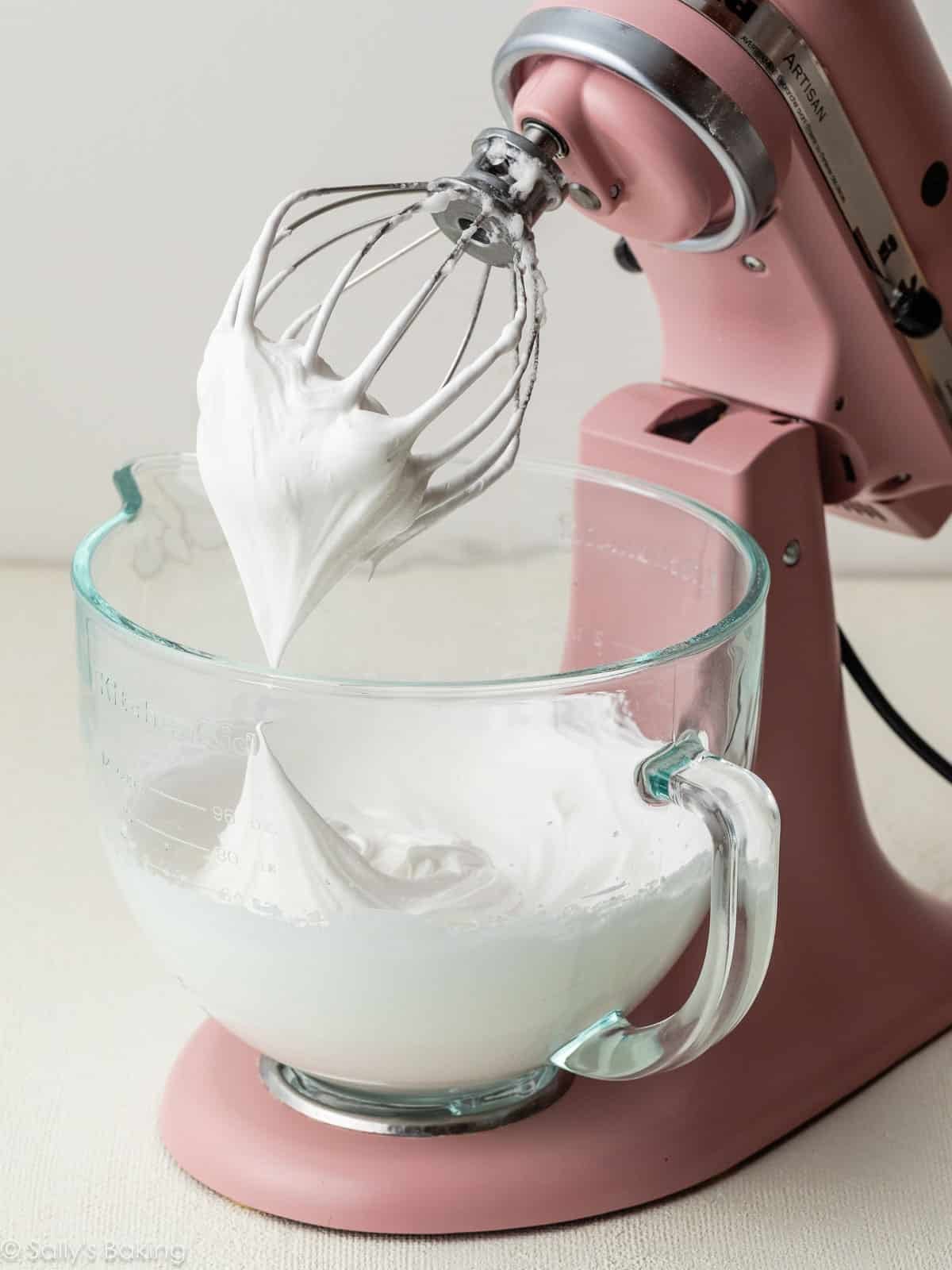
Whip until the meringue is glossy and holds stiff peaks. If you stop the mixer and lift up the whisk attachment, the peak shouldn’t move or fall off the attachment.
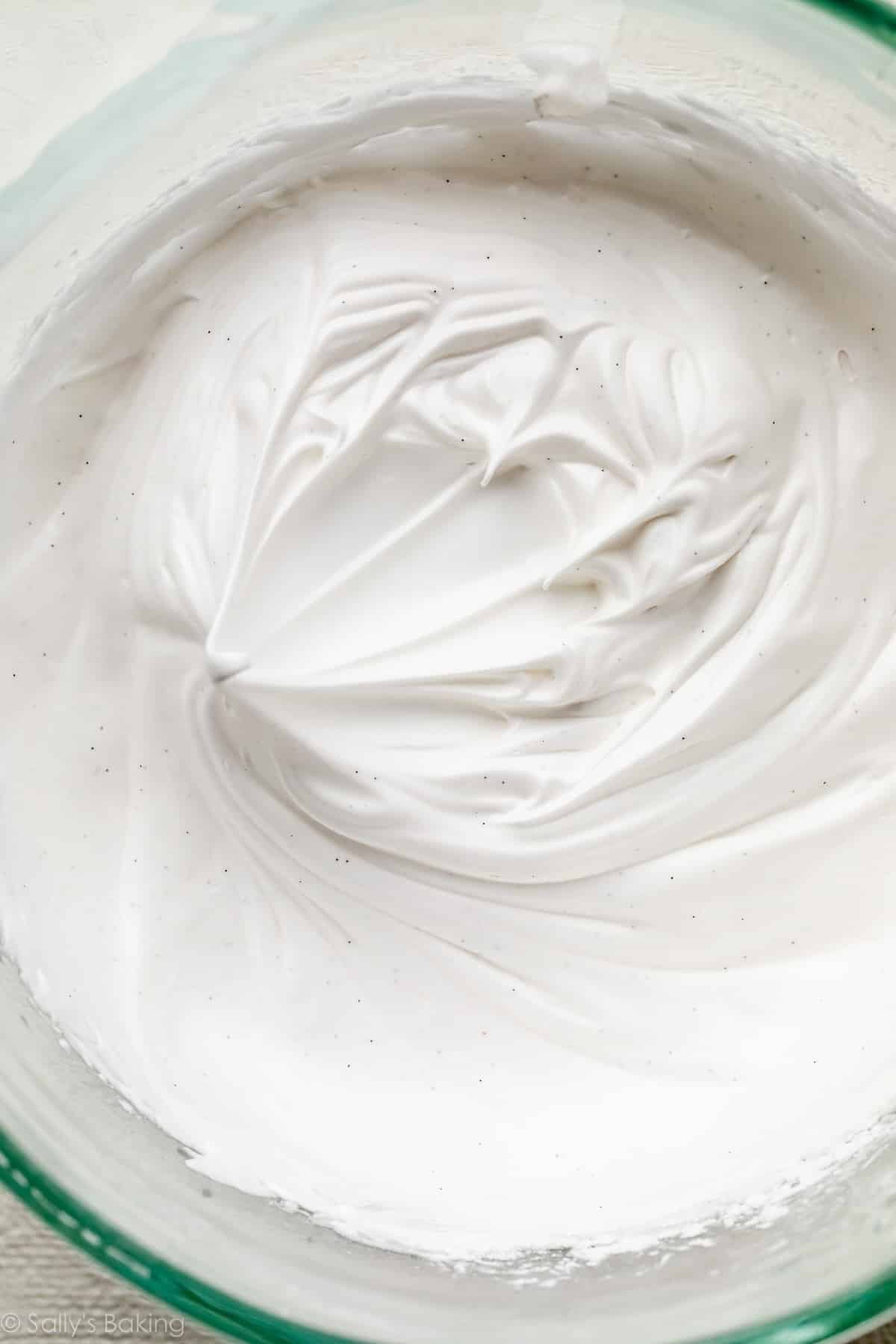
Mix in the remaining meringue ingredients. Now it’s ready to be spread in the pan, and I have some helpful tips for this step.
Prep the Pan
Here’s my team’s favorite trick: Use a little of the meringue as the “glue” to secure the parchment paper to the pan. Dab a bit of meringue in each corner of the pan, then press the parchment into place so it sticks. This makes spreading the meringue into the lined pan SO much easier, trust me!!!
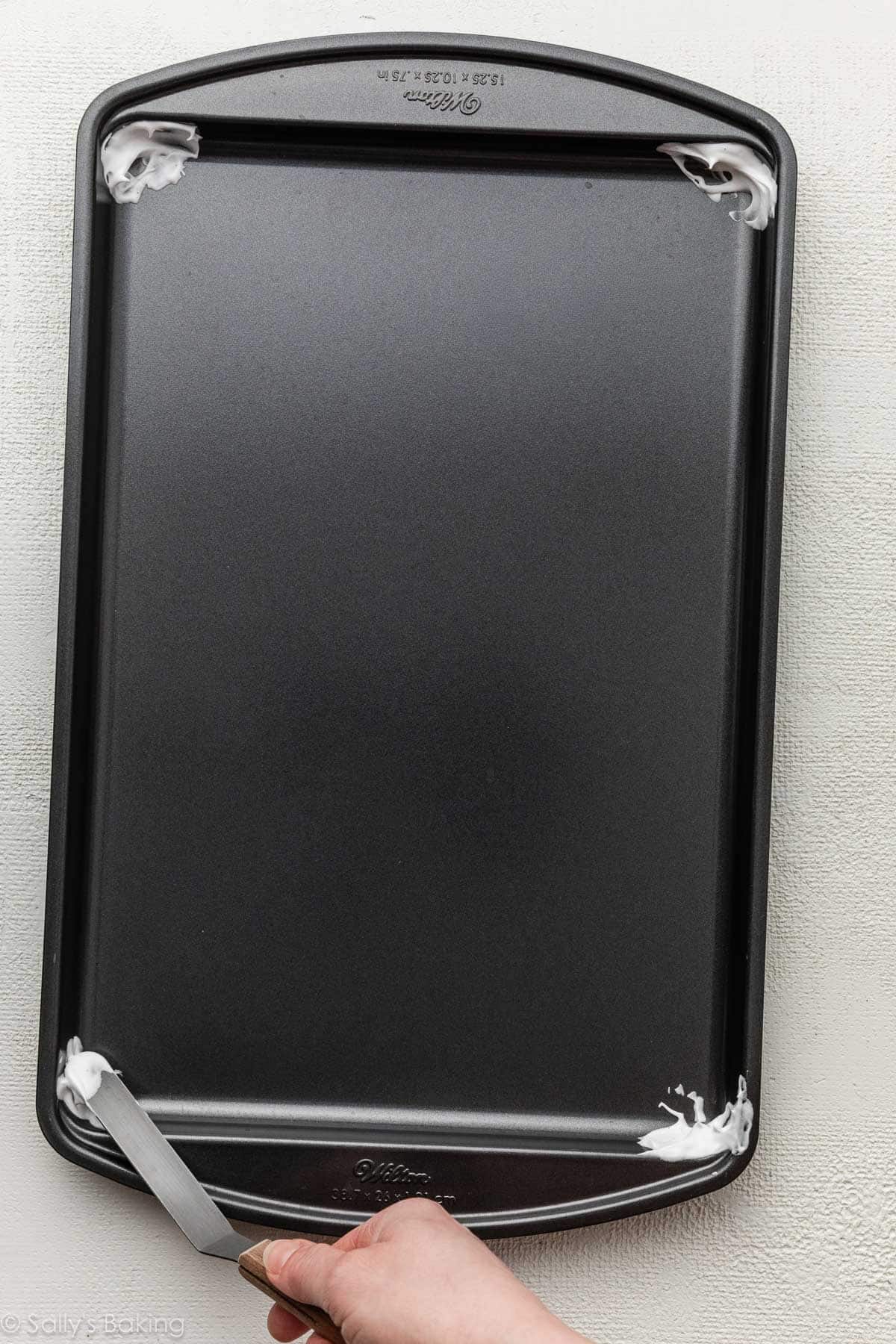
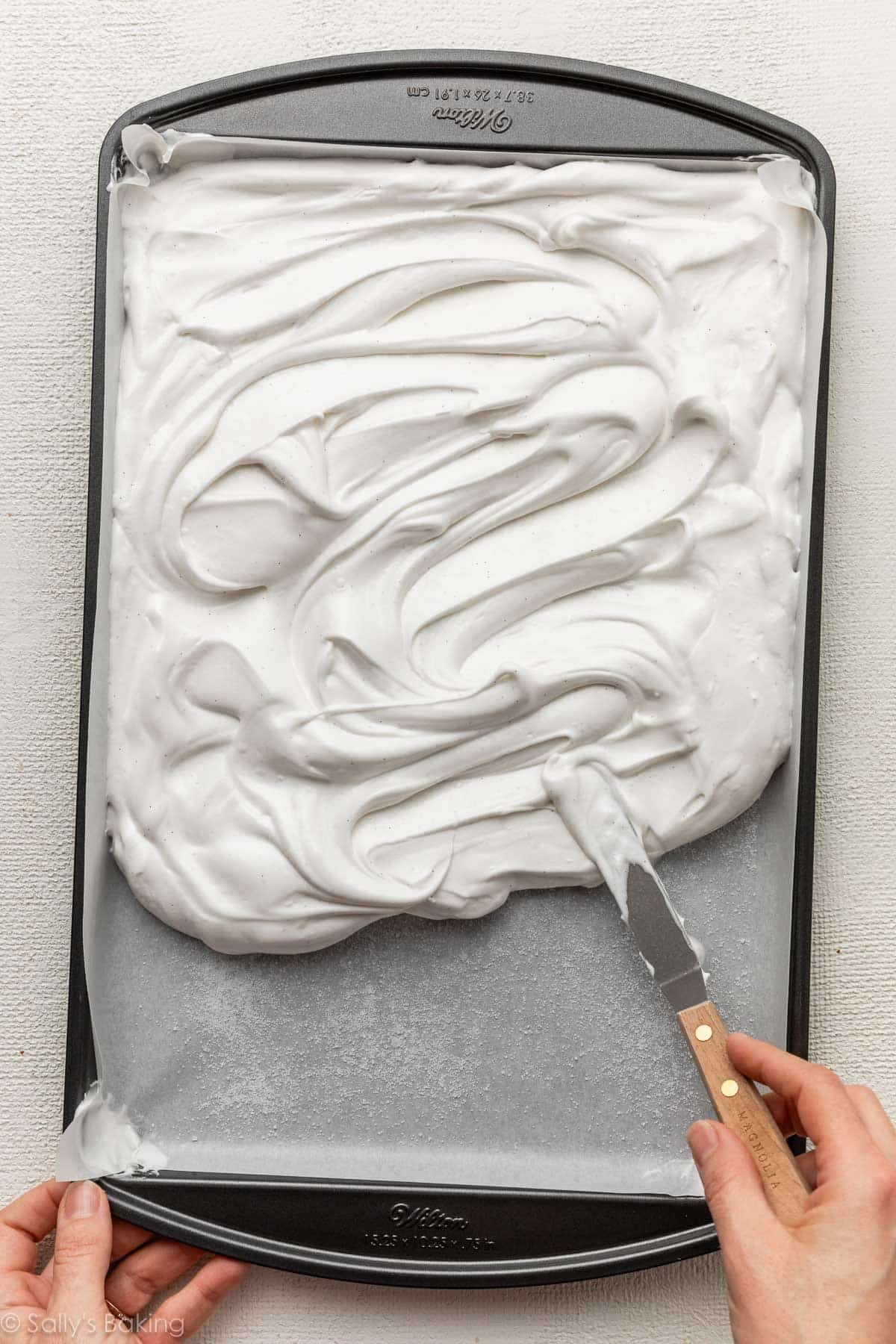
And one more detail: Sprinkle a little bit of granulated sugar very lightly over the parchment paper before you spread the meringue into the pan. This helps prevent it from sticking to the parchment.
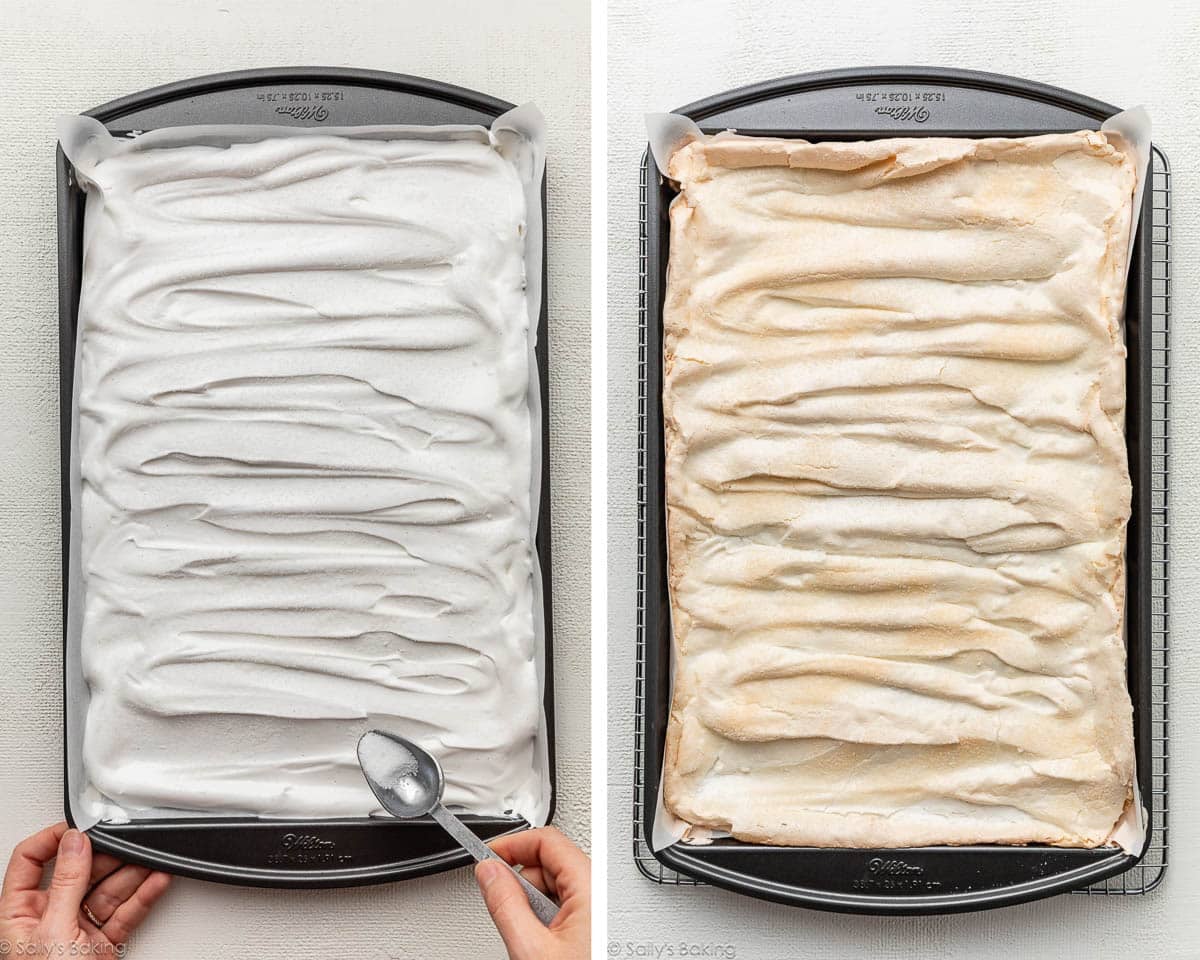
Then spread the meringue evenly to the edges of the pan. A small offset spatula is the best tool for spreading this meringue. Sprinkle a bit more sugar over the top before baking.
- Why? The dusting of sugar on top melts when it hits the oven, then recrystallizes as the meringue bakes. The result is a crisp exterior, which is a wonderful contrast to the soft, marshmallowy center inside your roulade.
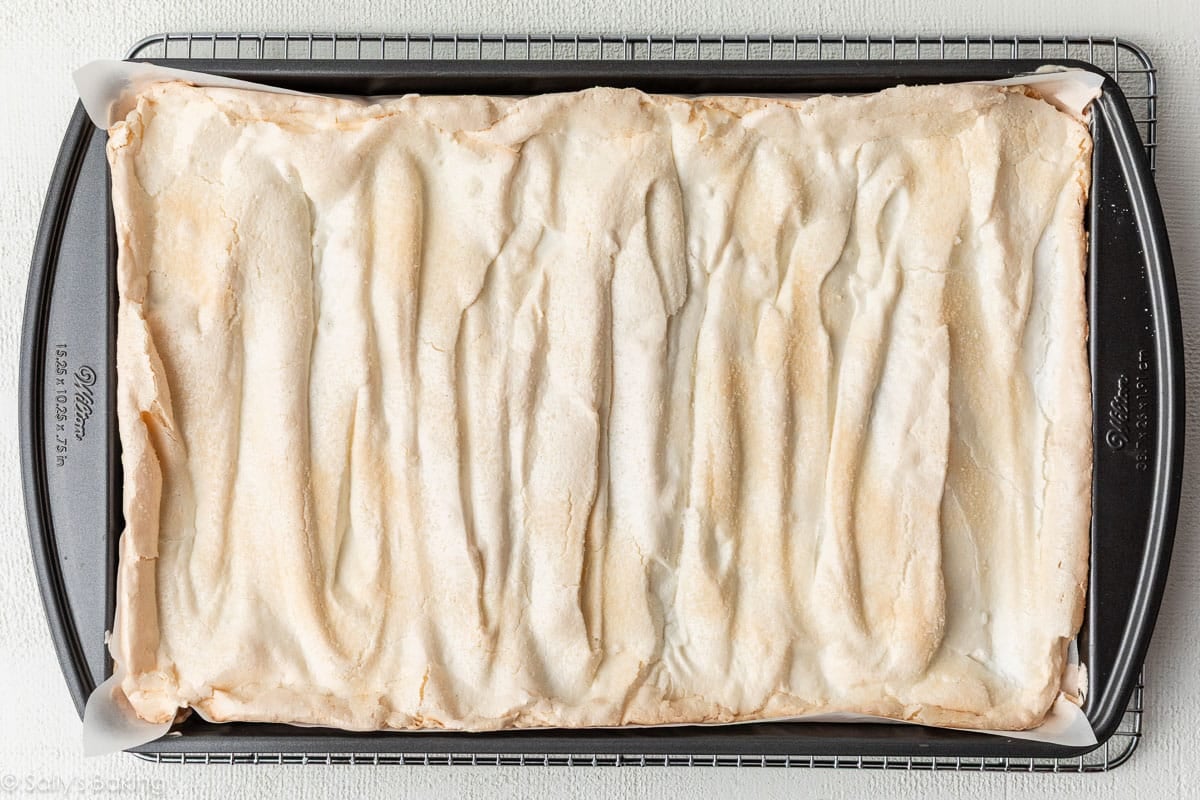
The meringue will puff up in the oven. The top should be just set (not wet or tacky) and if you touch it gently with your finger, it should feel lightly crisp on the surface, but springy beneath. Visually, it should still be pale in color, and just barely golden on top.
Here’s What We Learned When Rolling the Meringue
Like with any cake roll, such as this chocolate cake roll, rolling the meringue first without the filling is key for “training” the structure. Does that make sense?
Be sure the meringue is still warm for this step. If you let it cool for too long, it will crack. In our testing, we found just 10 minutes of cooling is the sweet spot, so set a timer once the meringue comes out of the oven. During this time, prepare for rolling:
Place a clean kitchen towel on the counter, then place a piece of parchment on top, aligning one of the short ends with the bottom end of the towel. Dust a little confectioners’ sugar over the top of the parchment.
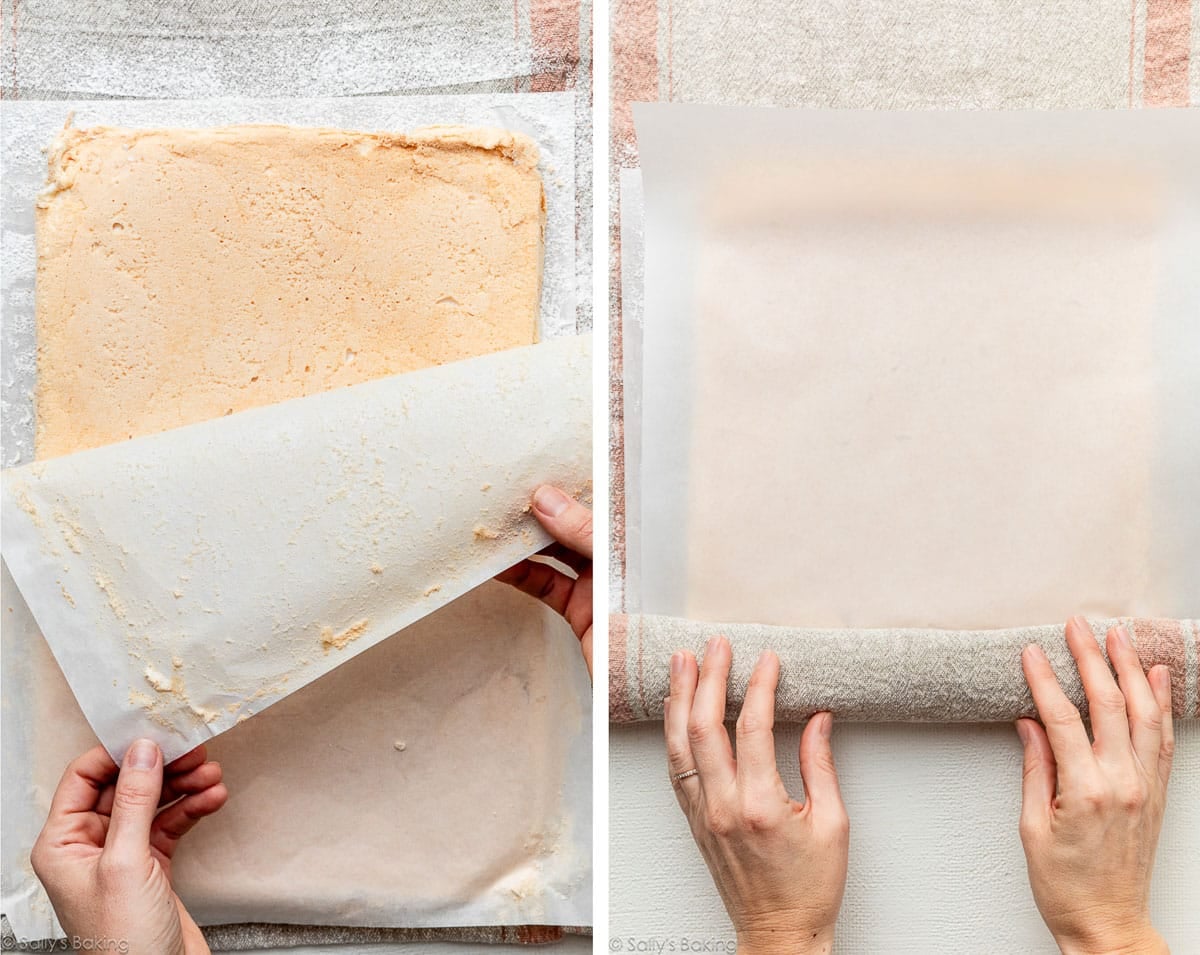
After 10 minutes of cooling, loosen the corners of the parchment from the pan, and carefully invert the meringue onto the prepared parchment/towel.
Slowly peel off the bottom parchment that baked under the meringue. Dust the meringue with a little more confectioners’ sugar, then place a fresh sheet of parchment on top.
Starting at the bottom, begin gently rolling the meringue up with the parchment and the towel. Tips for the first roll:
- Roll gently but confidently.
- Don’t compress too tightly.
- Let it cool completely in this shape (about an hour).
Make the Cream Filling
The cream filling we’re using in this meringue roulade is a slightly thicker, more stable version of regular homemade whipped cream. We’re using cream cheese here, but you could also use mascarpone instead if you’d prefer, like we use for the filling of this fruit tart.
Whip cream, sugar, and vanilla into soft peaks; then, beat cream cheese until smooth; and finally, mix it all together:
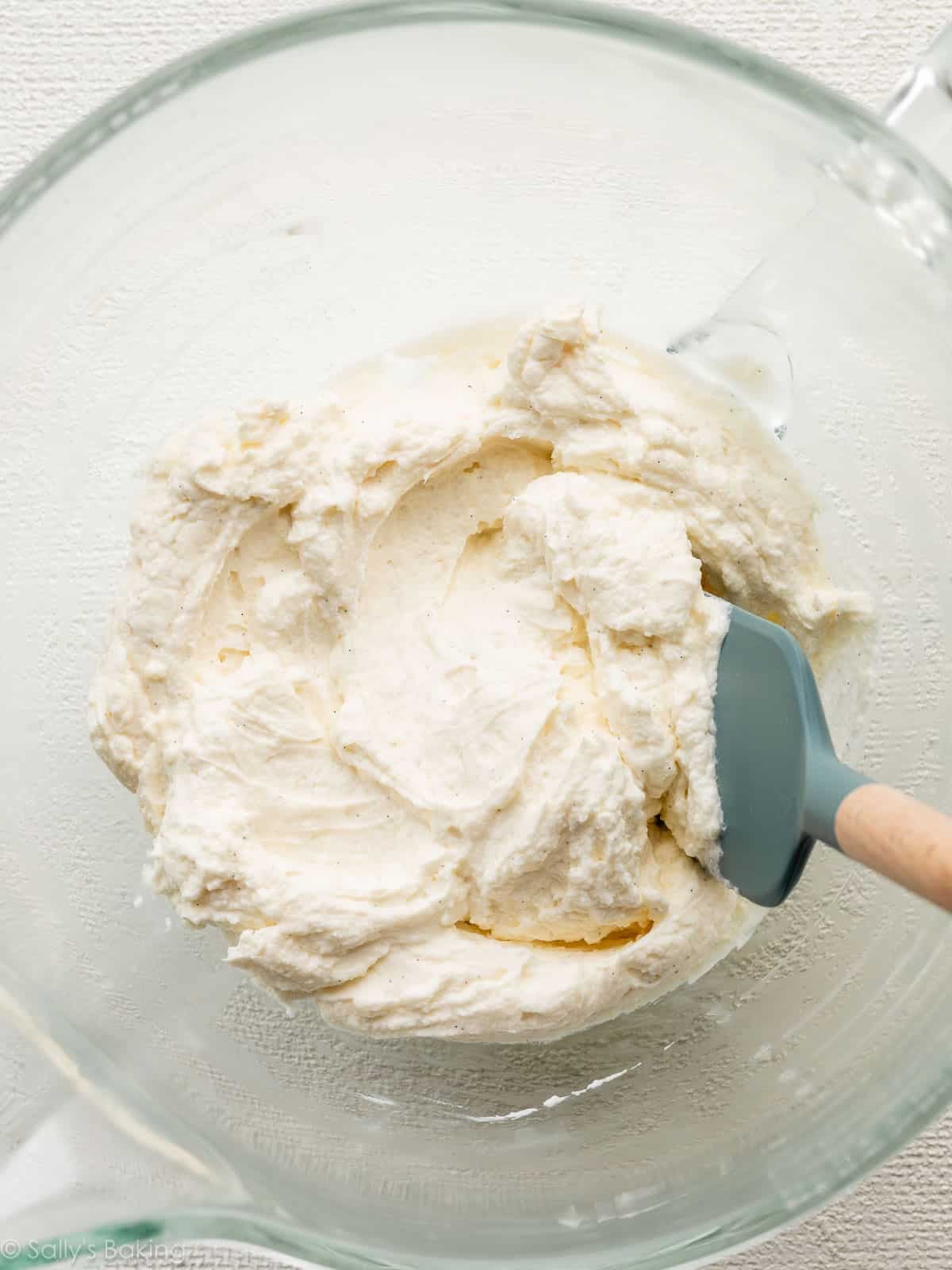
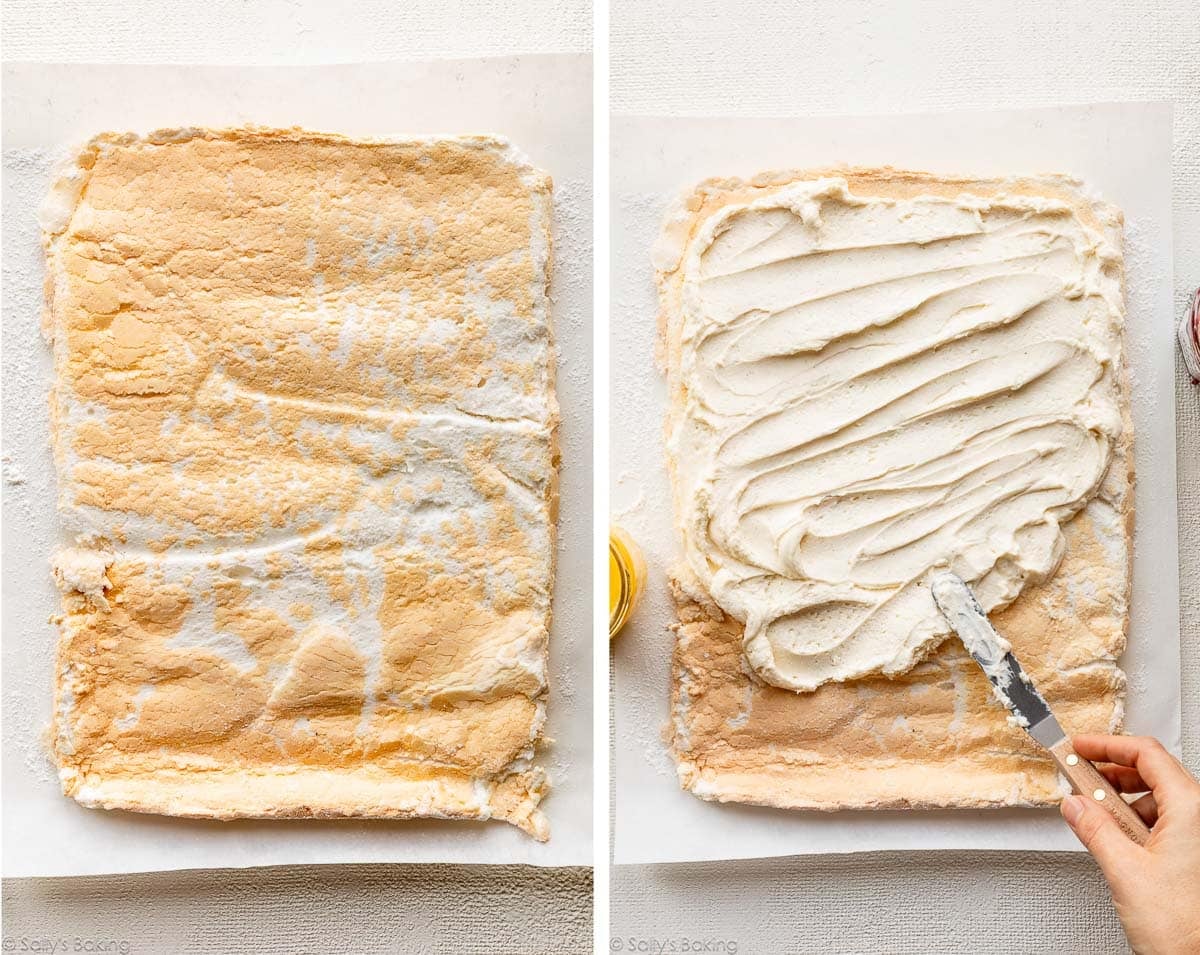
Unroll the cooled meringue gently.
***Some cracking is expected!*** But if your meringue roll falls apart in pieces, it was likely over-baked, or else cooled for too long before rolling. All is not lost—you can try to piece it together and spread the filling on top.
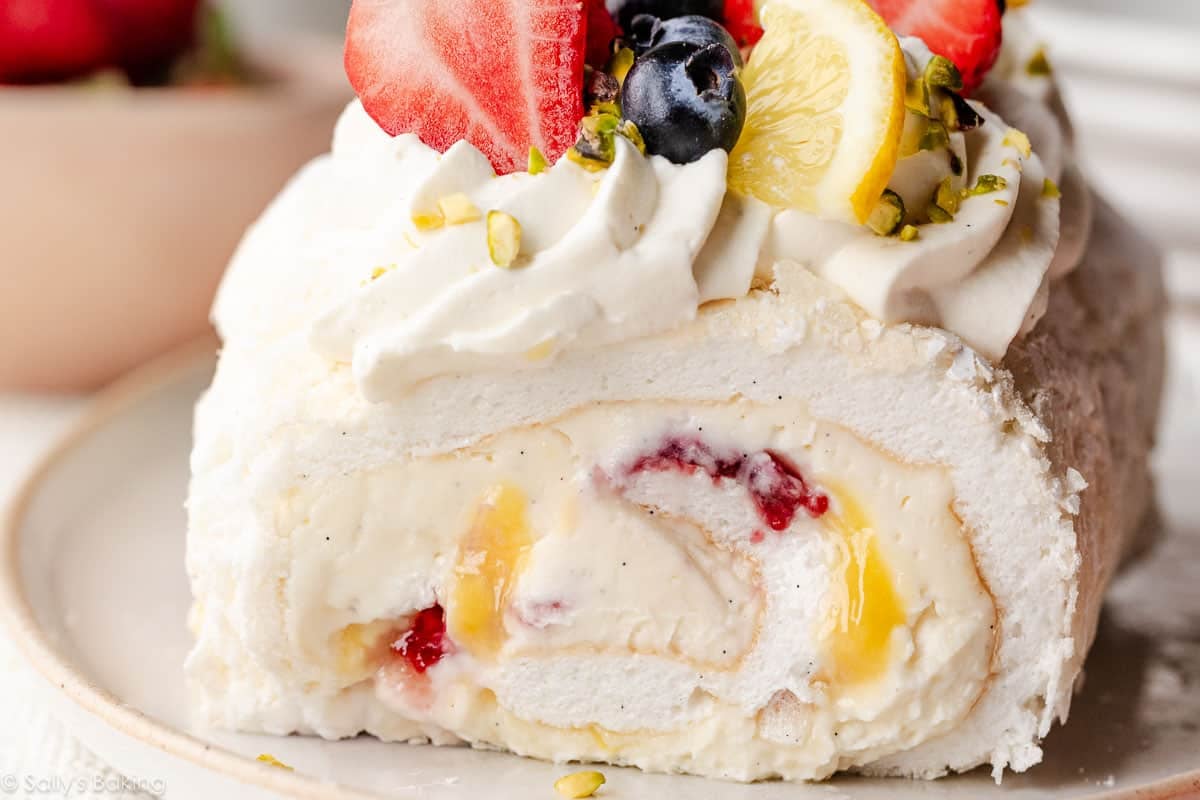
Spread the cream filling evenly over the unrolled meringue. If you’d like to add some extra flavor here, dollop some spoonfuls of lemon curd and/or raspberry jam (or your preferred flavors!) over the top.
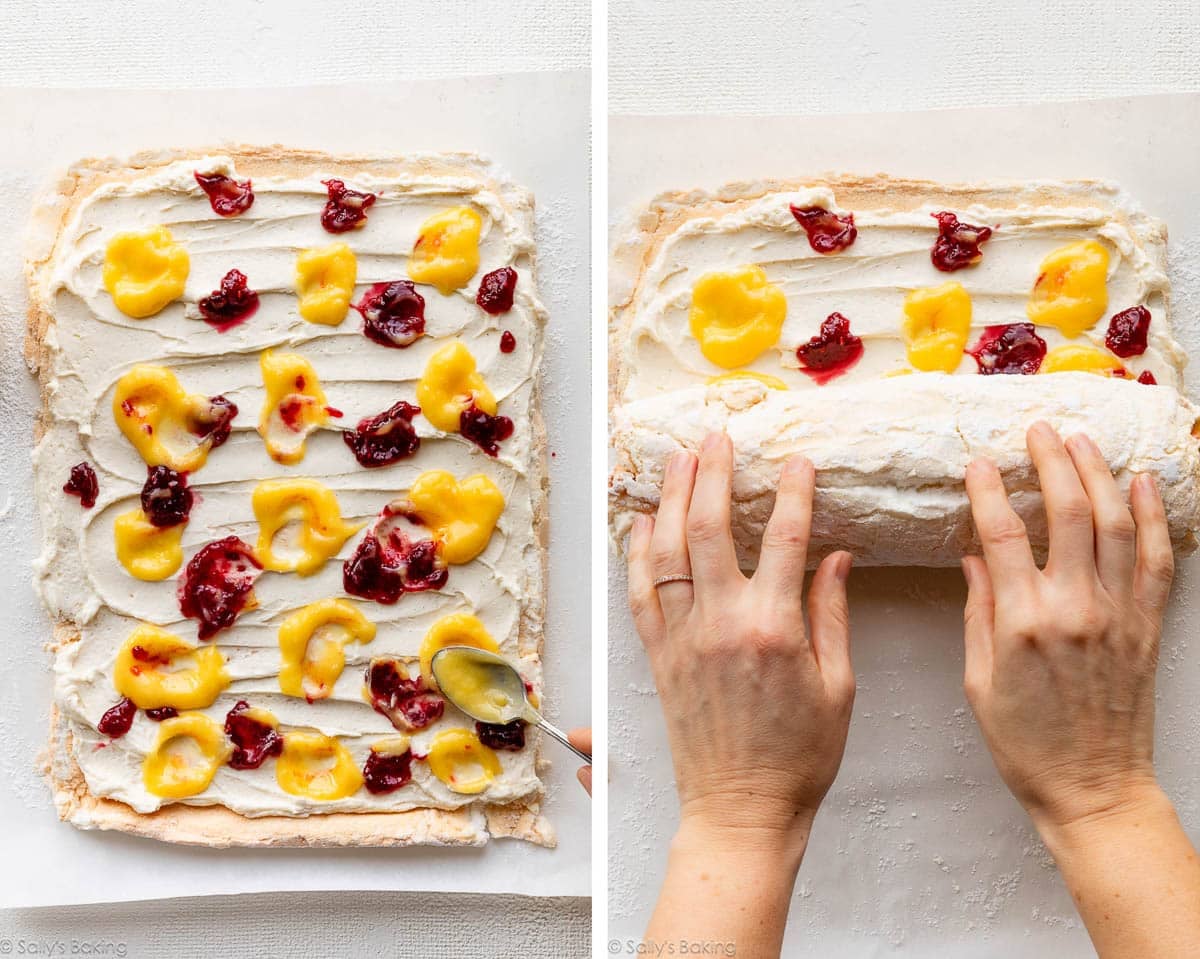
Final Roll
Roll it back up without the towel and parchment, using the bottom piece of parchment to help guide you. Tips for the second roll:
- Move slowly and evenly.
- Lift up the bottom piece of parchment to help ease the roll over onto itself.
- Accept minor cracks—they’re part of the meringue roulade’s rustic charm!
Variations & Customizations
Decorate your meringue roulade however you like!
Some garnish ideas:
- Piped dollops of whipped cream
- Fresh berries and sliced fruit
- A sprinkling of chopped pistachios
- Fresh mint sprigs or edible flowers
- Chocolate or white chocolate curls or shavings
- Sugared cranberries
For an alternate filling, you could try:
- The mascarpone cream from this fruit tart
- Homemade whipped cream
- Mocha whipped cream
- Pastry cream
- All lemon curd
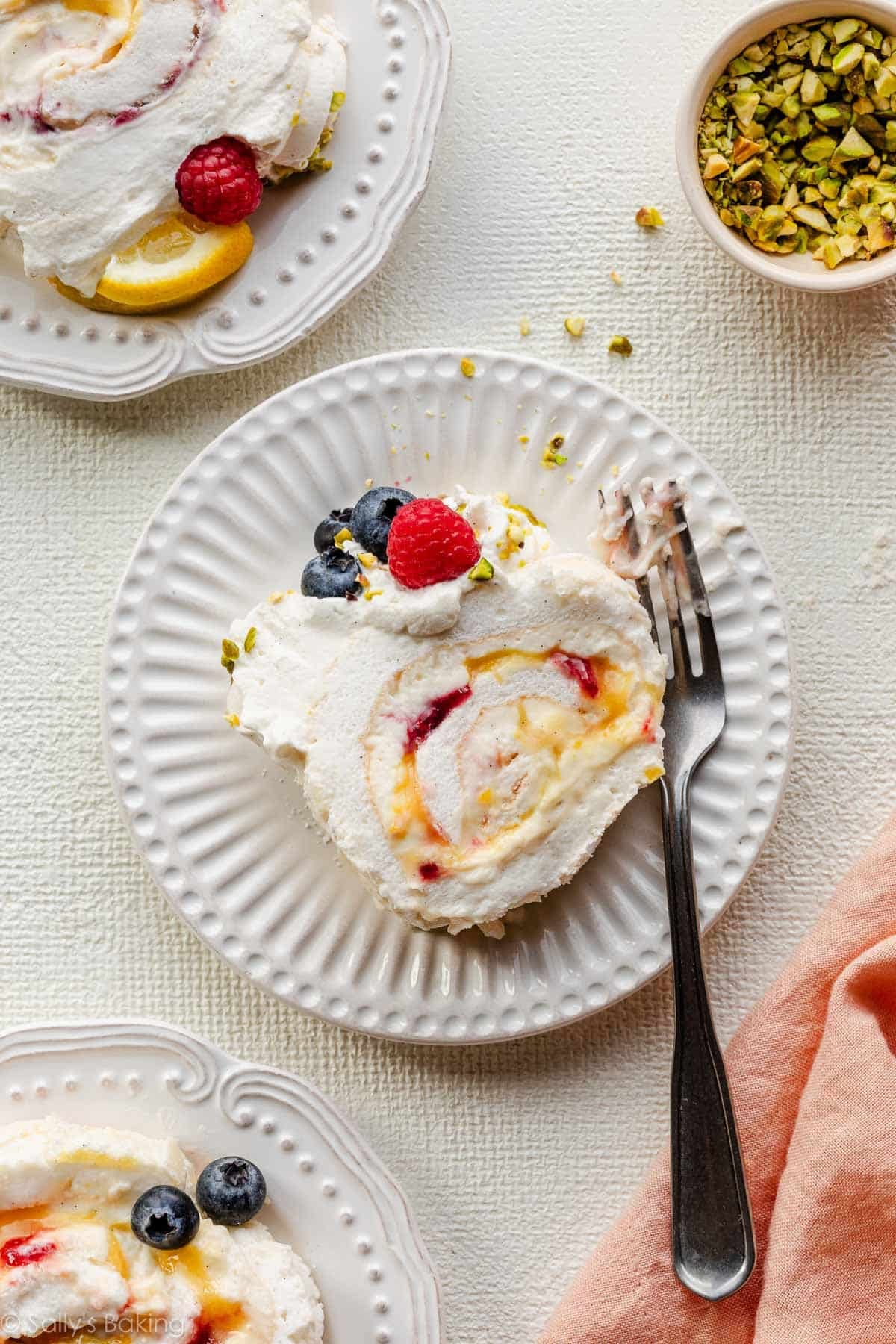
I consider this meringue roulade an advanced baking recipe because it requires technical precision and asks you to pay attention to visual cues. The reward for your effort is something truly special, though: a dessert you will feel VERY proud to say you made from scratch.
Bragging rights!
And don’t stress too much about the aesthetics… those soft swirls and delicate cracks are part of its charm, and how the meringue roll looks is absolutely less important than how it tastes.
A few small cracks are totally normal! Large cracks usually mean it was either over-baked, cooled for too long before rolling, or rolled too tightly.
Humidity can affect meringue. Sugar attracts moisture from humid air, causing the meringue to become sticky and unstable. If you have issues with the meringue sticking too much to the parchment it baked on when you peel it off, check to make sure you sprinkled the parchment with granulated sugar before you spread the meringue in the lined pan.
It’s normal for meringue to weep (leak liquid) after a while (such as if you refrigerate the meringue roll overnight), but if you notice it happening right away, this could be due to under-beating or the sugar not fully dissolving, which results in an unstable structure that releases moisture. If the sugar is not fully dissolved, it breaks down and creates a syrup that leaks. Be sure to start with superfine sugar and whip until your meringue has stiff peaks.
This meringue roulade is best enjoyed right away, but, if necessary, you can assemble it a couple of hours in advance. Expect the meringue to soften over time, however, and the roll to sink and/or flatten out. You will have better results if you make both the meringue and cream filling ahead but wait to put them together/assemble the roll until just before serving. See the recipe Notes below for make-ahead instructions for the individual components.
You can use a larger baking sheet, such as a half sheet pan. Cut your parchment paper to approximately 11×16 inches in size, dot a little of the meringue on each of the four corners, then flip it over and press the parchment on the baking sheet to secure it in place. Spread the meringue evenly on the parchment, leaving about a 1-inch inch border all the way around.



Meringue Roulade
- Prep Time: 40 minutes
- Cook Time: 25 minutes
- Total Time: 2 hours, 30 minutes (includes cooling)
- Yield: serves 8-10
- Category: Dessert
- Method: Baking
- Cuisine: European
- Diet: Gluten-Free
Description
Light as air, delicately crisp on the outside, and soft and marshmallowy within, this homemade meringue roulade is a show-stopping dessert worthy of a special occasion. Start by making a billowy whipped meringue, bake it just until set, then roll it up with a lightly sweet vanilla cream filling and your favorite flavors of jam or curd (we love this with lemon curd and raspberry jam!). Read through the entire recipe before beginning, and avoid making this on very humid days, as moisture in the air can affect the meringue’s texture.
Ingredients
Meringue
- 5 egg whites, at room temperature (150g) (use the yolks for lemon curd!)*
- 1 cup (200g) granulated sugar, + 1 Tablespoon (12g) for sprinkling
- 1/2 teaspoon cream of tartar
- 1 and 1/2 teaspoons cornstarch
- 1 teaspoon vanilla bean paste or pure vanilla extract
- pinch of salt
- confectioners’ sugar, for dusting parchment
Cream Filling
- 1 cup (240g/ml) heavy cream, cold
- 1/3 cup (40g) confectioners’ sugar
- 1 teaspoon vanilla bean paste or pure vanilla extract
- 4 ounces (113g) full-fat block cream cheese, softened to room temperature
- optional: lemon curd and/or jam
Garnishes (Optional)
- 1/2 batch homemade whipped cream
- Fresh fruit such as berries and lemon slices
- Crushed pistachios
Instructions
- I recommend reading this recipe in full before beginning, including the recipe Notes below and the troubleshooting and FAQ above. This helps set you up for success!
- Make the meringue roll: Preheat the oven to 300°F (149°C).
- In a food processor, process 1 cup (200g) of sugar until superfine, about 10 seconds.

-
In a completely grease-free bowl, using a stand mixer fitted with a whisk attachment or a handheld mixer, whip the egg whites on medium-high speed until foamy and soft peaks form, about 2–3 minutes. Add in the cream of tartar. With the mixer running on medium-high, begin adding the superfine sugar, 1 Tablespoon at a time. Once all of the sugar has been added, turn the mixer up to high speed and continue beating until glossy stiff peaks form, about 3 minutes (or a little longer if using a handheld mixer). The peaks should be stiff enough that you can hold the whisk upright and the peaks won’t droop. Rub a small amount of the meringue between your fingers. If you feel any sugar granules, keep beating until smooth. If not, it’s ready for the remaining ingredients. Add the cornstarch, vanilla, and salt, and beat on low speed just until combined, about 10 seconds.

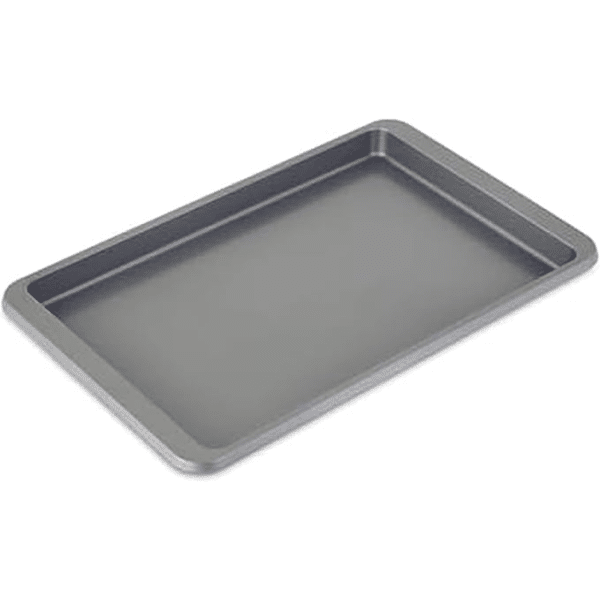
- Prepare the pan: Spread a little of the meringue in each of the corners of a 10×15-inch jelly roll pan (or any similar size) and then press the parchment paper into the pan, to help “glue” it into place. (This makes spreading much easier!) Lightly sprinkle about 1/2 Tablespoon of granulated sugar over the parchment.

- Spread the meringue in an even layer in the pan. An offset spatula is helpful here. Sprinkle the remaining 1/2 Tablespoon of granulated sugar evenly over the top. If you’re using a larger baking sheet, cut your parchment paper to 11×16 inches in size, and dot a little of the meringue on each of the four corners, then flip it over and press the parchment on the baking sheet to secure it in place. Spread the remaining meringue on the parchment, leaving about a 1-inch border all the way around.
- Bake for 25–30 mins. The meringue should look set and just barely golden on top, pull slightly away from the parchment edges, and if you touch it gently, feel crisp on top but springy under the surface.

- Remove the pan from the oven and set on a cooling rack. Let the meringue cool for just 10 minutes. If it cools for too long in this step, it’s much more likely to crack. It will deflate a bit as it cools.
- Prepare to roll: As the meringue cools, place a piece of parchment paper (larger than 10×15 inches) on top of a clean tea towel flat on the counter. Align one of the short edges of the parchment close to one end of the towel. Using a fine mesh sieve, dust the parchment with about 1 Tablespoon of confectioners’ sugar. After 10 minutes of cooling in step 8, invert the meringue onto the parchment. Carefully peel off the parchment paper that was on the bottom of the meringue as it baked. Dust a little more confectioners’ sugar on top, then cover with a new piece of parchment. Starting with the short end aligned with the end of the towel, gently roll the meringue up with the parchment and the towel. Do this slowly but steadily, and avoid rolling it too tightly. Allow the meringue to cool at room temperature rolled up in the parchment/towel, about 45 minutes to 1 hour. Feel free to set it aside at room temperature for up to 1 day.

- Make the cream filling: Using a handheld or stand mixer fitted with a whisk attachment, whip the heavy cream, confectioners’ sugar, and vanilla on medium-high speed until soft peaks form, about 2–3 minutes. Transfer the whipped cream to another bowl. Place the softened cream cheese in the mixer bowl (no need to clean it first) and beat with the whisk attachment on medium-high speed until completely smooth.
- Add the whipped cream back into the bowl with the cream cheese. Mix on medium-low speed until just combined. Use right away (next step), or cover and refrigerate the filling for up to 3 days before using.
- Once the meringue roll has cooled, gently unroll, and discard the top piece of parchment. Spread the cream filling evenly over the top. Spoon dollops of curd and/or jam on top, if using. Gently re-roll the meringue with the filling. If it’s helpful, lift up the bottom piece of parchment underneath the meringue to help ease the roll over onto itself. Transfer the meringue roll to a serving plate. Garnish as desired. I used a half batch of whipped cream piped with Wilton 1M piping tip, crushed pistachios, and lots of fresh fruit.

- Serve immediately or refrigerate for up to 2 hours. Expect the meringue to weep or deflate slightly in the refrigerator the longer it sits. A large serrated knife works best for slicing.
- Cover and store leftover meringue roulade in the refrigerator for up to 2 days. The meringue will soften over time, and may weep some liquid, but that shouldn’t affect the taste.
Notes
- Make-Ahead Instructions: Meringue roulade is best enjoyed the day it’s made. The meringue will soften and weep droplets of moisture over time. You can make the meringue (through step 9) a day in advance, and let it sit at room temperature, rolled up in the towel. You can make the cream filling up to 3 days in advance and store it, tightly covered, in the refrigerator until ready to use.
- Special Tools (affiliate links): Egg Separator | Food Processor or Blender | Electric Mixer (Handheld or Stand) | 10×15-inch Pan | Parchment Paper | Small Offset Spatula | Fine Mesh Sieve
- Egg Whites: Eggs separate easier when cold, but room-temperature egg whites whip faster and into greater volume than cold egg whites. So separate your eggs while cold, then allow the egg whites to come to room temperature before beginning. Use some of the yolks to make lemon curd!
- Sugar: You need superfine or caster sugar so it dissolves fully in the egg whites. To avoid tasting sugar granules, pulse 1 cup granulated sugar in a food processor. You now have superfine sugar to use in the recipe.
- Acid: Instead of the 1/2 teaspoon of cream of tartar, you can substitute 1 teaspoon of white vinegar, apple cider vinegar, or lemon juice.
- Gluten Free: This recipe is naturally gluten free. However, some brands of cornstarch may be processed on shared equipment with wheat, so if needed, check for a labeled gluten free cornstarch.














Reader Comments and Reviews
Delicious and marshmallow-y. The kids loved it.
Great sweetness! This was a fun challenge to check out! I am not a meringue fan and this was way too sweet for me. I’m glad I tried the roll process and it turned out well with Nutella and pistachio filling. Thanks!
Impressive dessert! I’ve made pavlova before so I was eager to attempt something a bit more challenging. Sally and her team provided lots of detailed instructions, which were very helpful. While my roulade cracked some, I was able to cover the mistakes with whipped cream (yay!). No one ever knew. It was tasty and a great dessert to please a crowd!
This cake was so light and airy. I was so surprised at the rolled meringue! I didn’t think it would come out. You must like Meringue! The cream filling was very smooth. I added strawberry jam to the insides and it added a very good taste.
I’ve made many pavlovas and many roll cakes, but had never tried a meringue roulade — this recipe is AMAZING, and I will absolutely be making this again!!
I did 1.5x the cream filling and used the extra for topping (with 1M swirls under various fruit). I did it to avoid using multiple bowls to whip cream at different times, but I think this helped take the flavor over the top as well!
I finally got around to making this for the monthly baking challenge and it turned out great! I carefully watched to make sure it didn’t over bake. I must have read the directions over 20 times lol. Challenge completed and now I’m off to wash a ton of dishes.
I can’t wait to try this with different flavors!
A crowd pleaser! Sally & team do a great job of breaking it down and making this show stopper manageable. The result was fluffy and delicious.
This was delicious and, as always, the directions were clear and easy to follow. My only difficulty was that it cracked a lot making the final product more like a layered dessert rather than a roulade. I filled it with coconut pastry cream and dots of lemon curd. Soooo good! I’ll try it again and see if I can get the beautiful roll to work.
This Meringue Roulade was incredibly delicious! The recipe was super easy to follow, and the pictures were also very helpful. I felt so proud of myself when it was done! It was the fanciest dessert I have ever made, but it was also suprisingly easy! Though it was time consuming, it was so worth it. I will definitely be making this again! Thank you Sally, for another amazing recipe!
Easier than I anticipated! I had some cracking because I think I waited to long to roll it after the oven, but the filling holds it all together so it was fairly easy to roll back up again. It was all eaten in one sitting and my family says it’s a definite “make again”!
After reading the recipe multiple times before starting, I eventually dove into this project bake! Doing those pre-reads definitely helped and made the process so much easier! Not only that. This came out better than where my expectations were set. Very fun, different bake with an easy to follow recipe!
This meringue roulade was delicious! I used the lemon curd and raspberry jam filling combo – the tartness of these fillings was a nice complement to the sweetness of the rest of the dessert. My meringue baked nicely and didn’t crack too much during rolling. The most difficult part was moving it from the towel to the serving plate!
This was so unbelievable good! I made a few mistakes and it totally cracked, but it was still delicious. I will definitely be making this again. Everyone loved how light and fresh it tasted. So unique and impressive! And Sally’s instructions are great – just make sure you follow them!
This was surprisingly easy and I was able to do it in one afternoon!
I made the Meringue Roulade last weekend and it was delicious!
Extremely easy to roll and the filling was beautiful. Will definitely make again.
What a delicious recipe, I was not sure and may have used a little more filling as it doesn’t look as pretty but good for the first time!! We liked it a lot!
The meringue came out nice and fluffy with well balanced flavors.
One of the most delicious desserts ever! Sally’s instructions set you up for success. I’ve never felt more proud of a bake!
I went into this thinking I’d surely fail but not only did it turn out (certainly not perfectly) but it wasn’t any where near as challenging as I’d expected- I know I can attribute this to how thorough Sally always is with her instructions, tips, and photos. This recipe is superb! So delicious- decadent yet light. Thank you for another amazing recipe!
I can see this definitely being a challenge for those who might be at a beginners level of baking. It is a great recipe to test out some new skills like making meringue as well as practicing that rolling method that can be used in many other recipes. It took me two attempts to get the meringue baked correctly – I found paying attention to the appearance vs baking time allowed me to get it right the second time. I cooked it for longer to make sure it wouldn’t stick to the parchment paper. I was thinking this would be very sweet, but it actually balanced well with the whipped filling as well as the brightness from the lemon curd and fruit jams. I definitely recommend incorporating fresh berries to lighten the dish!
This was my first time making a meringue and it wasn’t as intimidating as I thought it would be! I did crack it a few times when rolling, which I covered with whipped cream and fruit to hide the imperfections. It all goes to the same place, as my grandma would say! I made the filling and whipped cream the day before, meringue morning of, and served with Easter dinner. Everything tasted great and I would make it again but not on a day when so much else needed tending to, as it was time consuming.
A little too sweet but tasty! The meringue with everything else was pretty sweet to me, so I would use a little less sugar less time and add more lemon curd. I would also use a little less filling than it made and not put the curd and jam on the edge because it overflowed when I rolled it up. Yummy recipe though!
This was a challenge, but it was fun to bake! I think the 2nd time around will be easier. There are a lot of steps, but Sally breaks them down well and gives good pics for demonstration. It was worth the time and effort. Super delicious!!
This recipe was intimidating haha. But the overall result tasted delicious. Unfortunately, mine cracked really badly. I ended up with one solid piece that I was able to stack together with the cream and some strawberry jam dollops. I definitely need to attempt this one again! It’s super sweet.
This is like eating a billowy cloud, so light and airy. I had it in my mind that is was going to be difficult but it really is very easy as long as you g as you pay attention to each step. I definitely recommend the lemon curd in this it’s a perfect pairing.
Always just love the way the recipes are written to help all skill levels.
It was easier than I thought it would be and it tasted delicious!
Mine completely fell apart but I scooped it into a pie plate, called it a trifle and served it anyways. It was delicious!
Wow, this came out so well, even though I am a baking newby.
Some advice for other newbies: As Sally said, read all the instructions before attempting this. Although I did read it thoroughly, in the excitement of getting the meringue in the oven, I forgot to sprinkle some castor sugar at the bottom of the pan. It still came out great, but would probably be a lot less sticky if I did as I was told!
I would also suggest using a hand mixer to soften the cream cheese rather than a stand mixer. My stand mixer is not the best quality and the cream cheese got stuck in the bottom of the bowl. I then battled to fully integrate it with the cream. That all said, the recipe is super forgiving and despite my battles it came out really well.