

Irish Soda Bread is a quick bread that does not require any yeast. Instead, all of its leavening comes from baking soda and buttermilk. This Irish soda bread recipe is my grandmother’s and has been cherished in my family for years. It’s dense, yet soft and has the most incredible crusty exterior. Buttermilk and cold butter are the secret to its delicious success!
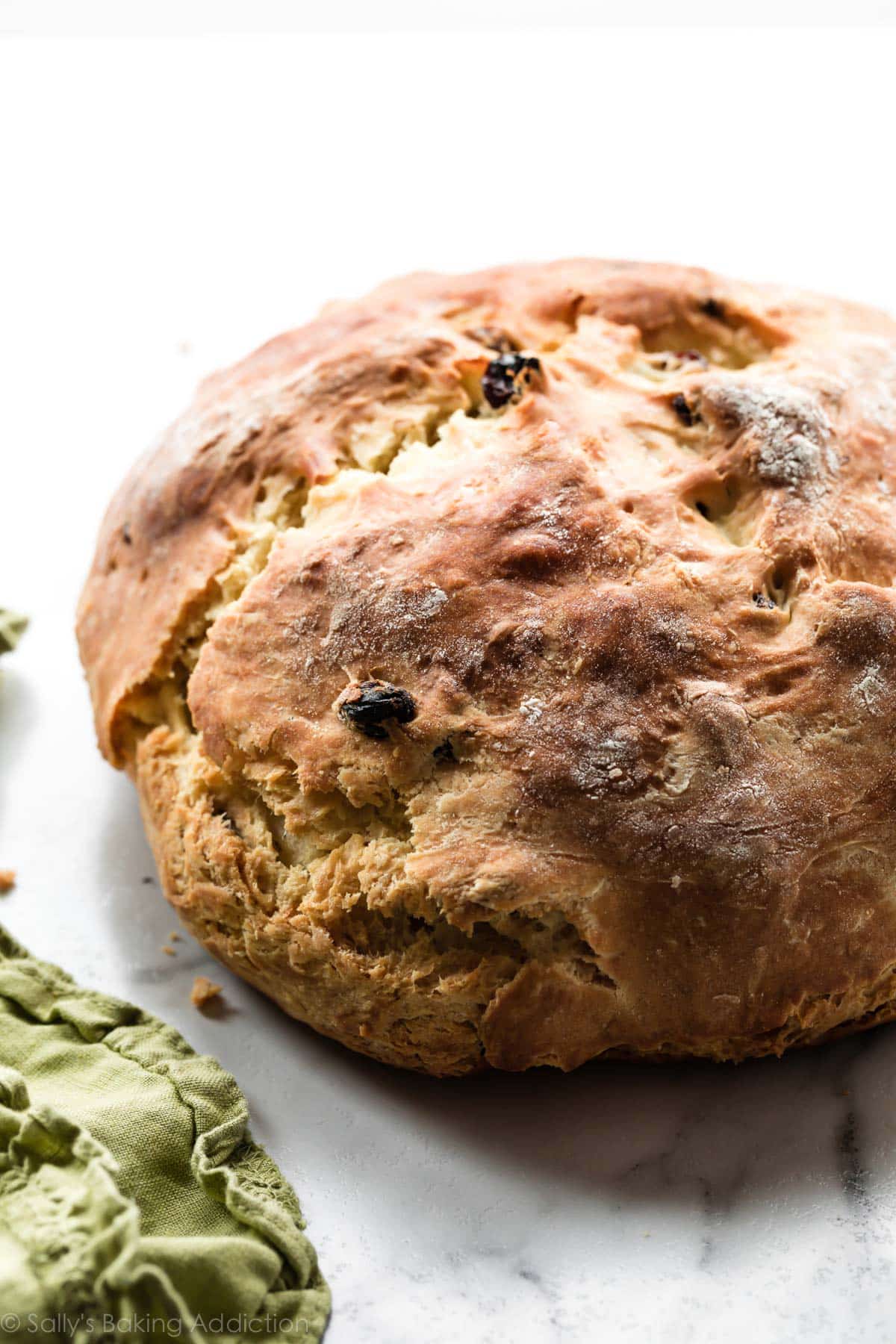
Welcome to my favorite Irish Soda Bread recipe. I shared this no yeast bread recipe on my blog a few years ago and decided to revisit with fresh new pictures and a video tutorial. This recipe is my grandmother’s. She passed away in 2011, 2 weeks before I started this food blog. I dedicated my 1st cookbook to her. Full of energy and the creator of the best homemade pie crust on earth, she would be in her 90s today. St. Patrick’s Day is her birthday.

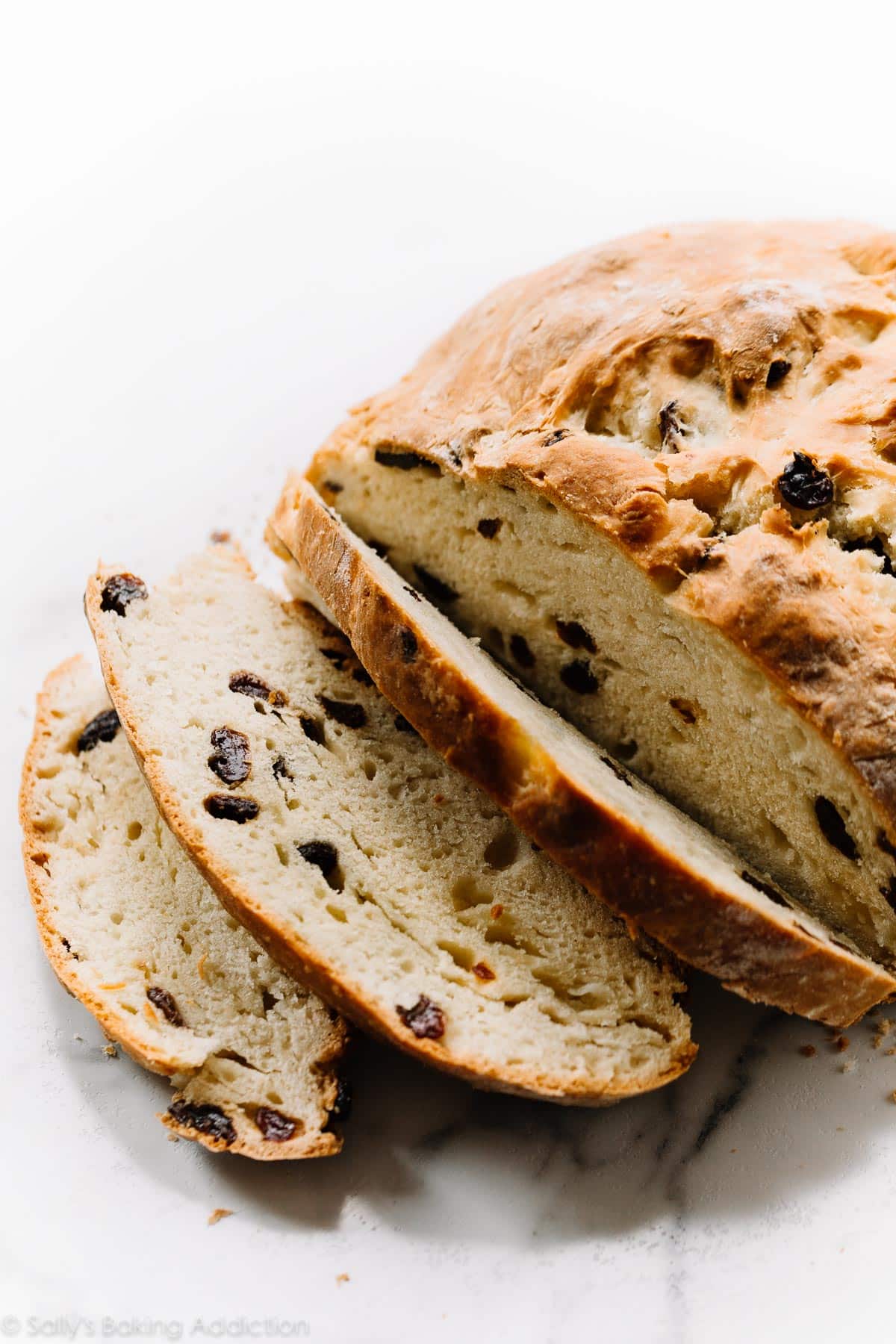
Irish Soda Bread is a Quick Bread
Does the thought of homemade bread send you running for the hills? Sometimes homemade bread feels daunting, but you’re in luck today. Irish soda bread is a quick bread made with baking soda, not yeast. Like my easy no yeast bread, this is a shortcut bread that doesn’t skimp on flavor. (If you want a yeast bread, I recommend my sandwich bread recipe!)
- What’s the texture like? The best Irish soda bread, like this recipe, has a golden brown crust with a dense, tight crumb. The bread isn’t heavy, it’s actually quite tender and soft inside. The crust is nice and crisp when it comes out of the oven and becomes a little chewy on day 2 and 3. It’s so good.
My grandmother’s Irish soda bread contains some sugar, but it’s not overly sweet. It’s a wonderful companion for savory dinners like hearty stew or you can serve it with butter, honey butter, jam, and/or cheese. The raisins are optional, but Grandma would never let you skip them.
Video Tutorial: Homemade Irish Soda Bread
Overview: How to Make Irish Soda Bread
The full printable recipe is below. Irish soda bread dough comes together in about 10 minutes. You need buttermilk, egg, flour, sugar, baking soda, salt, and butter.
- Whisk buttermilk and 1 egg together. Whisk the flour, sugar, baking soda, and salt together in another bowl.
- Cut cold butter into the flour mixture. Like scones and pie crust, cutting cold butter into the flour is a key step. Coating the flour in cold butter guarantees a lovely flaky texture. You can use a fork, your hands, or a pastry cutter. Add the wet ingredients.
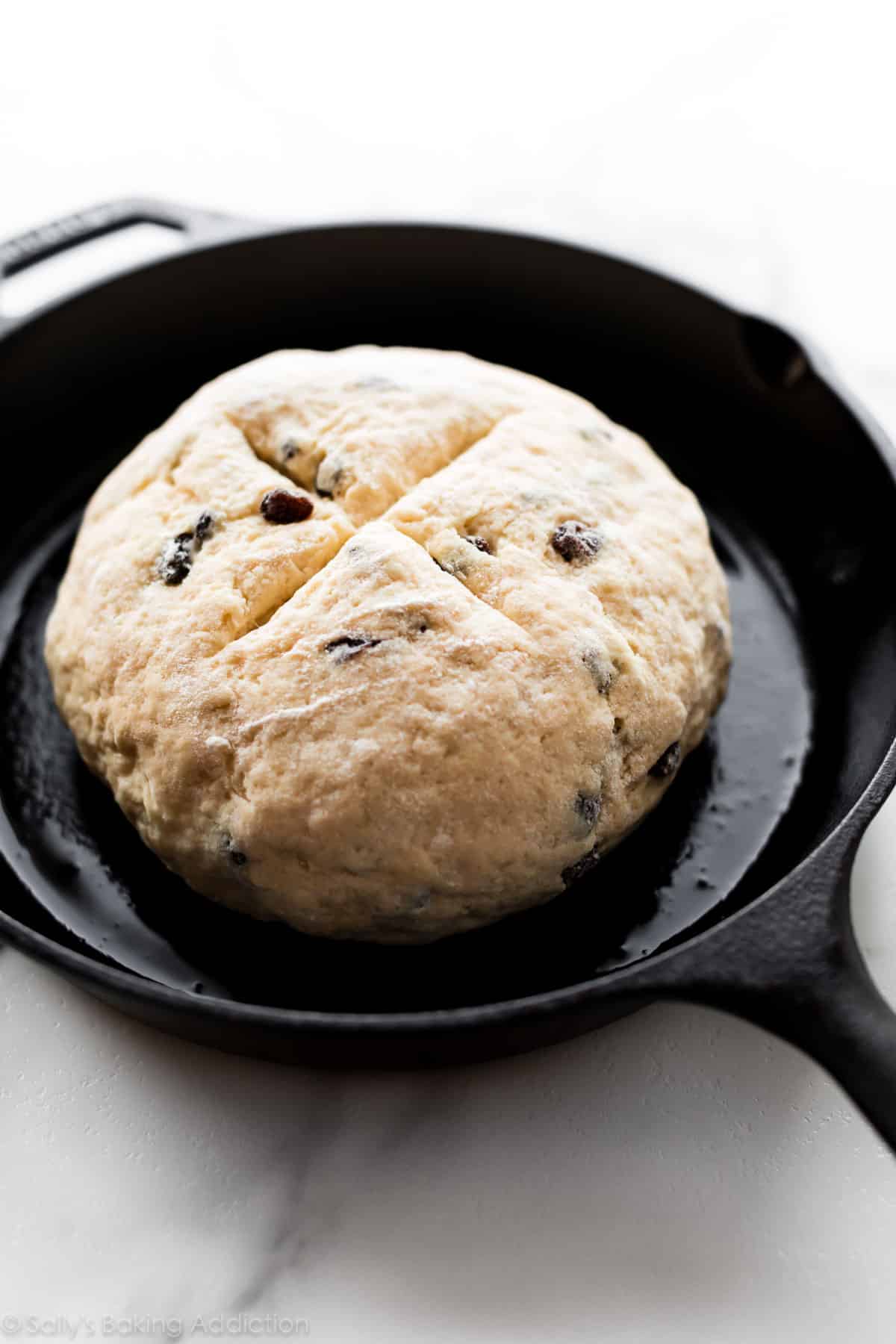
- Bring the dough together with your hands. Using a very sharp knife, score the dough. This allows the center to bake.
- Bake until golden brown.
Buttermilk is the Secret
Irish soda bread only requires a few ingredients, including buttermilk. Buttermilk reacts with the baking soda to provide the bread’s leavening. It also adds wonderful flavor! We use buttermilk for the same reasons in my regular no yeast bread, too. If you’re interested, I have plenty more on this topic in my Baking with Buttermilk post (including a DIY buttermilk substitute recipe).
Feel free to Skip the Egg
Irish soda bread can be made with or without an egg. 1 egg adds richness and density. Feel free to skip it to make a slightly lighter loaf. No other changes necessary, simply leave out the egg.
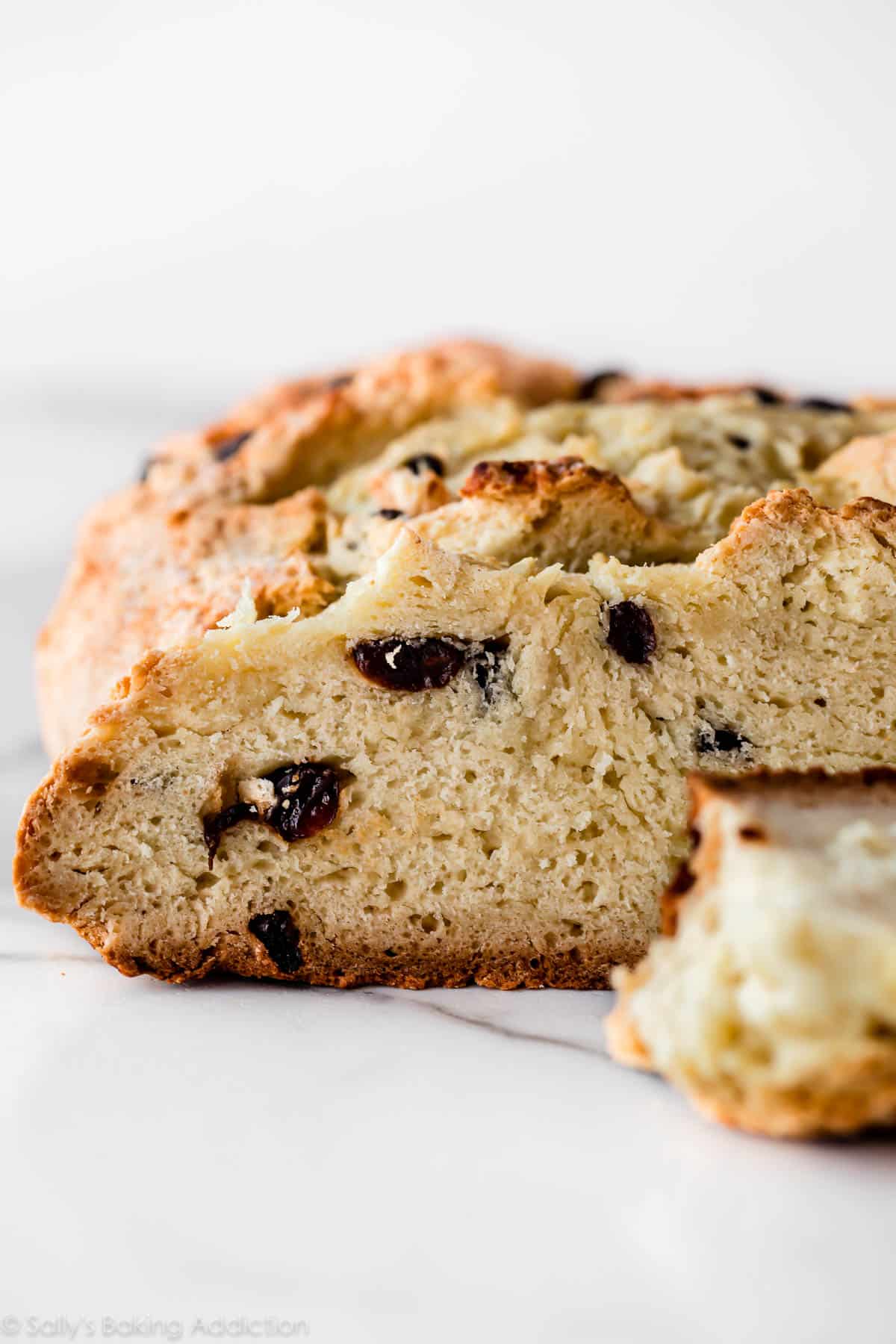
3 Success Tips
- Don’t over-work the dough. It’s supposed to look a little shaggy.
- Score the top of the dough with an “X” before baking. This helps the center bake through.
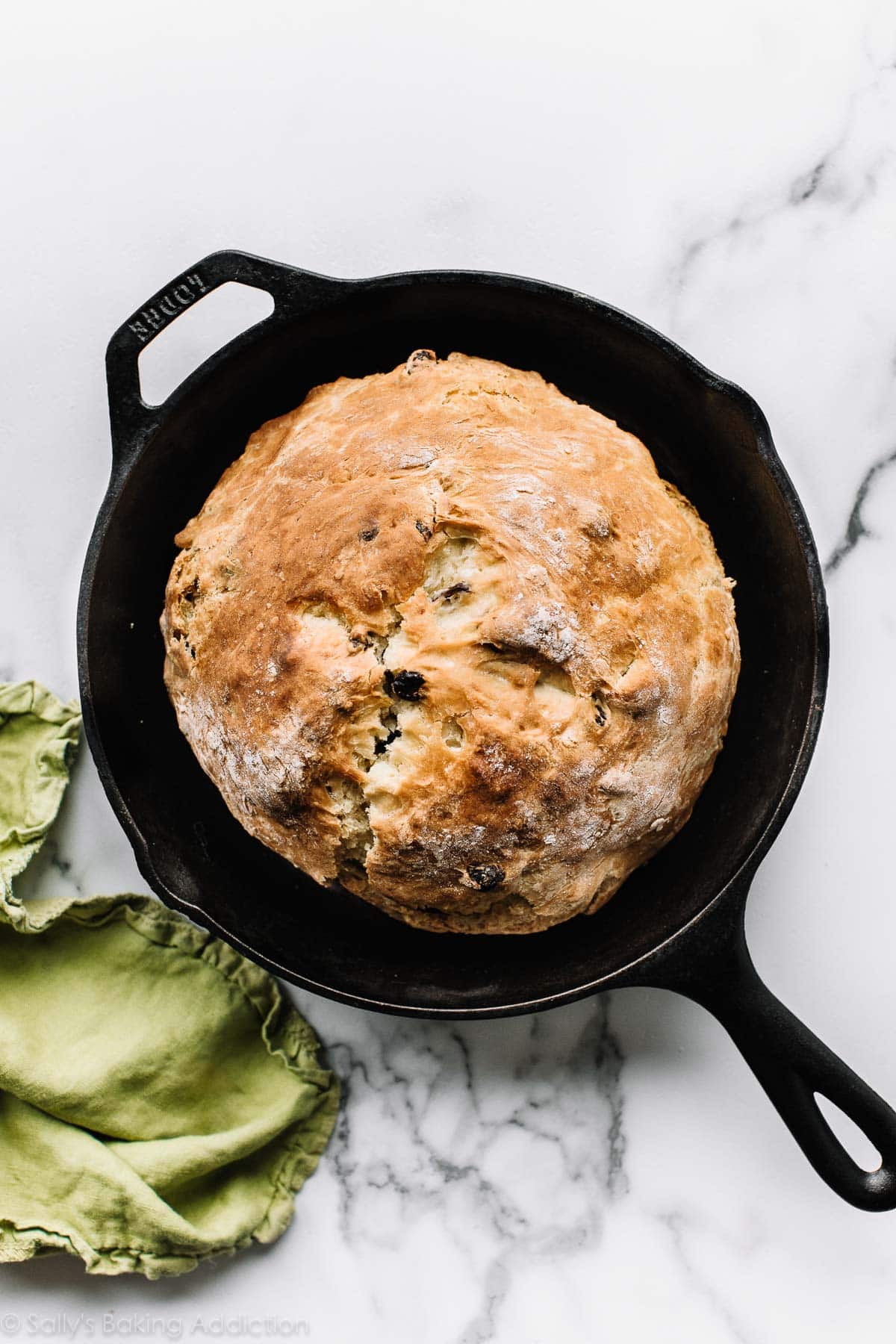
- You can bake Irish soda bread on a baking sheet, in a baking pan, or in a cast iron skillet. I recommend a cast iron skillet because it helps guarantee a super crispy crust. Here’s how to keep your cast iron cookware seasoned.
If you’re baking for St. Patrick’s Day, you’ll love my Guinness Brownies, Baileys and Coffee Cupcakes, Guinness Chocolate Cake, Guinness Chocolate Cupcakes, Lucky Charms Treats, and shamrock St. Patrick’s Day Cookies, too.
Print
Grandma’s Irish Soda Bread
- Prep Time: 10 minutes
- Cook Time: 45 minutes
- Total Time: 55 minutes
- Yield: 1 loaf
- Category: Bread
- Method: Baking
- Cuisine: Irish
Description
Irish Soda Bread is a quick bread that does not require any yeast. Instead, all of its leavening comes from baking soda and buttermilk. This Irish Soda Bread recipe is my grandmother’s and has been cherished in my family for years. It’s dense, yet soft and has the most incredible crusty exterior.
Ingredients
- 1 and 3/4 cups (420ml) buttermilk*
- 1 large egg (optional, see note)
- 4 and 1/4 cups (531g) all-purpose flour (spooned & leveled), plus more for your hands and counter
- 3 Tablespoons (38g) granulated sugar
- 1 teaspoon baking soda
- 1 teaspoon salt
- 5 Tablespoons (71g) unsalted butter, cold and cubed*
- optional: 1 cup (150g) raisins
Instructions
- Preheat oven & pan options: Preheat oven to 400°F (204°C). There are options for the baking pan. Use a regular baking sheet and line with parchment paper or a silicone baking mat (bread spreads a bit more on a baking sheet), or use a seasoned 10-12 inch cast iron skillet (no need to preheat the cast iron unless you want to), or grease a 9-10 inch cake pan or pie dish. You can also use a 5 quart (or higher) dutch oven. Grease or line with parchment paper. If using a dutch oven, bake the bread with the lid off.
- Whisk the buttermilk and egg together. Set aside. Whisk the flour, granulated sugar, baking soda, and salt together in a large bowl. Cut in the butter using a pastry cutter, a fork, or your fingers. Mixture is very heavy on the flour, but do your best to cut in the butter until the butter is pea-sized crumbs. Stir in the raisins. Pour in the buttermilk/egg mixture. Gently fold the dough together until dough it is too stiff to stir. Pour crumbly dough onto a lightly floured work surface. With floured hands, work the dough into a ball as best you can, then knead for about 30 seconds or until all the flour is moistened. If the dough is too sticky, add a little more flour.
- Transfer the dough to the prepared skillet/pan. Using a very sharp knife or bread lame, score the dough with a slash or X about 1/2 inch deep. (“Score” = shallow cut.)
- Bake until the bread is golden brown and center appears cooked through, about 45-55 minutes. Loosely tent the bread with aluminum foil if you notice heavy browning on top. For a more accurate test, the bread is done when an instant-read thermometer reads the center of the loaf as 195°F (90°C).
- Remove from the oven and allow bread to cool for 10 minutes, and then transfer to a wire rack. Serve warm, at room temperature, or toasted with desired toppings/spreads.
- Cover and store leftover bread at room temperature for up to 2 days or in the refrigerator for up to 1 week. We usually wrap it tightly in aluminum foil for storing.
Notes
- Freezing Instructions: Baked and cooled bread freezes well up to 3 months. Freeze the whole loaf or individual slices. Thaw in the refrigerator or at room temperature, then reheat as desired.
- Special Tools (affiliate links): Cast Iron Skillet, 9-inch Round Cake Pan, 9-inch Pie Dish, Dutch Oven, or Baking Sheet with Silicone Baking Mat or Parchment Paper | Glass Mixing Bowl | Whisk | Pastry Cutter | Bread Lame | Instant-Read Thermometer
- Baking Pan: There are options for the baking pan (see Special Tools Note above). You can use a lined large baking sheet (with or without a rim), a seasoned 10-12 inch cast iron skillet, or a greased or lined 9-10 inch cake pan or pie dish. I don’t recommend a loaf pan because the loaf may not bake evenly inside. This dough is best as a flatter loaf.
- Buttermilk: Using cold buttermilk is best. Buttermilk is key to the bread’s flavor, texture, and rise. The bread will not rise without it. If you don’t have any buttermilk on hand, you can make a homemade buttermilk substitute. Whole milk or 2% milk is best, though lower fat or nondairy milks work in a pinch. Add 1 Tablespoon of lemon juice or white vinegar to a liquid measuring cup. Add enough cold milk to make 1 and 3/4 cups. Whisk together, then let sit for 5 minutes before using in the recipe.
- Egg: 1 egg adds richness and density. Feel free to skip it to make a slightly lighter loaf. No other changes necessary, simply leave out the egg.
- Cold Butter: The colder the butter, the less sticky the dough will be. Make sure it’s very cold, even frozen cubed butter is great.
- Smaller Loaves: You can divide this dough up to make smaller loaves. The bake time will be shorter, depending how large the loaves are. An instant read thermometer will be especially helpful. Bake the loaves until an instant-read thermometer reads the center of the loaf as 195°F (90°C).












Reader Comments and Reviews
anyone else have issues way the dough beign EXTREMELY wet?
Hi Sa, we’re happy to help troubleshoot. Irish soda bread dough should actually be quite soft and a little sticky. If the dough looks overly wet next time, it’s perfectly fine to sprinkle in a little extra flour, about 1 Tablespoon at a time, just until it comes together into a shaggy, workable dough that you can gently shape and score. Try to avoid adding too much, though, because soda bread can become dense if the dough gets too dry.
I also found it to be too wet, as opposed to soft. I weighed the dry ingredients and still had to add more flour. It took a solid 1 hour and 25 minutes to finish (used a Thermapen thermometer). Had to cover it after 40 min. The texture and flavor of the bread was good, but the bottom and sides were very hard. In the future, I’ll make two, smaller loaves and cook them on a sheet pan.
tastes great. i did have question after the initial 10 minutes out of the oven – how long before you slice? i should have waited because mine was a little crumbly? thank you
Hi Irene, If the bread was piping hot you may wish to wait longer before slicing next time. Other culprits for a crumbly loaf can be over baking, as well as over measuring flour. Be sure to spoon and level (or use a kitchen scale) to ensure the flour isn’t over measured.
I just made this for St. Patrick’s Day and I made the same mistake this year that I made last year, I think. I let it cool for 10 minutes and then sliced it open to try a piece warm, only to find the texture inside kind of gummy (despite reaching 195 degrees). Google thinks slicing it too early let the steam escape before the crumb had set and says I should have let it cool for at least an hour before slicing to avoid that. Maybe a helpful edit to make to the recipe if that’s true. (It tastes great anyway, and putting it back in the oven for a few minutes seems to have helped the texture.)
Hi, there.
Is it acceptable to eliminate the salt when using salted butter?
I am gathering the ingredients (including real buttermilk) & can’t wait to bake the bread for St. Patrick’s Day dinner (corned beef & cabbage).
Hi Chrissie! If you use salted butter you may wish to slightly reduce the amount of added salt in the recipe – we would try about 3/4 tsp instead of 1 tsp.
I had to use the standing mixer to bring the dough together. I did not use the egg. Bread was delish!!!!
Made this bread this morning and my husband and I promptly ate half of it! I used cast iron and it burned on the bottom, though. I may have overbaked it trying to get to the 195 degrees the recipe mentions. My husband said that won’t work at our altitude. Do you have any suggested changes for baking this at high Colorado altitude? Thanks!
Hi Sue! I wish we could help, but have no experience baking at high altitude. Some readers have found this chart helpful: https://www.kingarthurflour.com/learn/high-altitude-baking.html
Thanks Trina!
This bread came together easily and turned out beautiful. I did not need to add more flour other than the light dusting of the counter and my hands. I used a kitchen scale for my measurements and feel that makes a huge difference in many recipes.
Hi,
I’m about to make the soda bread and I don’t see caraway seeds in the recipe. Is that an oversight?
Hi Kathleen, Caraway seeds are a great addition here. We’d recommend about a Tablespoon of caraway seeds.
Hello. Love this recipe….thank- you! I like that buttermilk is great for acid reflux and I used a gluten free flour .I added fennel seeds and dry parsley .. I am on an alkaline diet . Cheers ,Lynn
I’m about to make this recipe for the first time on St. Pat’s day tomorrow. I cannot seem to find the quantity of raisins to add. From the video, it looks like a bit over one cup. Suggestions? Thanks!
Sally – yep, another Sally
Hi Sally! Yes, 1 cup raisins (listed with the ingredients). Happy baking!
My dough was entirely too sticky. It wasn’t like in the video. I must have measured the flour wrong to start with. I followed recipe exactly and it all looked good til the final dough. I couldn’t score once I finally plopped it onto the pan with quite a lot still stuck to my hands and the counter. It’s baking now so I remain hopeful
Sally I love the recipe but I find bottom to get too brown. I use a cast iron fry pan to bake. I did tent for last 20 minutes. Should oven temperature be lowered to avoid this?
Hi Donna, You can definitely try decreasing the temperature as you mention, or moving the pan away from the heating element. Will help prevent any excess browning. Thank you for making this Irish Soda Bread!
Easy and excellent! Thank you!
When ever I am looking for a baking recipe and I see you have one, I’m so excited to try it! Thank you so much for sharing your recipe for your grandmother’s irish soda bread. It will become my family’s favorite for sure!
This was a hit with our corned beef dinner last night – no leftovers. I was not sure that it would come together as my dough was very dry and crumbly. I was amazed by how much it expanded on the baking sheet. The surface was rough but it still sliced very nicely and tasted great!
I followed some advice I read in another comment to turn the temp down and bake longer. 350F for 55 minutes. Instant read thermometer at 195F.
I made this bread this weekend. The dough was not at all as described. It was so sticky, I couldn’t knead it. It stuck to my fingers and didn’t form into a ball at all. I had to add quite a bit more flour – probably 1/2 cup to a cup – to get it to form into something, but it still wasn’t kneadable. I decided to bake it anyways and it was delicious but I have no idea what I did wrong. I will make again to see if I have the same experience, or perhaps I measured wrong this time.
Hi Katelin, we’re happy to help troubleshoot. Irish soda bread dough should actually be quite soft and a little sticky. If the dough looks overly wet next time, it’s perfectly fine to sprinkle in a little extra flour, about 1 Tablespoon at a time, just until it comes together into a shaggy, workable dough that you can gently shape and score. Try to avoid adding too much, though, because soda bread can become dense if the dough gets too dry. As for the kneading, Irish soda bread is very different from yeast breads, so there’s no endless kneading involved. In this recipe, you’re simply kneading it to bring the dough together until the flour is moistened. Usually just a few gentle turns on the counter, about 30 seconds. We hope this helps for your next batch!
Can I use home ground oat flour in a ratio to regular flour? Enough to make also scones. Cani fold in currants with raisins. We bake each Saint Patrick’s day for Irish residents at local Convent, Harry Contois
Hi Harry, we don’t recommend oat flour here instead. It would take some testing to properly incorporate, since it’s not always a 1:1 swap. You can certainly add in some currants with the raisins, keeping the total amount of add-ins about the same. Hope you enjoy the bread!
This is Thee Best soda bread recipe I’ve found, in 40 years. It’s a nice big loaf and the texture is amazing, especially when made in a cast iron skillet. My go-to for the rest of my life. I followed the recipe, to the letter. Sally’s is the best baker’s recipe site EVER! It never fails me!
I only have 1 and a half cups of buttermilk, will that be okay?
I am new to baking bread, and have a hard time know when kneading is done. I definitely scored the bread too deeply. The crust came out perfect, but the inside was very soft, but almost mushy. Did I over-knead or was it because I scored it too deeply?
Hi Danielle, great question. Irish soda bread is very different from yeast breads, so there’s no endless kneading involved. In this recipe, you’re simply kneading it to bring the dough together until the flour is moistened. Usually just a few gentle turns on the counter, about 30 seconds. Over-kneading can make soda bread tough, but it wouldn’t cause a mushy interior. It’s more likely from the bread being underbaked. If you have an instant read thermometer, that’s extremely helpful to determine doneness. (It’s done when the thermometer reads the center of the loaf as 195°F (90°C).) Scoring too deeply wouldn’t cause a mushy interior either; it just helps the bread expand as it bakes.
This bread tastes delicious, this is my second time making it. My one complaint is that when I mix the ingredients together, it comes out more like a batter instead of a dough. I thought about adding more flour but thought it would need a lot more flour to get it to kneading and shaping consistency. I baked it as is (without adding flour) and it just looks kind of uneven because I couldn’t score it. I used powdered buttermilk and followed the directions for adding the water exactly as it was described on the container. Just seems like the recipe calls for too much liquid or too little flour. Any suggestions would be appreciated!
Hi Andrea, thanks so much for making it again. I’m so glad you enjoyed the flavor! Irish soda bread dough should actually be quite soft and a little sticky, but it shouldn’t be as thin as a batter. Using powdered buttermilk may be the culprit here, because the liquid ratios can vary quite a bit depending on the brand and how it’s mixed. If the dough looks overly wet next time, it’s perfectly fine to sprinkle in a little extra flour, about 1 Tablespoon at a time, just until it comes together into a shaggy, workable dough that you can gently shape and score. Try to avoid adding too much, though, because soda bread can become dense if the dough gets too dry. If possible, I recommend using liquid buttermilk (low fat or whole milk) for the most reliable texture, but you can definitely make the powdered version work with a small flour adjustment.
First off this bread was a huge hit at the party.
My glass measuring cup isn’t accurate. I looked up the mass of water, 236.6gm/cup, and tried my dry measuring cups to see what worked. 1 dry cup plus 3 1/4 cups plus 1 dry teaspoon is 418gm which is just 4gm over the precise mass of 1.75 cups water. Close enough for kitchen science, and who knows what the mass of buttermilk is? So we go by volume. And it’s good to know how to get repeatable accuracy of ingredients (scale everything!)
I have enough real whole milk buttermilk left to make another loaf so I will try my workaround and see how it goes. I used the glass measuring cup yesterday and the dough was really wet; I had to add nearly half a cup of flour to get it right. The bread was still great and even had a little crumb.
Delicious and easy recipe! My new go-to!
Two questions: the bottom of my bread is quite hard and difficult to cut through ( baked 48 min on a parchment-lined baking sheet). This has happened before when baking other soda bread recipes. Any suggestions to minimize this?
Also, my dough was very sticky and difficult to handle …it didn’t gather as easily as yours ( from your photo) and I did not want to add too much extra flour ( I weighed flour originally). Any thoughts?
My final product still looked beautiful and tasted great!
Thank you!
Lisa T.
Hi Lisa, This is a sticky dough. Does yours look similar to the video tutorial above? There are a lot of variables that go into the consistency – there’s nothing wrong with adding just a little more flour to bring the dough into a less sticky and knead-able consistency.
I did some experimenting and found that the mass of buttermilk is nearly the same as water. This means you can forego measuring cups and scale the buttermilk. To be scientifically accurate, 1.75c water is 414gm. So use a splash less buttermilk and see if that helps.
My dough was super sticky too and I had to add at least 1/3c flour to make it manageable.
As for burned bottoms, try a different rack height in your oven. I used a cool glass pie pan on the center slot. I checked it at 40 minutes, decided it was brown enough so put foil over it. My thermapen showed it was nearly done in most places, so after 3 minutes tented I turned off the oven and left it in another 5 minutes. No scorched bottoms.
I made your grandma’s Irish soda bread. So easy to make and turned out great!
Thanks Sally!
I used half raisins and half dried cranberries. This was the best Irish soda bread I’ve made. I also did milk with lemon juice for the buttermilk. It was delicious!
My bread was tough. Did I over work the dough?
I only have a 12 inch skillet
That works here.
This is the BEST soda bread I have ever made! Sliced warm and lathered with butter…ooowee! I did not have raisens on hand, so I used craisens. Came out delicious. I live in a high altitude area 6,500′. Followed recipe with no egg, and needed to bake for an additional 10 minutes. Total baking time was 65 minutes. Perfectly crunchy on the outside, light texture on the inside.
I made this recipe today and it’s delicious. The only substitution was currants instead of raisins. I’m at ~ 4,000 ft altitude and didn’t make any other adjustments. My bread was done in 55 minutes baking in a cast iron skillet. My first time making this quick bread, and it’s so easy. Thanks so much for this recipe!
I haven’t made soda bread in years and I’m wanting to make to go with my corned beef and cabbage this weekend. I have a domed bread oven – 9″ I believe. It has a lid. With parchment underneath, should I bake it with the lid on or off? Thank you in advance!
Hi Megan, absolutely! We recommend following the baking instructions for our no-knead cranberry nut bread.