

This raspberry twist bread comes together with a rich brioche-style dough, raspberry jam, and sweet vanilla icing. The simple way we twist up the dough results in multiple buttery flaky layers. It tastes like fruity breakfast danish pastries!
This recipe is brought to you in partnership with Red Star Yeast.
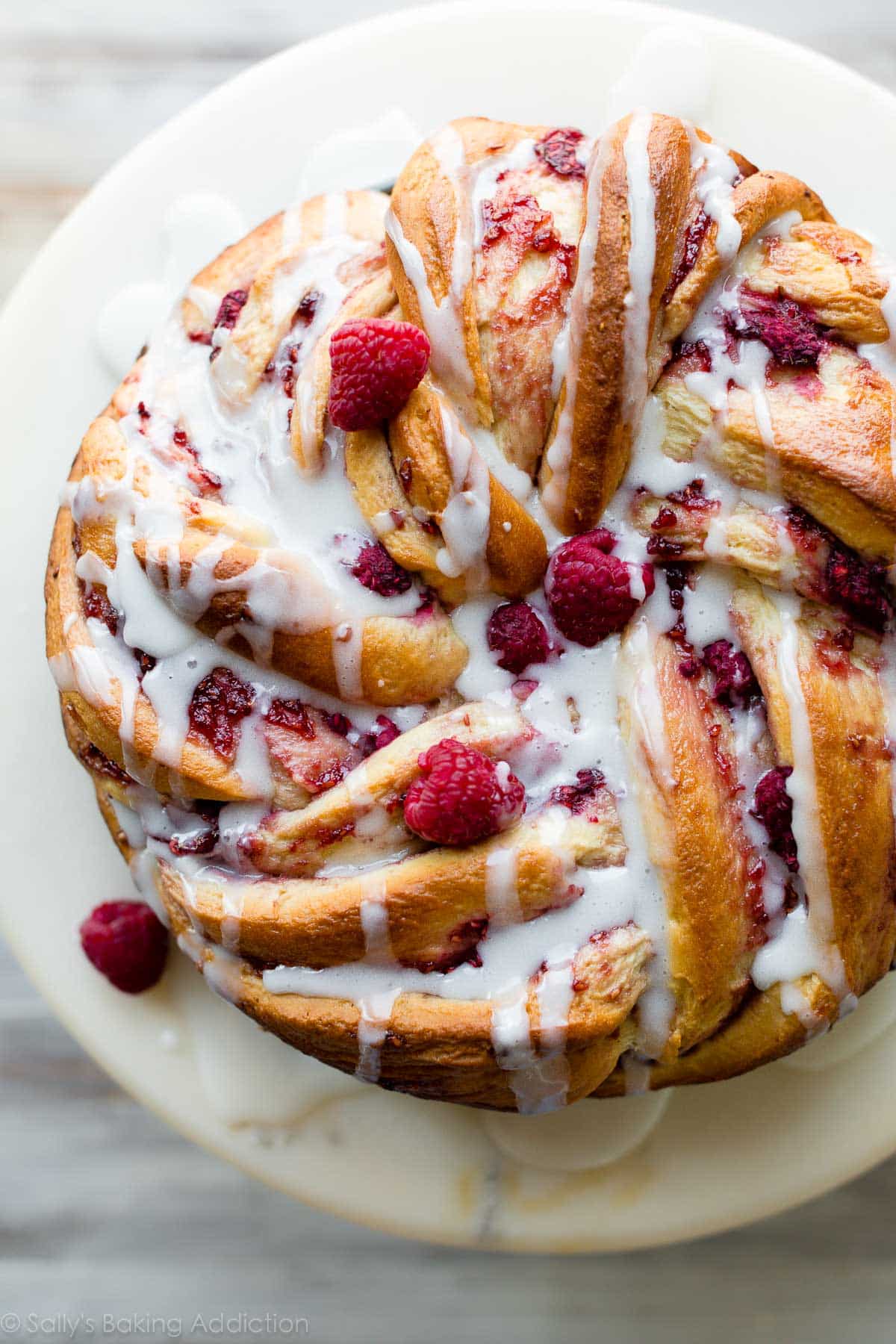
Some mornings are for granola bars and some mornings are for THIS.
Welcome to the billionth way to twist up dough and call it breakfast. But unlike all the other sweet rolls on my blog, this melt-in-your-mouth raspberry twist bread combines flaky, crispy, and fruity with buttery, soft, and sweet. A generous drizzle of creamy vanilla icing seeps into every delicious pocket. Sliced warm and served cake-style, this twist impresses everyone who’s lucky enough to steal a taste. It is, without a doubt, always the prettiest treat in my annual spread of Easter brunch recipes.
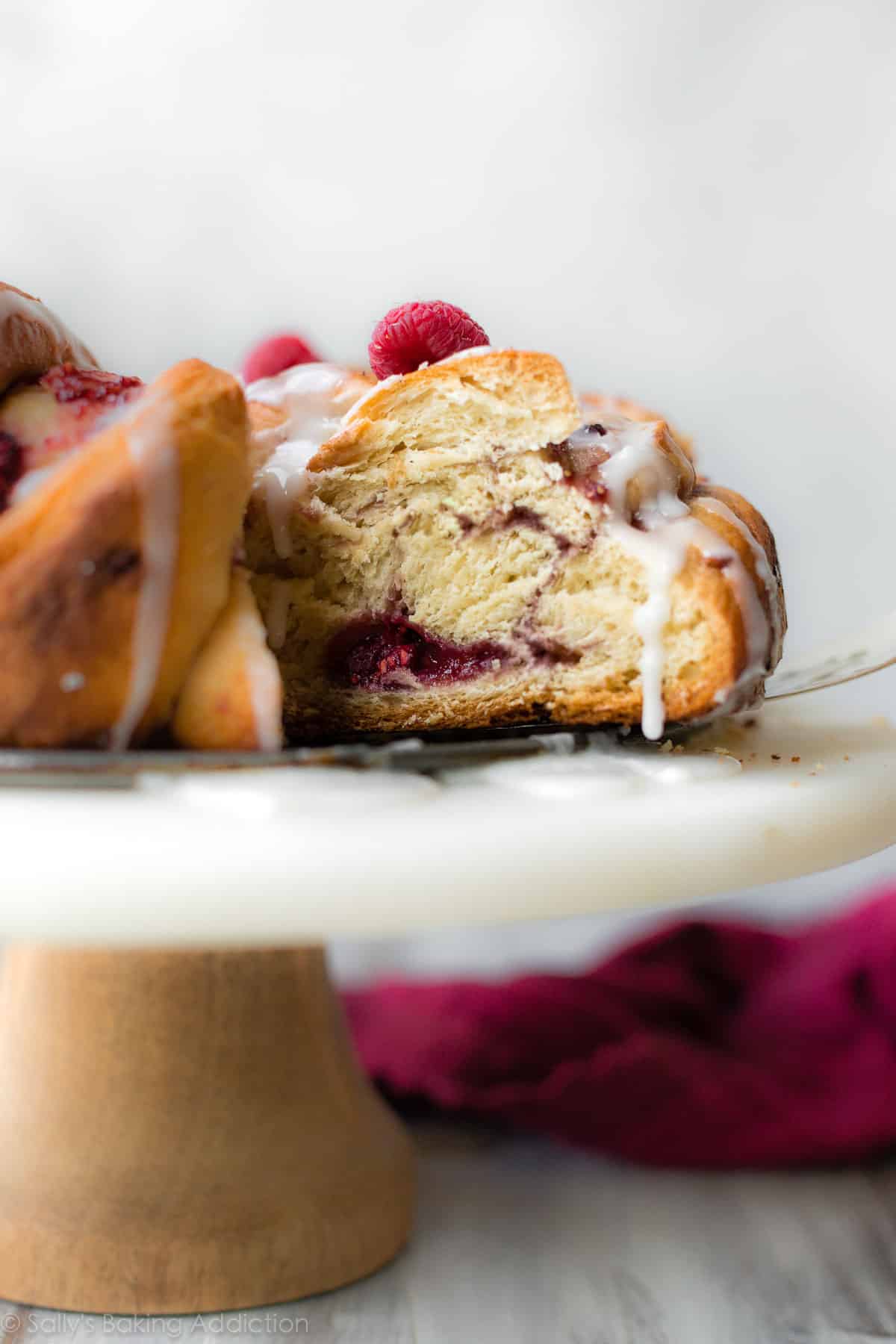
This breakfast bread is texture paradise channeling the flakiness of breakfast pastries but with half the work. How’s it possible? The secret is in the way we twist the dough. And even though that hypnotizing twist looks complicated to replicate, I swear it COULD NOT BE EASIER. And today I’m showing you how. Let’s start with a super quick video tutorial!
Video Tutorial: Raspberry Twist Bread
This Requires a Rich Dough
There are two main types of dough: lean dough and rich dough. We distinguish between the two based on the amount of fat present. Dough that’s prepared with less fat is called lean dough and yields crusty bread like homemade bagels and pizza dough. There’s less fat in these recipes, so they aren’t as soft. Rich dough incorporates fats like eggs, milk, and butter which guarantee a soft and supple dough, one that promises indulgent cinnamon rolls and breakfast pastries. For even more information about baking with yeast be sure to reference my Baking with Yeast Guide before you begin.
Raspberry Twist Bread Ingredients
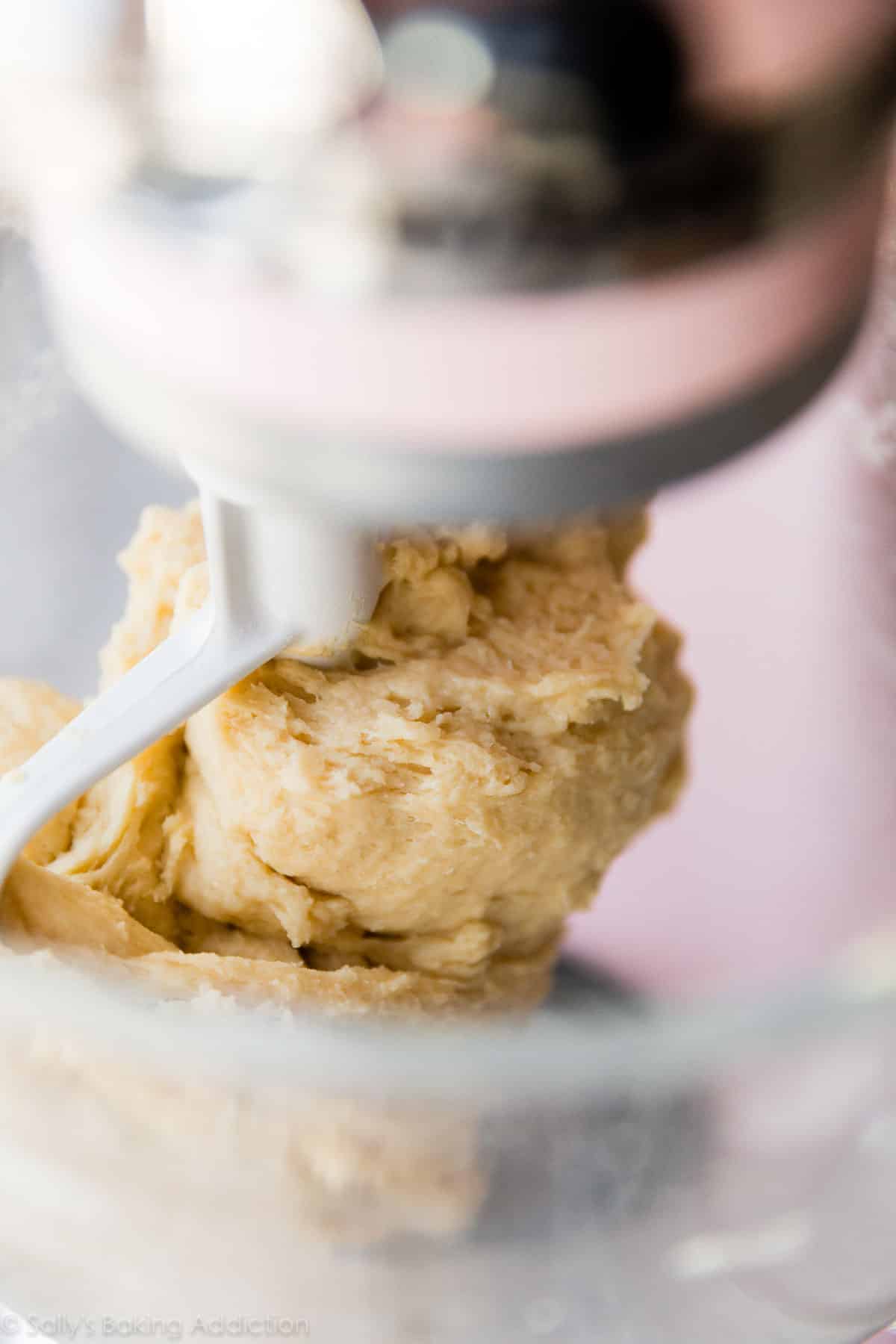
The dough we’re using for this raspberry bread is a scaled down version of my overnight cinnamon rolls and my Nutella babka. Use the same 7 ingredients that most rich dough requires.
- Milk: Liquid activates the yeast. For the softest twist bread, use whole milk. Nondairy or low fat milks work too, but whole milk produces phenomenal flavor and texture.
- Yeast: You can use active dry yeast or instant yeast. If using active dry yeast, your dough might take a little longer to rise. I recommend Platinum Yeast from Red Star, which is an instant yeast blended with natural dough improvers.
- Sugar: Sugar feeds the yeast, increases its activity, and tenderizes the dough.
- Eggs: 2 eggs provide structure, richness, and flavor.
- Butter: Butter promises tender bread and creates flaky layers. Make sure you are using room temperature butter.
- Salt: A little salt balances the sweetness.
- Flour: You can use all-purpose flour or bread flour in this recipe. All-purpose flour is convenient for most, but bread flour produces a chewier twist. There are no other changes to the recipe if you use bread flour.
For today’s raspberry bread, we’ll also use raspberry preserves or jam and fresh raspberries. If using frozen raspberries, do not thaw before using.
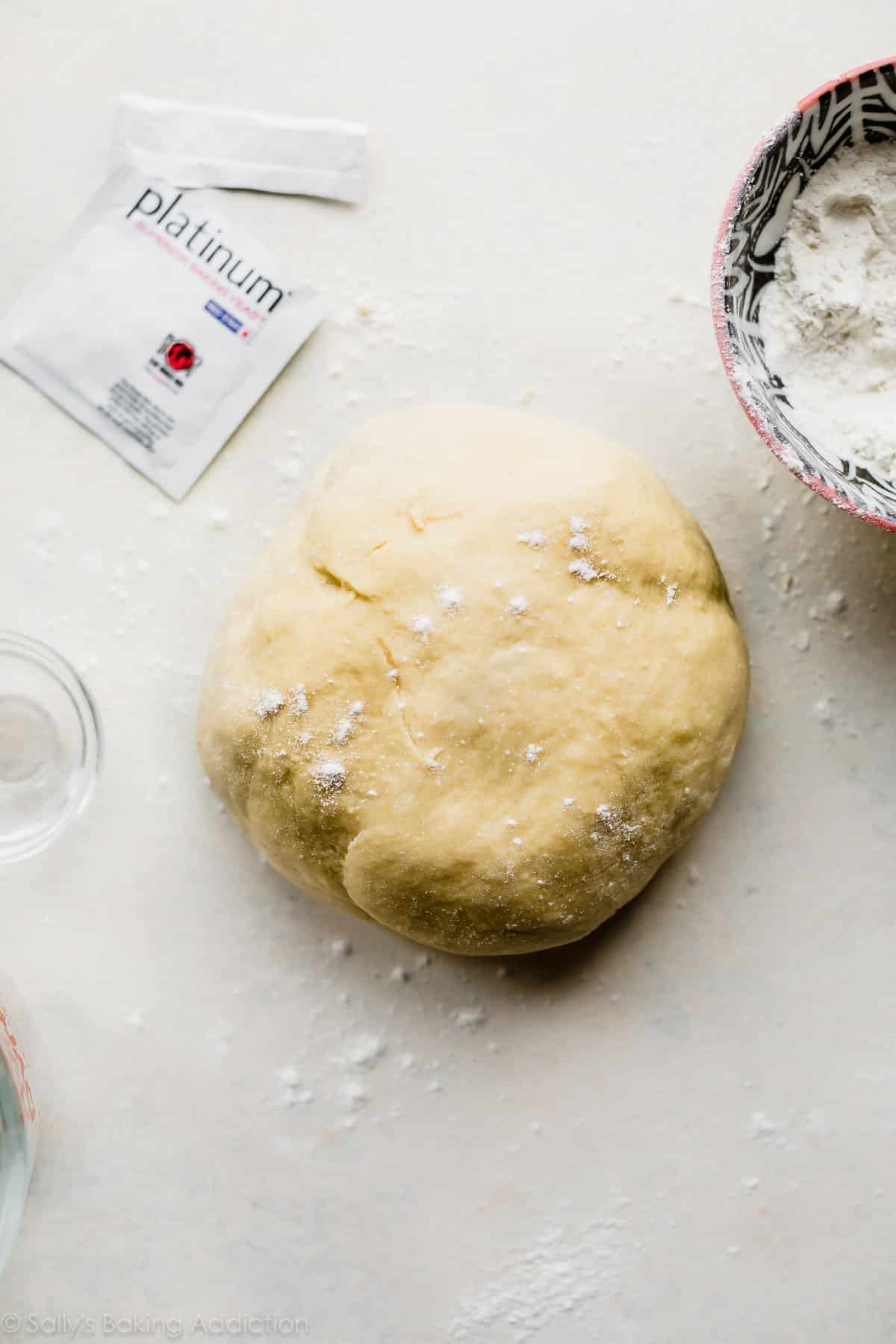
What Kind of Yeast to Use?
Behind every great bread dough is a great yeast—it’s simply the workhorse behind this whole recipe. Like usual, I use Platinum Yeast from Red Star. Platinum is an instant yeast that builds a stronger, taller, more voluminous dough. If you don’t have Platinum, Red Star Active Dry or Quick Rise Yeast works too! If using active-dry, your dough may take a little longer to rise.
Whether you’re a beginner baker or pro, it’s important to understand how yeast works. I urge you to read through my Baking with Yeast Guide where I answer many common yeast questions.
Baking with Yeast Guide
Reference this Baking with Yeast Guide whenever you work with baker’s yeast. I include practical answers to all of your common yeast questions.
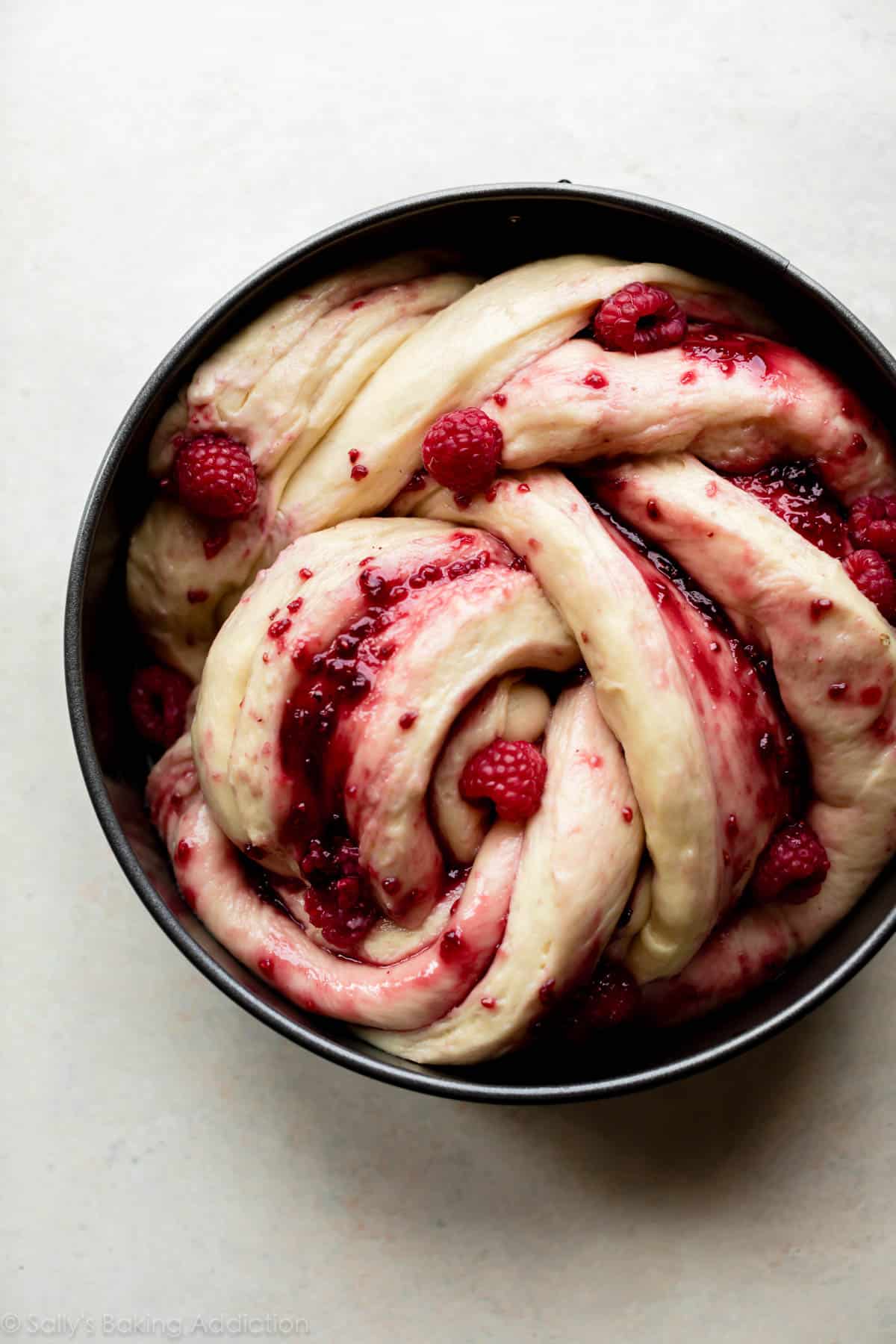
How to Make Raspberry Twist Bread
Our raspberry twist bread requires 2 rises:
- 1st rise: after the dough is made – 90 minutes
- 2nd rise: after the dough is shaped/twisted – 45 minutes
Here’s an overview of the steps:
- Make the dough.
- Knead the dough for 1 minute. Reference my How to Knead Dough video tutorial if you need extra help with this step.
- Cover the dough and let it rise. The dough rises in about 1-2 hours in a relatively warm environment.
- Punch down the dough to release the air. At this point you can freeze the dough and save for a raspberry twist bread sort of morning. Or you can shape into a rectangle, spread a thin layer of raspberry jam on top, roll it up cinnamon roll-style, then slice in half, twist, and coil into a circle. Remember Nutella babka? Similar to that.
- Shape the twist. Watch the video above before continuing with this step. The visual guide will help! The trick is to use a thin layer of jam. The more jam, the bigger mess you’ll need to clean up. I forgot to do it in the video, but for added raspberry goodness, dot a few fresh raspberries on top of the jam.
- Cover the twist and let it rise. Allow the dough to rise once again in a slightly warm environment until puffy, about 45 minutes. After this rise, it’ll be big, beautiful, and ready to bake. Sneak more raspberries in there if you can!
- Bake for 40-45 minutes until golden brown.
- Make the vanilla icing. Do this while the twist cools.
- Drizzle icing, slice, and serve warm.
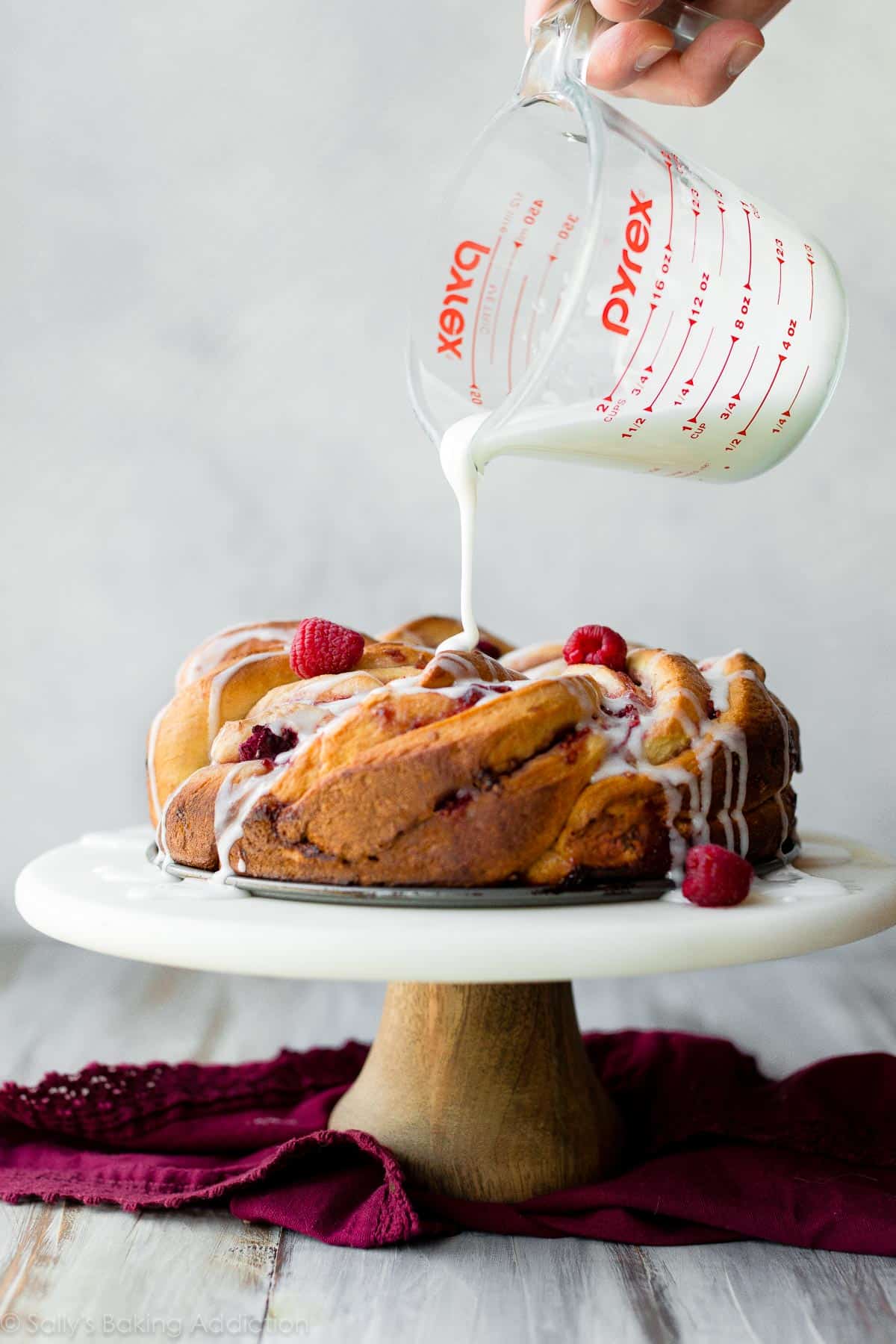
The Best Pan to Use
We’re baking the raspberry twist bread in a springform pan; its high sides confine the twist so it rises straight up instead of straight out. When finished baking, carefully remove the rim of the springform pan for seamless serving.
No springform pan? No problem! A cast iron skillet with tall sides could work too. We want to make sure the twist maintains its coiled shape!
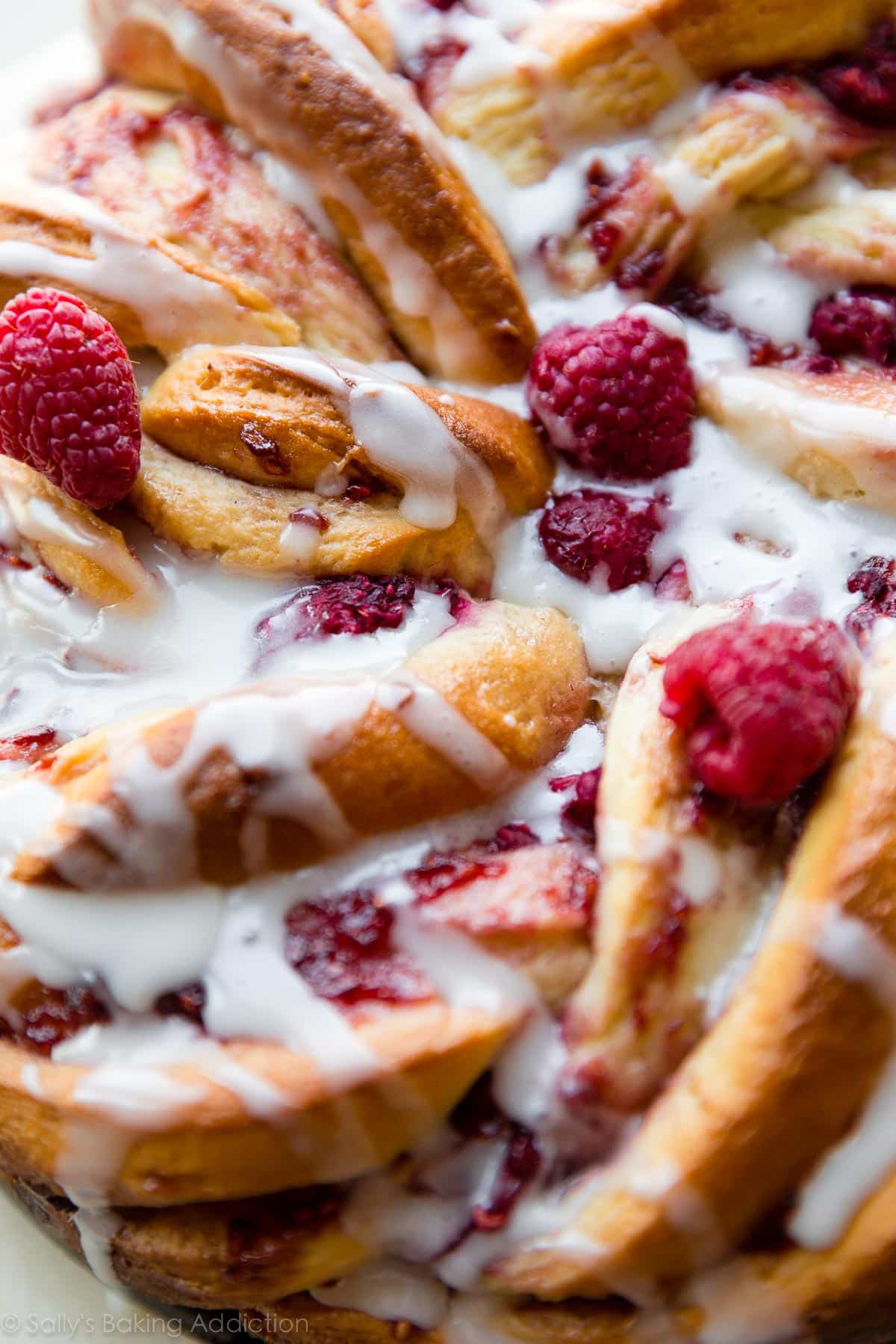
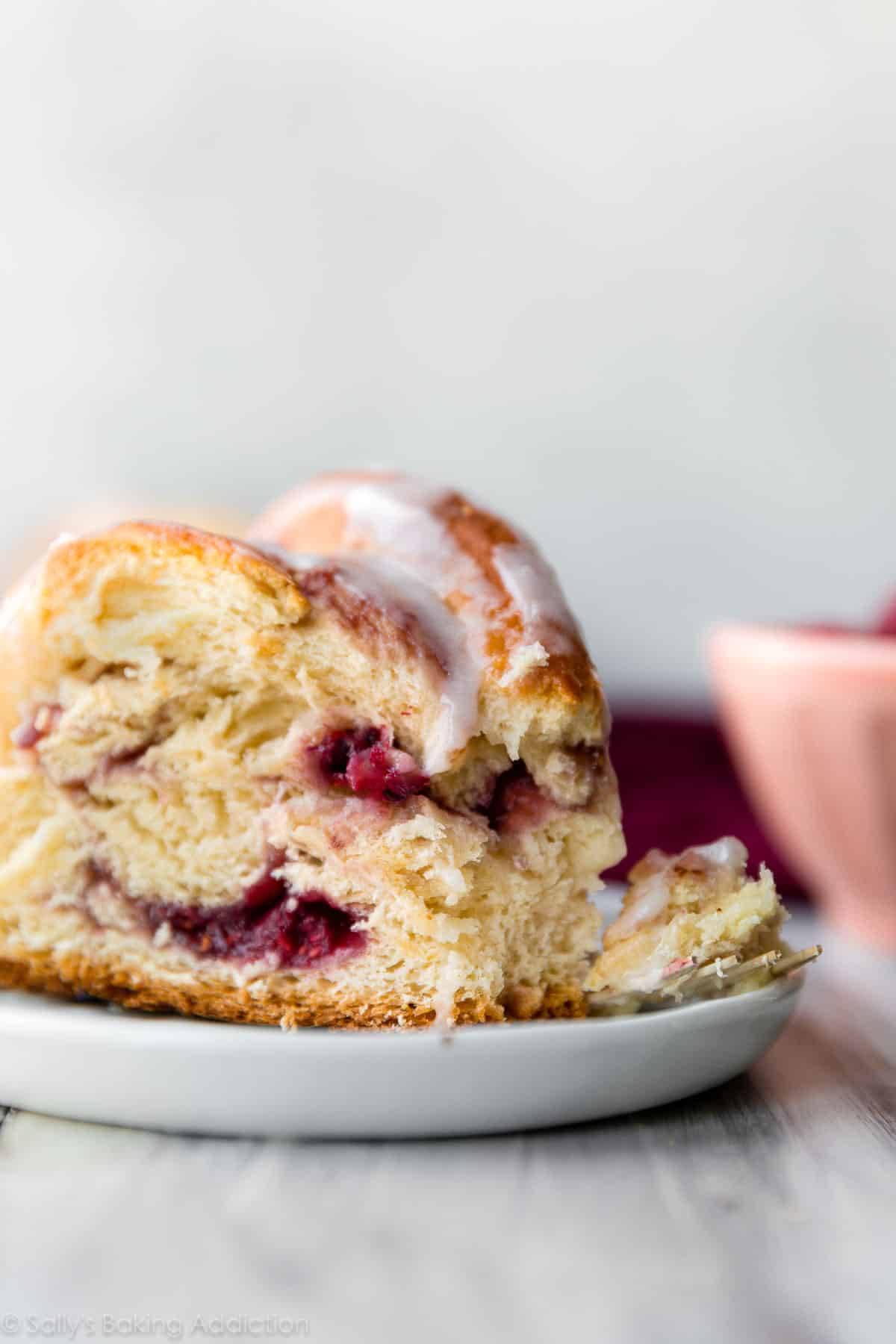
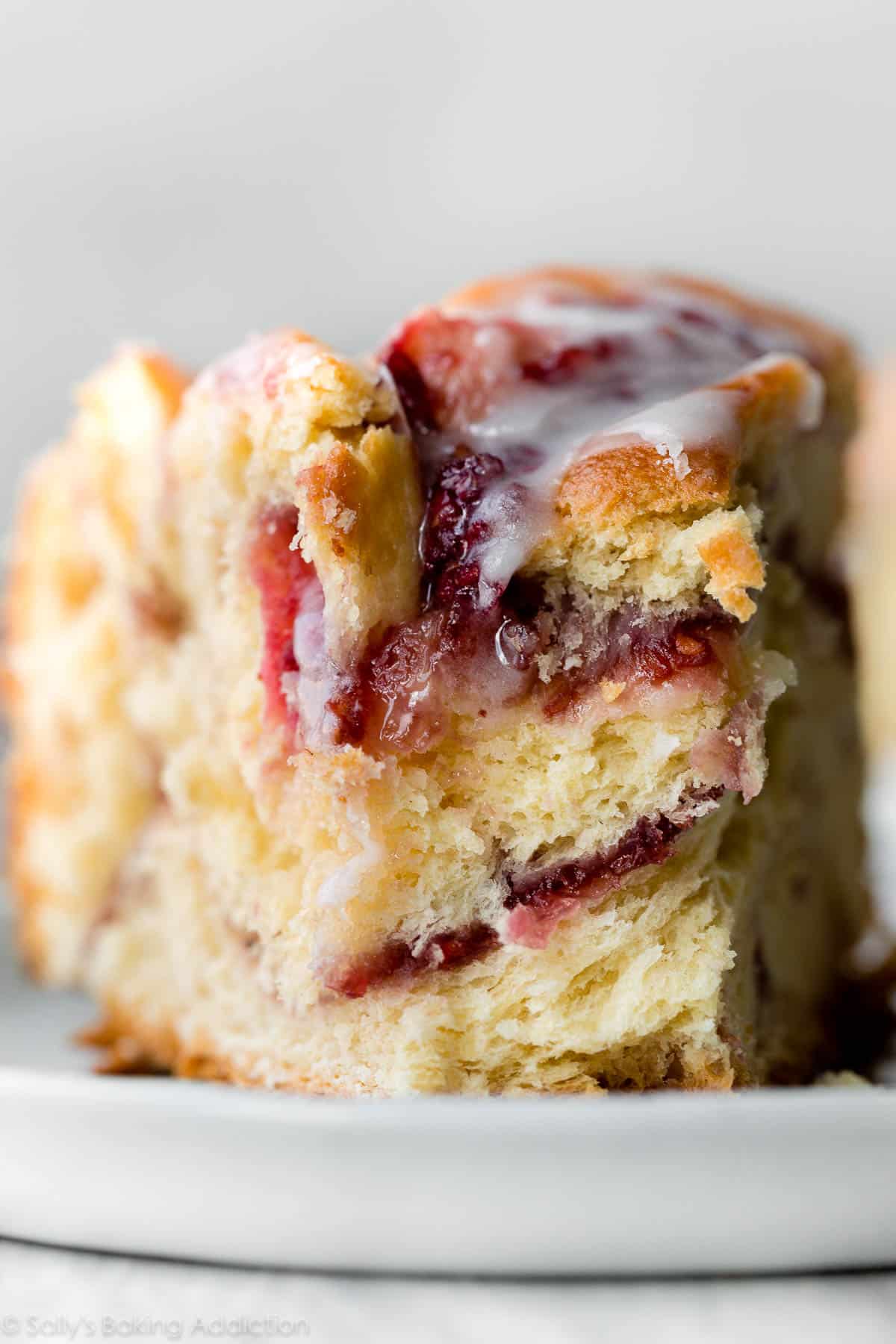
You’ll live for those pockets of raspberry between the flakes of buttery dough.
And for your next raspberry breakfast treat, try my raspberry sweet rolls!
More Indulgent Breakfast Treats
- Nutella Babka
- Star Bread
- Maple Pecan Sticky Buns
- Croissants
- Glazed Doughnuts
- Cinnamon Rolls
- Iced Raspberry Danish Braid

Raspberry Danish Twist Bread
- Prep Time: 3 hours, 15 minutes
- Cook Time: 45 minutes
- Total Time: 4 hours
- Yield: serves 8-10
- Category: Breakfast
- Method: Baking
- Cuisine: American
Description
This melt-in-your-mouth raspberry danish twist bread combines flaky and crispy, fluffy and soft, buttery and fruity. A generous drizzle of creamy vanilla icing seeps into every delicious pocket.
Ingredients
- 2 and 1/4 teaspoons Platinum Yeast from Red Star instant yeast* (1 standard packet)
- 3 Tablespoons granulated sugar
- 3/4 cup (180ml) whole milk
- 1/4 cup (4 Tablespoons; 56g) unsalted butter, softened to room temperature
- 2 large eggs
- 3 and 1/2 cups (438g) all-purpose flour (spooned & leveled), plus more as needed
- 1 teaspoon salt
- 3/4 cup (240g) raspberry preserves/jam
- optional: 1/2 cup (80g) fresh or frozen raspberries
Vanilla Icing
- 1 cup (120g) confectioners’ sugar
- 3 Tablespoons (45ml) heavy cream (or half-and-half or milk)
- 1/4 teaspoon pure vanilla extract
Instructions
- Make the dough: Place the yeast and sugar in the bowl of a stand mixer fitted with a dough hook or paddle attachment. Or, if you do not own a stand mixer, a regular large mixing bowl. Heat the milk on the stove or in the microwave until warm to touch, about 110°F (43°C). Pour warm milk on top of yeast/sugar. Whisk gently to combine, then loosely cover with a clean kitchen towel and allow to sit for 5-10 minutes. The mixture will be frothy after 5-10 minutes.
- If you do not have a mixer, you can mix by hand in this step. Add the butter, egg, flour, and salt. Beat on low speed for 4 minutes. Dough will be soft.
- Knead the dough: Keep the dough in the mixer and beat for an additional 5 full minutes, or knead by hand on a lightly floured surface for 5 full minutes. (If you’re new to bread-baking, my How to Knead Dough video tutorial can help here.) If the dough becomes too sticky during the kneading process, sprinkle 1 teaspoon of flour at a time on the dough or on the work surface/in the bowl to make a soft, slightly tacky dough. Do not add more flour than you need because you do not want a dry dough. After kneading, the dough should still feel a little soft. Poke it with your finger—if it slowly bounces back, your dough is ready to rise. You can also do a “windowpane test” to see if your dough has been kneaded long enough: tear off a small (roughly golfball-size) piece of dough and gently stretch it out until it’s thin enough for light to pass through it. Hold it up to a window or light. Does light pass through the stretched dough without the dough tearing first? If so, your dough has been kneaded long enough and is ready to rise. If not, keep kneading until it passes the windowpane test.
- 1st rise: Place the dough in a greased bowl (I use nonstick spray to grease) and cover with plastic wrap or aluminum foil. Place in a slightly warm environment to rise until doubled in size, about 90 minutes. For this warm spot, I suggest using the oven. Preheat to 200°F (93°C), then turn the oven off after preheating. Place the covered bowl inside and shut the oven door. This is your warm environment.
- Grease a 9-inch springform pan. Turn the risen dough out onto a lightly floured work surface, punch it down to release the air.
- Shape the twist & 2nd rise: Using a rolling pin, roll into a 12×16 inch rectangle. Spread jam evenly on top. If desired, dot randomly with raspberries. Tightly roll up the dough to form a 16-inch long log. Place the log on its seam. Using a sharp knife, cut the log in half lengthwise. I find a serrated knife works best. Criss-cross one half on top of the other half—forming an X. Twist the two together then coil into a circle. Carefully transfer to prepared springform pan. (I carefully pick it up using two flat spatulas!) Cover the twist with plastic wrap or aluminum foil, then allow to rise once again in a slightly warm environment until puffy, about 45 minutes.
- Adjust the oven rack to the lower third position then preheat oven to 350°F (177°C).
- Bake until golden brown, about 40-45 minutes. If you find the top is browning too quickly, tent with aluminum foil. Remove from the oven and allow to cool for 5 minutes. Meanwhile, make the vanilla icing by whisking the icing ingredients together until smooth.
- Carefully remove the rim of the springform pan. Drizzle with vanilla icing. Slice and serve. Cover and store leftovers in the refrigerator for up to 1 week.
Notes
- Make Ahead Instructions: You can freeze the baked and cooled twist bread for up to 3 months. Thaw at room temperature or overnight in the refrigerator and warm in the oven to your liking, then top with icing. The dough can be prepared through step 3, then after it has risen, punch it down to release the air, cover tightly, then place in the refrigerator for up to 2 days. Continue with step 5. To freeze the dough, prepare it through step 3. After it has risen, punch it down to release the air. Wrap in plastic wrap and place in a freezer-friendly container for up to 3 months. When ready to use, thaw the dough overnight in the refrigerator. Then let the dough sit at room temperature for about 30 minutes before continuing with step 5. (You may need to punch it down again if it has some air bubbles.)
- Special Tools (affiliate links): Stand Mixer or Glass Mixing Bowl and Silicone Spatula | 9-inch Springform Pan | Rolling Pin
- Yeast: I always use Platinum Yeast from Red Star, an instant yeast. If you don’t have Platinum, Red Star Active Dry or Quick Rise Yeast works too! If using active-dry, your dough may take a little longer to rise. Reference my Baking with Yeast Guide for answers to common yeast FAQs.












Reader Comments and Reviews
Wondering if second rise could be overnight in the fridge? Would love to be able to bake fresh in the morning but don’t want to be up at 0400 to do it!
Hi Mimi, we don’t recommend shaping the bread the night before as it will puff up too much overnight.
I would love to make this and add cardamom to the dough. How much cardamom would you suggest adding?
Hi Marleen, you could start small (say, 1/2 teaspoon or so) and then adjust more/less for future batches. Enjoy!
Why spring form pan? I am going to try this using a standard baking dish.
Hi Meg, do you have a baking dish or cast iron skillet with tall sides? We want to make sure the twist maintains its coiled shape!
Could you use the recipe to make smaller individual rolls?
Hi Kimberly, we have a recipe for individual Breakfast Pastries.
Would this work with a different fruit preserve? For example: peach preserves.
Hi Chrissy, we can’t imagine why not!
I have made this bread several times. It is a fabulous recipe. I am wondering how I might be able to make a smaller loaf. I do have a 6 inch springform pan. What would your recommendation be for this smaller size loaf?
Hi Melanie, we haven’t tested this recipe in a smaller pan, but what we would suggest is rather than halving (which can be tricky for yeasted recipes), to make the batch as is and split the dough into 2 6-inch pans. Bake time should be just a bit shorter so keep a close eye on it. Let us know if you try it!
Just made it, totally delicious will definitely be making it again…. It won’t last long.
I’ve made this and it’s exceptional! Sally, you never disappoint. I think I’m going to attempt to make a cinnamon roll version of this with a cream cheese glaze.
Very good. What is the best way to reheat it?
Hi Emma, you can reheat slices in the microwave or reheat the whole bread in the oven at 350 until warm.
Could this be doubled? I think it would make a fabulous Easter gift- and a bonus if I could make two at once! Thanks sally!
Hi Emily, For the best results, we recommend making 2 separate batches rather than doubling.
Can I use any brand of instant yeast?
Absolutely.
Interesting recipe that offers a large array of variations using the same dough and panning technique. I always prefer recipes with weight measurements. They are accurate.
One simple error in my opinion in the instructions. A contradiction of terms possibly. “…Beat on low speed.” Beat is usually a term in mixers as a higher speed than “Low”. I was a bit confused on using pe paddle or dough hook during the “Beating”. I used the paddle during the “Beating”, and the dough hook forr the “Kneading:
The dough, was spot on for this type of pastry.
I did not add the optional whole raspberries. Kind of wished I would have to add a touch more raspberry taste.
A tip. When rolling the dough to form the 16” log, Try lifting the back of the roll more than just rolling to avoid squeezing out the raspberry jam. I used a pastry scrapper-cutter to lift it into the pan.
Well worth trying.
This is one of my favorite recipes on your whole website! I’ve made it three times and each time I’ve rolled out out a thin layer of almond paste on the rolled out dough before spreading the raspberry and have gotten rave reviews every time!