

Here’s an in-depth look at common cake pan sizes & conversions, as well as how to adjust recipes or make substitutions based on the pan sizes you have. Free printable included.
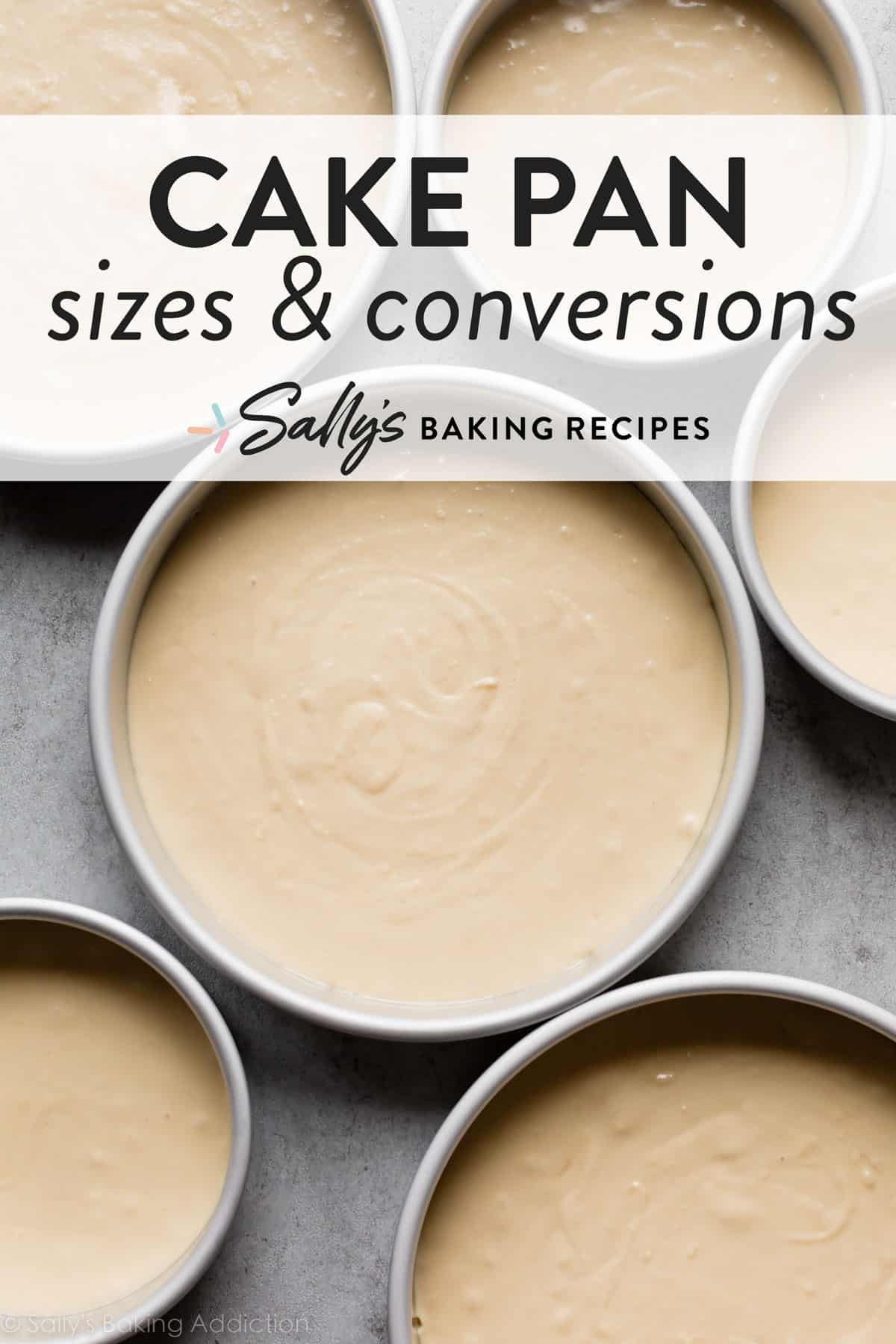
Unless you have a fully stocked kitchen with dozens of baking pans, chances are that you’ll run into a recipe where you don’t have the specific pan required. In fact, a cake pan substitution is the subject of most recipe questions I receive. I figured it would be easier to store all of this information in one convenient place for us all to reference.
Welcome to my Cake Pan Sizes & Conversions lesson!
This Post Includes:
- Common Baking Pan Measurements
- Cake Pans That Are Similar
- Substituting Cake Pans
- Adapting Cake Recipes to Fit Certain Pans
- Amount of Batter Some of My Cake Recipes Yield
Common Baking Pan Measurements
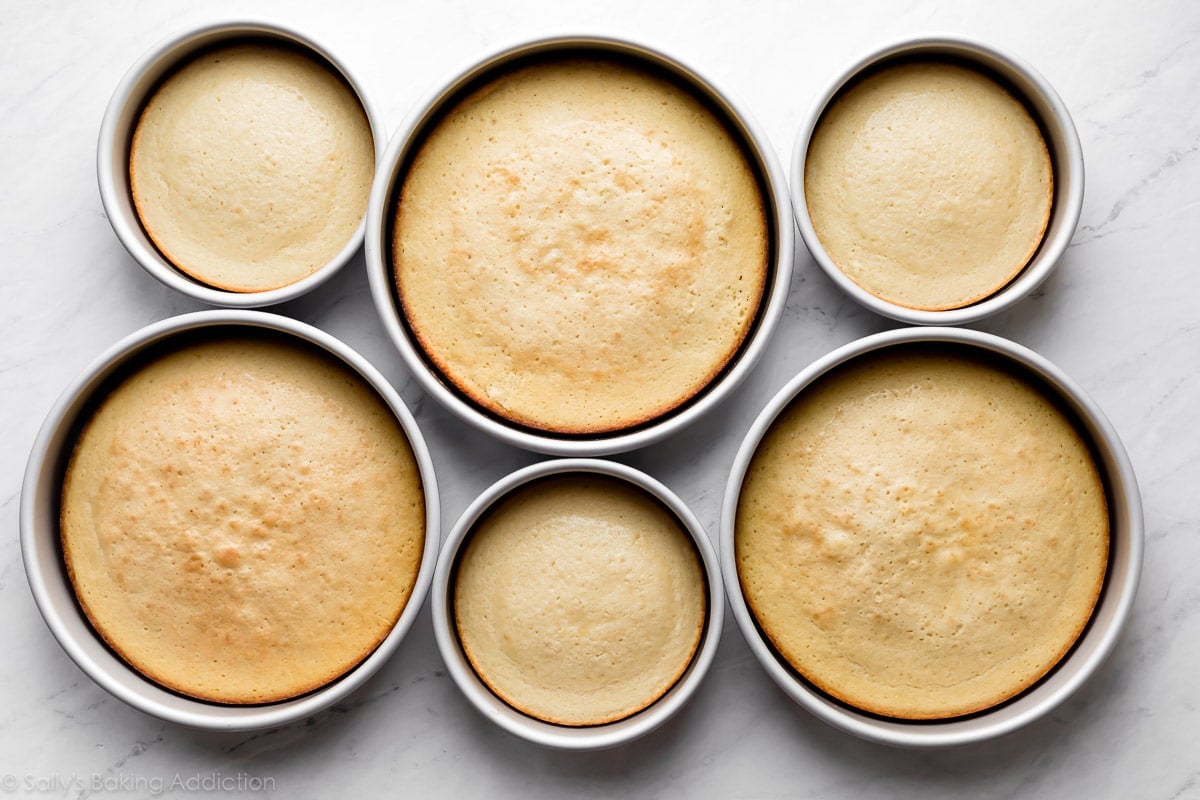
In this list, you’ll find common baking pan measurements and the volume of batter they hold. **The amount listed is the total amount of batter each pan holds, but you usually only fill cake pans halfway (unless otherwise noted in the recipe you are using).** Most measurements were taken at my home kitchen. Cross referenced with the always trusted Joy of Baking, as well.
Measurement Conversions
- 1 inch = 2.54cm
- 1 cup = 240ml
Round Pans:
6×2 inches (15 x 5cm) = 4 cups (960ml)
8×2 inches (20 x 5cm) = 6 cups (1.4 liters)
9×2 inches (23 x 5cm) = 8 cups (1.9 liters)
Square Pans:
8×2 inches square (20 x 5 cm) = 8 cups (1.9 liters)
9×2 inches square (23 x 5 cm) = 10 cups (2.4 liters)
10×2 inches square = (25 x 5 cm) = 12 cups (2.8 liters)
Rectangular Pans – 2 inch (5 cm) tall
11×7 inches (28 x 18 cm) = 10 cups (2.4 liters)
13×9 inches (33 x 23 cm) = 14 cups (3.3 liters)
Springform Pans:
9x 2.5 inches (23 x 6 cm) = 10 cups (2.4 liters)
10x 2.5 inches (25 x 6 cm) = 12 cups (2.8 liters)
Bundt Pan – volume varies because of various designs
10×3 inches (25 x 8 cm) = 10-12 cups (2.8 liters)
Tube Pan:
9×3 inches (23 x 8 cm) = 12 cups (2.8 liters)
Jelly Roll Pans – 1 inch (2.5 cm) tall
10×15 inches (27 x 39 cm) = 10 cups (2.4 liters)
12×17 inches (32 x 44 cm) = 12 cups (2.8 liters)
Loaf Pans – about 3 inches (8 cm) tall
8×4 inches (20 x 10 cm) = 4 cups (960ml)
9×5 inches (23 x 13 cm) = 8 cups (1.9 liters)
How to Determine the Volume Yourself
If you want to calculate a pan’s volume yourself, it’s so easy! Simply fill your pan with 1 cup of water at a time and count until it’s full. That’s what I do!
How Much Does This Pan Hold?
Here’s a helpful list of the most common baking pans and the volume of batter they hold, as well as which pans hold the same amount of batter. ***Keep in mind that the volumes listed mean you are filling the pan all the way to the top with batter, which isn’t ideal for baked goods. Unless otherwise noted, filling pans around 2/3 full is the best practice. This leaves room for rising.
- For example, my vanilla cake recipe yields around 8 cups of batter which I divide between 3 9×2 inch round cake pans. (Each hold 8 cups of batter!) Each cake layer has a little less than 3 cups batter each.
Use the following section to determine which baking pans can be substituted for others based on their full volume.
Round Pans
- 6×2-inch round pan holds 4 cups of batter, the same as an 8×4-inch loaf pan. Fun discovery! Cupcake recipes yielding 12–16 cupcakes fit wonderfully in three 6-inch cake pans. See my post for 6-inch cake recipes for more information.
- 8×2-inch round pan holds 6 cups of batter.
- 9×2-inch round pan holds 8 cups of batter, the same as an 8×2-inch square pan and a 9×5-inch loaf pan.
- 10×2-inch round pan holds 10–11 cups of batter, the same as a 9×2-inch square pan, 11×7-inch pan, 10×15-inch jelly roll pan, 10×3-inch Bundt pan, and a 9×2.5-inch springform pan.
Square Pans
- 8×2-inch square pan holds 8 cups of batter, the same as a 9×2-inch round pan and a 9×5-inch loaf pan.
- 9×2-inch square pan holds 10 cups of batter, the same as a 10×2-inch round pan, 11×7-inch pan, 9×2.5-inch springform pan, 10×3-inch Bundt pan, and a 10×15-inch jelly roll pan.
- 10×2-inch square pan holds 12 cups of batter, the same as a 12×17 inch jelly roll pan, 10×3-inch Bundt pan, 10×2.5-inch springform pan, and a 9-inch tube pan.
Rectangle Pans
- 11×7-inch pan holds 10 cups of batter, the same as a 10×2-inch round pan, 9×2-inch square pan, 9×2.5-inch springform pan, 10×3-inch Bundt pan, and a 10×15-inch jelly roll pan.
- 9×13-inch pan holds 14–16 cups of batter, essentially the same as two 9×2-inch round pans.
Jelly Roll Pans
- 10×15-inch jelly roll pan holds 10 cups of batter, the same as a 10×2-inch round pan, 9-inch square pan, 11×7-inch pan, 9×2.5-inch springform pan, 10×3-inch Bundt pan.
- 12×17-inch jelly roll pan holds 12 cups of batter, the same as a 10×2-inch square pan, 10-inch Bundt pan, 10×2.5-inch springform pan, and a 9-inch tube pan.
Bundt Pans
10-inch Bundt pans are the standard size. I actually have several that are 9.5 inches and most Bundt cake recipes still fit.
- 10-inch Bundt pan holds 10–12 cups of batter, the same as a 10×2-inch round pan (10 cups), 9×2-inch square pan (10 cups), 10×2-inch square pan (12 cups), 11×7-inch pan (10 cups), 10×15-inch jelly roll pan (10 cups), 12×17-inch jelly roll pan (12 cups), 9×2.5-inch springform pan (10 cups), 10×2.5-inch springform pan (12 cups) and a 9-inch tube pan (12 cups).
Tube Pans
9×3-inch tube pans are the standard size. I have a few that are 8 inches and 10 inches and most recipes using tube pans fit nicely in all.
- 9×3-inch tube pan holds 12 cups of batter, the same as a 10×2-inch square pan, 12×17-inch jelly roll pan, and a 10×2.5-inch springform pan.
Springform Pans
- 9×2.5-inch springform pan holds 10 cups of batter, the same as a 10×2-inch round pan, 9×2-inch square pan, 11×7-inch pan, a 10×15-inch jelly roll pan.
- 10×2.5-inch springform pan holds 12 cups of batter, the same as a 10×2-inch square pan, 12×17-inch jelly roll pan, and a 9×3-inch tube pan.
Loaf Pans
- 8×4-inch loaf pan holds 4 cups of batter, the same as a 6×2-inch round pan.
- 9×5-inch loaf pan holds 8 cups of batter, the same as a 9×2-inch round pan and an -inch square pan.
Substituting Cake Pans
I’m piggy-backing this one to the section above because there’s often a need to substitute different cake pans. If substituting a baking pan that holds the same amount of batter, be wary of the baking time because the dimensions of the baked good will change. Always keep your eye on the oven and begin checking for doneness earlier than the recipe states.
Remember, only fill pans about 1/2 to 2/3 full unless otherwise instructed in the recipe.
FREE PRINTABLE
Here is a free printable you can hang in your kitchen workspace: Volumes & Measurements of Common Baking Pans
Adapting Recipes to Fit Certain Cake Pans
Adapting recipes to fit the cake pans you have (or need) can often be complicated. While it’s always best to stick to the written recipe, sometimes you need to make adjustments and that’s where a little math can help.
1) Determine the volume your pan can hold. You can also determine the actual surface area of the pan in square inches. I actually used Food 52’s article by Alice Medrich on this subject to brush up on my math!
- For square and rectangle pans, multiply the length of the sides. For example, a 9×13-inch baking pan is 117 square inches. 9×13 = 117.
- For circle pans, determine the area by multiplying the radius squared by ?. (? = 3.14, the radius is half of the diameter, and squaring means multiplying a number by itself.) For example, the area of a 9-inch round pan is 63. The radius is 4.5. 4.5×4.5 = 20.25. Multiply that by 3.14 = 63.5.
2) After you determine the volume your pan can hold or its square inches, you can confidently make baking pan substitutions.
- For example, if a 9×13-inch pan is 117 square inches and a 9-inch round pan is 63.5 square inches, you can be confident that the volume from one 9×13-inch pan can fit into TWO 9-inch round pans (approximately 120 square inches total).
What if volumes and square inches don’t match up perfectly? You’ll have to adjust the recipe and this requires more math.
For example, if you want to adapt a 9-inch round cake to a 10-inch round cake, you’ll need to make adjustments. A 9-inch round cake pan is 63.5 square inches/holds 8 cups of batter. A 10-inch round cake pan is 78.5 square inches/holds 10–11 cups of batter. Without any adaptions, your 10-inch cake layers will be very thin. You’ll need to increase the batter by 25%.
The get this percentage, work with the cups or square inches. Subtract the number you have (8 cups) from the number you want (10 cups). Divide that (2 cups) by what you have (8 cups), then multiply by 100. (The universal way to find a percentage.) This equals 25%.
How to Avoid the Math
What works for me most of the time (because I don’t trust myself with too much math!) is to 1.5x the recipe or even making 2 batches of batter. (For best success, taste, and texture, I always recommend making separate full batches instead of doubling. Doubling risks over-mixing or under-mixing and could overwhelm your mixer.) Then, I use leftover batter to make a few cupcakes on the side to freeze for another time.
It’s better to have extra batter rather than not enough.
What About Eggs?
If you need part of an egg for when you are adjusting a recipe, crack the egg, beat it, and whatever percentage of that mixture you need. If you need 1/3 of an egg and you have 3 Tablespoons of beaten egg, use 1 Tablespoon. For a more precise amount and if you don’t trust your measurements, you can also weigh the beaten egg on a kitchen scale to determine exactly how much you need.
- Cover, refrigerate, and add any leftovers to your scrambled eggs the next morning!
Amount of Batter Some of My Cake Recipes Yield
The following list will help if you need to adjust my recipes for different pan sizes. These are the recipes I know and all measurements are approximate.
- Checkerboard Cake: about 8 cups
- Vanilla Naked Cake: about 8 cups
- Vanilla Cake: about 8 cups
- Confetti Cake: about 8 cups
- Chocolate Cake: about 6 cups
- White Cake: about 7 cups
- Banana Cake: about 6 cups
- Strawberry Cake: about 7 cups
- Snickerdoodle Cake: about 8 cups
- Coconut Cake: about 7–8 cups
- Red Velvet Cake: about 6–7 cups
- Lemon Cake: about 7 cups
My Favorite Baking Pans
I have a list for you! Stock your kitchen with these 8 best baking pans and these 10 cake baking & decorating tools.
The next time you have a question about cake pan sizes & conversions, I hope you find your answer in this post so you can confidently make the adjustments needed.













Reader Comments and Reviews
Thank you. I have wondered. Where was the PRINT BUTTON?
Hi Kris, If you look in the post above, there is a section called “Free Printable” with a link to a page you can print. Hope this helps!
This is great! Thank you! 👍
Would you say a 8×8 pan is equivalent of a 12x muffin tray? I am very interested in trying your marbled pound cake recipe, but would love to make it in a muffin tin (more serveable) if that’s possible?
Hi Elizabeth, you can use this marble loaf cake in muffin tins. It should make about 12. We’re unsure of the best bake time, though, so keep a close eye on them and use a toothpick to test for doneness. Enjoy!
That was a fraction workout for my brain!! I will know in 50 minutes if I calculated correctly increasing from 8″ to 9″!
This information was invaluable…thanks for posting!
Thank you so much for this very helpful summary! I live in Austria, so I am using the metric system, and calculating back and forth is just tiresome!
And I’d like to add another BIG thank-you for including metric measurements in all of your recipes, it makes baking your yummy creations so much easier!
all the best from Austria, evi
Thank you so much for this guide! I was wondering, can I keep pans of different sizes (for example, 4”, 6”, and 8”) in the oven at the same time? Will it affect the cakes when I pull out the smaller pan while the larger ones are still baking, especially with the oven door opening and letting air in?
Are there any tips I should keep in mind when baking different sized cakes together? Thank you so much!
Hi Selva, It should be ok to bake them together provided your oven has enough space that the pans aren’t touching. Some tips for doing this: 1) Don’t open the oven early. since cakes are most vulnerable to collapsing before their structure has set. Wait until the 4″ cake is genuinely close to done before opening the door.
2) Open the door, pull out the finished pan, and close it. Don’t leave the oven open while checking every cake with a toothpick.
3) Don’t slam the door. A gentle close avoids jarring cakes that are still rising. Hope this helps!
Thank you so much for your quick response!
Hi Sally,
Is there a specific reason that you only suggest cupcake recipes? Is the recipe more suited for small cakes in some way other than the volume of batter required?
Thanks
Post on pan size FANTASTIC!!!
Thank you so much
I need to make/bake a 10″ Carrot Cake (30 servings).
Please advise – how much batter should I put into the cake tin?
Hi! If I want to do 3 8inch cakes would I just divide the 6 cups of batter by 3. So each tier would get 2 cups of batter? Would this be the same cooking time as the 9inch vanilla cake
A wonderful reference. Thanks
I am single and I have some of the smaller Bundt pans so as not to waste making a huge cake. Is there a way to determine how much batter for the smaller pans.
Hi Lynn, If you want to calculate a pan’s volume yourself, it’s easy! Simply fill your pan with 1 cup of water at a time and count until it’s full.
Hi Sally,
I’m making a single layer 10×2 cake. How much frosting will I need to frost this cake?
Thanks for your help.
This information, and in one place, is so helpful! My problem now is knowing what size of pans I have. The dimensions aren’t printed on some of them, including ones that have angled sides, so the bottom surface area is smaller than higher up the sides. For those pans, would I measure from inside the bottom of the pan? Or from inside at the top of the pan? Or from some spot in the middle? Thank you!
Hi Jennifer, To determine your pan size, you can measure from inside edge to inside edge at the top opening. Hope this helps!
Is the information in the brackets a typo?.
For example, my vanilla cake recipe yields around 8 cups of batter which I divide between 3 9×2 inch round cake pans. (Each hold 8 cups of batter!) Each cake layer has a little less than 3 cups batter each.
Hi Vicki, that’s correct!
Any recommendations for the best way to double a cake with 3, 8 in layers? Should I just make two?
I was hoping to double the ingredients and make a bigger cake, but I’m concerned with all the size options and changes in baking time…
Hi Simone! Two batches of batter is the best way to ensure the best results. You could make two batches of batter and combine them to make a larger cake, but we’re unsure of bake times needed.
I keep sending my email for recipes it says success but I never get them why
Hi Anne, are you filling out this form? Be sure to check your junk and spam folders to be sure our e-mails aren’t going there instead of your inbox. If you’re still having trouble, you can send us an e-mail to sally@sallysbakingaddiction.com and we’d be happy to help!
Very helpful especially in my country where standard sizes of baking pans are often not available. How do I substitute a mini six inch loaf pan? I have only standard sizes.
Hi Sally,
I’d like to use a Bundt pan as that is all I ever use. Is this okay?
Hi Kimberly, we can help you if you let us know which recipe you’re looking to make.
So glad you mentioned filling pans 1/2 to 2/3 full. Not everyone is aware and it’s important. I’ve found 2/3 almost always works well, unless a recipe states something else.
Hi Sally, I’m going to be doubling my 9 X5 loaf pan recipes & making some pound cakes in 16 x 4 x 4 inch pans. What baking temperature and time do you think would work best? I was thinking possibly 325 degrees for 50-60 min.??? Thank you
Hi sally I’m loving your website & your recipes. Could you please tell me if I use a heart shaped pan would it be the same recipe size as a round pan of the same size. Thank you
Hi Julie, If the heart shape is 9 inches at the widest part, it would likely hold less batter than a 9 inch round pan. Sometimes, when you purchase the pans, the packaging will tell you how many cups of batter to use. When in doubt, simply fill the pans 2/3 full of whatever cake batter you are using and bake until a toothpick inserted in the cake comes out clean.
This was so helpful! I have been having trouble figuring out the sizes and what are my options. I bought smaller bunt pans from Williams and Sonoma and have been struggling with how much batter to use.
So glad this is helpful, Alexandria!
Wow. Just wow! The recipe information is so detailed and has given me the confidence to try to bake a cake from scratch! A friend brought the lemon blue berry cake for a dinner party at my home and it was amazing! I asked if she would bake another for a family birthday and she was not going to be in town so she sent me the recipe. I read it carefully and said, I can do this! We will see how it works out. I’ve prepped as much as I can today and will bake the cake tomorrow to bring to a dinner party! The instructions are so detailed and answered so many of my questions. Wish me luck!! I have not baked anything from scratch in probably 40 years—because I know what I am good at! . I hope this is a new adventure as I LOVE to cook!
Wow. Just wow! The information provided, so detailed and has given me the confidence to bake a cake from scratch. A friend brought the lemon blue berry cake for a dinner party at my home and it was amazing! I asked if she would bake another for a family birthday and she was not going to be in town so she sent me the recipe. I read it carefully and said, I can do this! We will see how it works out. I’ve prepped as much as I can today and will bake the cake tomorrow to bring to a dinner party! The instructed are so detailed and answered so many of my questions. Wish me luck!! I hope to become a baker!
If I’ve followed correctly, I should be able to use an 8″ square for my quiche that I usually bake in a 9″ round pan. Yes?
Hi Diane, yes, that should be fine!
Thank you so much for all the helpful scaling information! Although total volumes differ, your scaling math suggests that a 9×5 loaf pan has about half the bottom surface area as a 9×9 square cake pan (45 vs. 81). If you want to make less cake for a smaller group, would you advise trying to bake half of a recipe designed for a 9×9 square cake pan in a 9×5 loaf pan? Or, given your experience baking differing batters at different levels (less than 1/2 to 2/3 full) in differing pans, would you expect the higher walls of the loaf pan to change the way the batter inside bakes significantly? Would it be safer to attempt to build an interior wall with aluminum foil to change the 9×9 pan to a 9×5?
I’m going to buy some of the Fat Daddio pans. I prefer to make square cakes vs round, so will be buying 8x8x2 pans.
Other than tradition, is there a reason most cakes are done in round pans? I read elsewhere that square pans for cakes risk dry corners – is that true?
Hi Elise! Square cakes do lend to drying out since the corners bake faster.
This is awesome. Thanks so much for this. I have been baking for 60 years.
This will be so so helpful!!!!
I live your recipes.
Happy Baking