

Here you’ll find a full recipe and cake decorating video tutorial for a DIY homemade wedding cake. This simply decorated and elegant vanilla wedding cake has 2 tiers and comes with full assembly instructions. With the help of this carefully detailed post, this wedding cake recipe is perfectly manageable for any home baker.
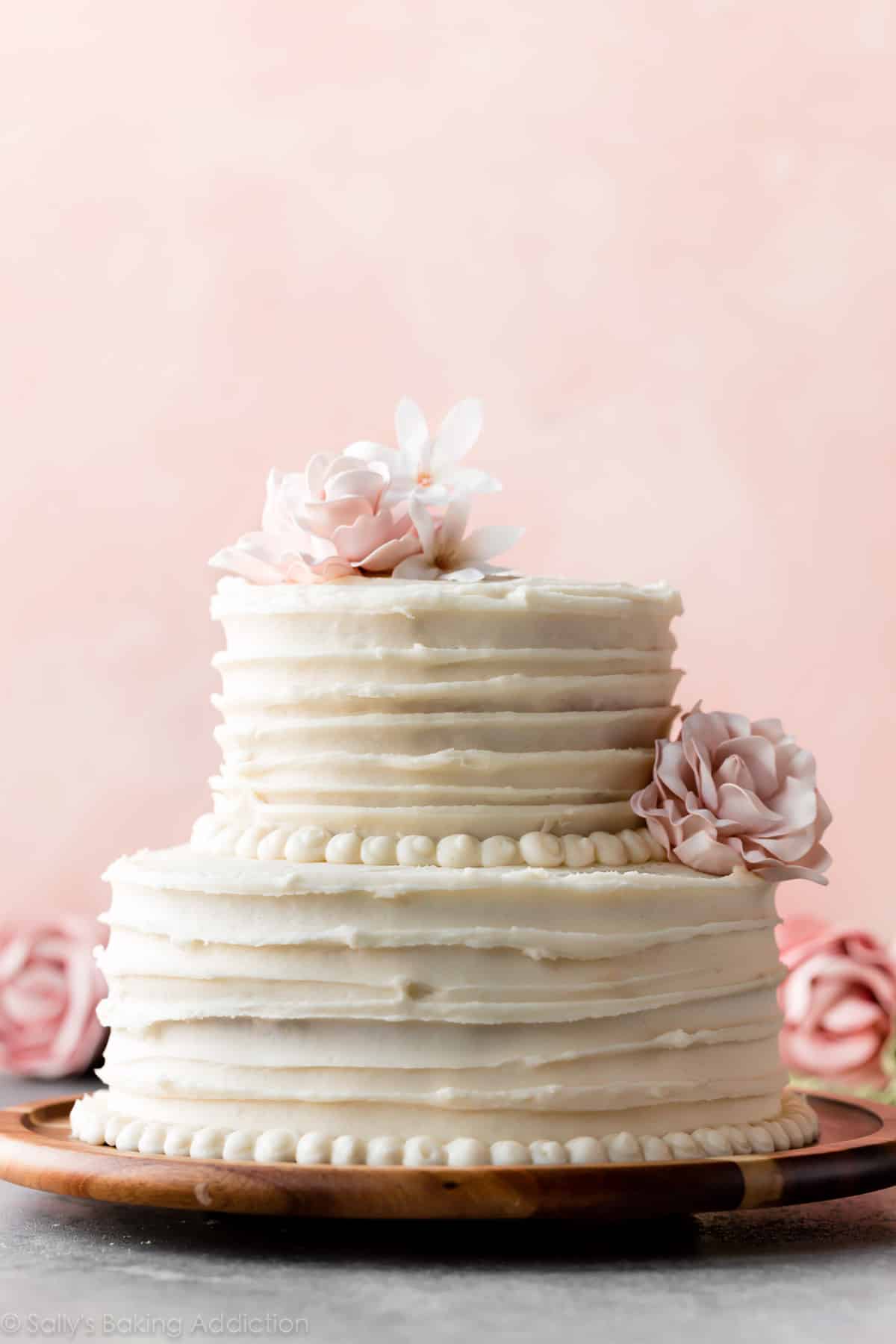
By the request of many readers, let me present you with a homemade 2 tier wedding cake recipe. Adapted from my trusted vanilla cake and 6 inch cake recipes, this from-scratch wedding dessert is not only beautiful—it tastes remarkable, too.
(Isn’t that what counts?)
Fully equipped with complete details and recipe instructions to make this one-of-a-kind dessert, you will wow the happy couple and wedding guests alike. This post has it all.
This DIY Homemade Wedding Cake Is:
- Completely from-scratch
- Manageable for any home baker
- Simple, yet elegant—rustic chic meets traditional
- Complete with a full list of helpful kitchen tools
- Perfect for a small wedding (approximately 30-35 people)
- Wonderful for a larger wedding if other dessert options are available
How to Make a DIY Homemade Wedding Cake
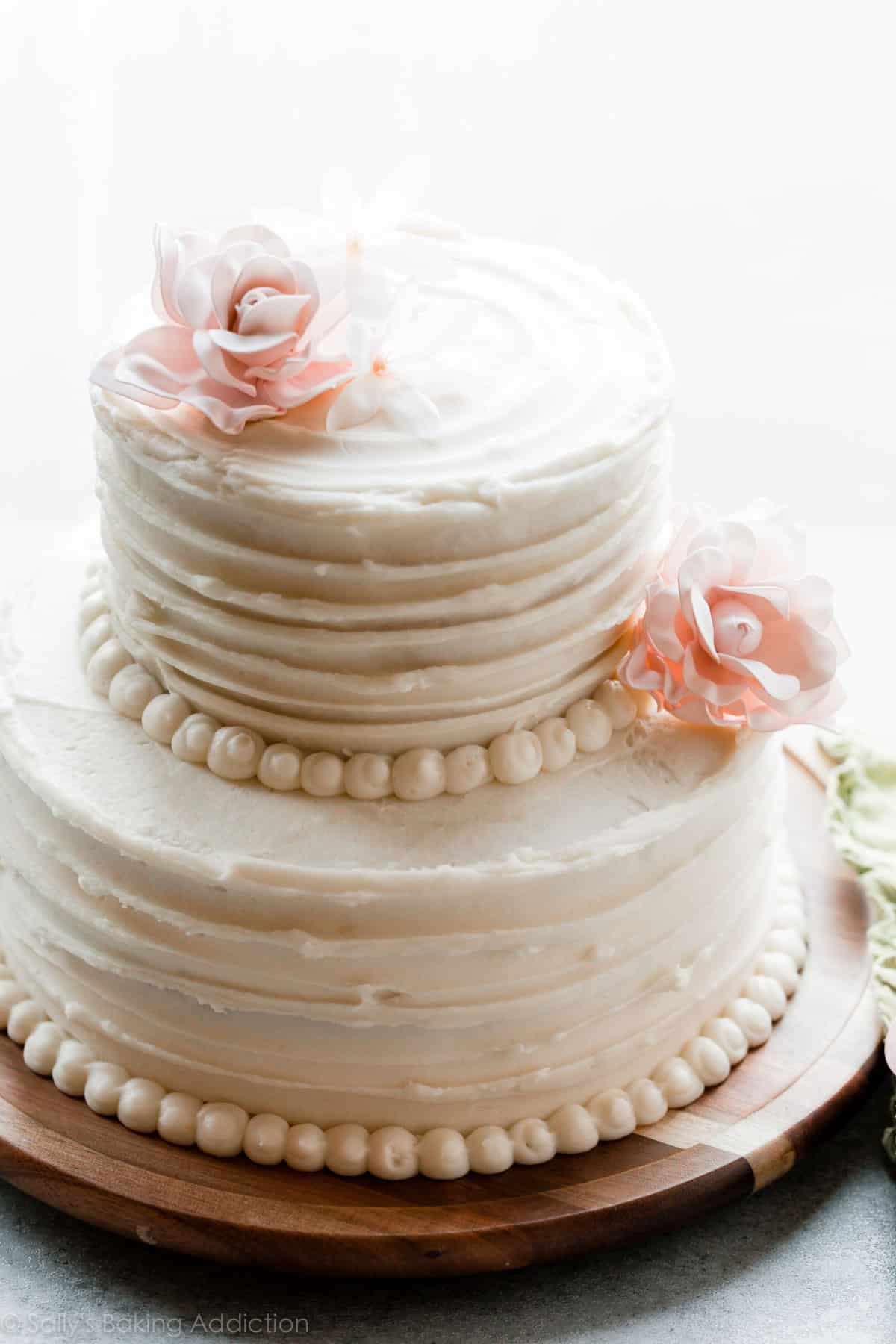
This is a 2 tier wedding cake. Both tiers are buttery, soft, and moist. In lieu of traditional fondant, this homemade wedding cake recipe uses my vanilla buttercream, but in a higher quantity. To avoid (1) overwhelming your mixer with excess cake batter and (2) over-mixing or under-mixing the batter, make each cake separately.
- Make each batch of frosting separately too.
Unless you have extra oven(s) or oven space, prepare the cake batters and bake the layer cakes one at a time. Cool the cakes completely before assembling and decorating, which I cover in a separate section below.
Same Ingredients for Both Tiers
Both cakes use the same exact ingredients and each has a special job, so I do not recommend substitutions. Use sugar, cake flour, egg(s), extra egg whites, sour cream, whole milk, and proper room temperature butter. (Among a few other ingredients.) If needed, use this cake flour substitute. Here are recipes that use leftover egg yolks.
- 2-3 batches of lemon curd, which uses egg yolks, would be fantastic as a filling between these cake layers.
The bottom cake is my vanilla cake recipe, but I swap buttermilk for whole milk and sour cream. I do this so you don’t need any varying ingredients for both tiers. (Because the top tier uses whole milk and sour cream.) Sure, you could use buttermilk to replace both the whole milk and sour cream in the 6 inch cake, but whole milk and sour cream are more readily available to most than buttermilk.
Other Flavor Options
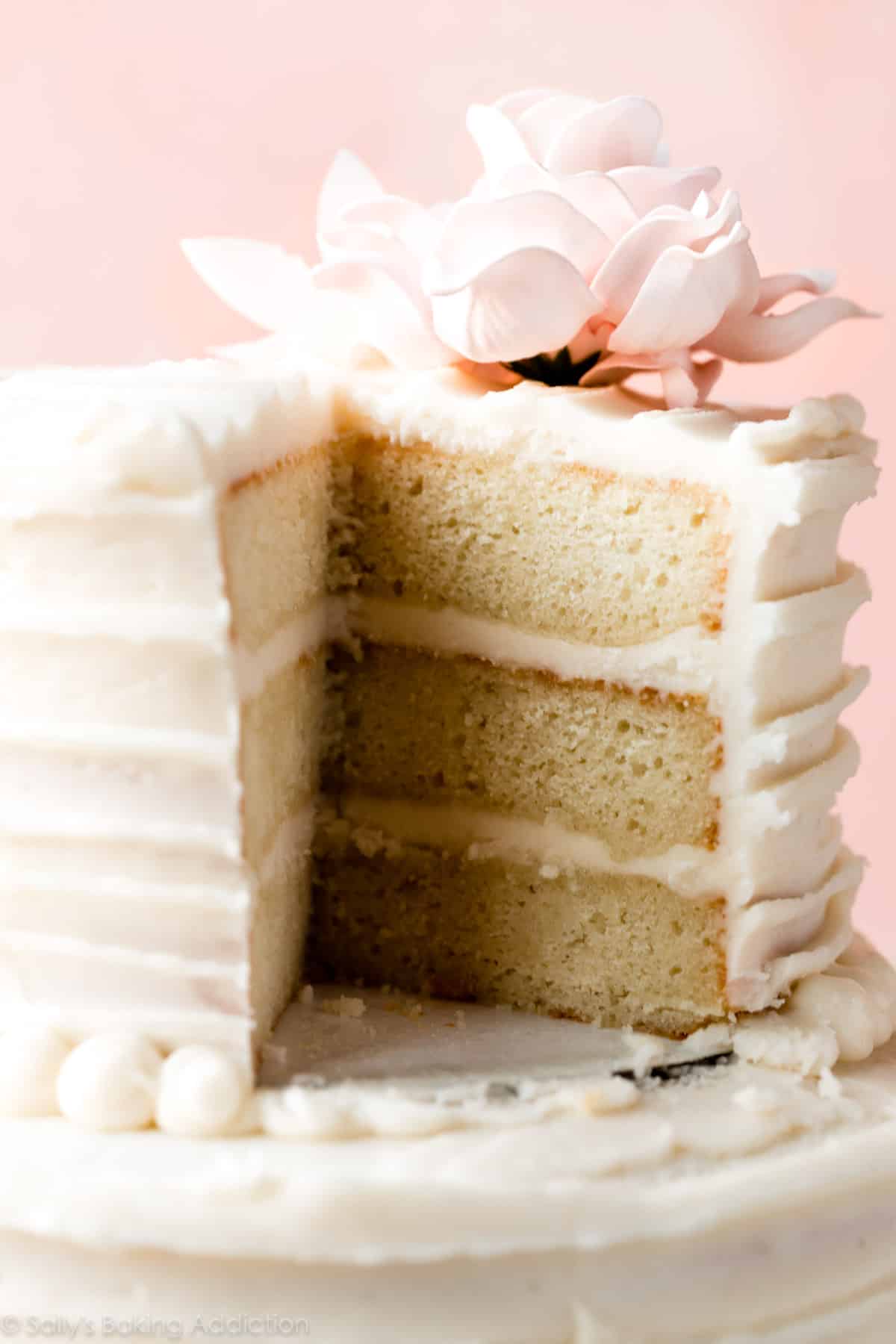
This is vanilla flavored, which is a classic choice to please a variety of wedding guests. You can have fun with frostings, fillings, and flavorings. Here are 5 other cake flavor options:
- Carrot Cake: Use my carrot cake recipe for the bottom tier and make a half batch of the batter for the top tier. Use the same 6 inch cake baking instructions described below.
- Red Velvet Cake: Use my red velvet cake recipe for the bottom tier. You can divide between 3 9-inch cake pans as instructed in the recipe notes. Use my red velvet cupcakes batter for the 6 inch cake. Use the same 6 inch cake baking instructions described below.
- Lemon Cake: Use my lemon cake recipe for the bottom tier. Use my lemon cupcakes batter for the 6 inch cake. Use the same 6 inch cake baking instructions described below.
- Marble Cake: Use my zebra cake for the bottom tier. Use my smaller zebra cake recipe (see this 1st birthday cake) for the 6 inch cake on top.
- Chocolate Chip: After adding the milk in both batters, fold 1 and 1/2 cups (270g) mini chocolate chips into the 9-inch vanilla cake batter and 1 cup (180g) of mini chocolate chips into the 6-inch vanilla cake batter. Regular size chocolate chips would be fine, but mini chocolate chips mean more in each bite.
*These are the only flavors I’ve tested with tiers. At this time, I don’t have a sturdy enough chocolate version to use as the bottom tier.
Want to mix and match flavors? Stick with the vanilla cake on the bottom (or other flavors listed above) and use any cupcake recipes listed in my 6 inch cakes post for the top tier. As explained in that post, cupcake batter yielding between 12-15 cupcakes makes the perfect 3 layer 6 inch cake.
Filling ideas: The filling in my cake is vanilla buttercream, but feel free to use other frosting flavors if desired. You can add extracts to the frosting such as almond, lemon, orange, or coconut. (Start with 1 teaspoon, taste, then add more to taste.) You can even mix a few Tablespoons of raspberry jam into the vanilla buttercream for the filling or use raspberry cake filling.
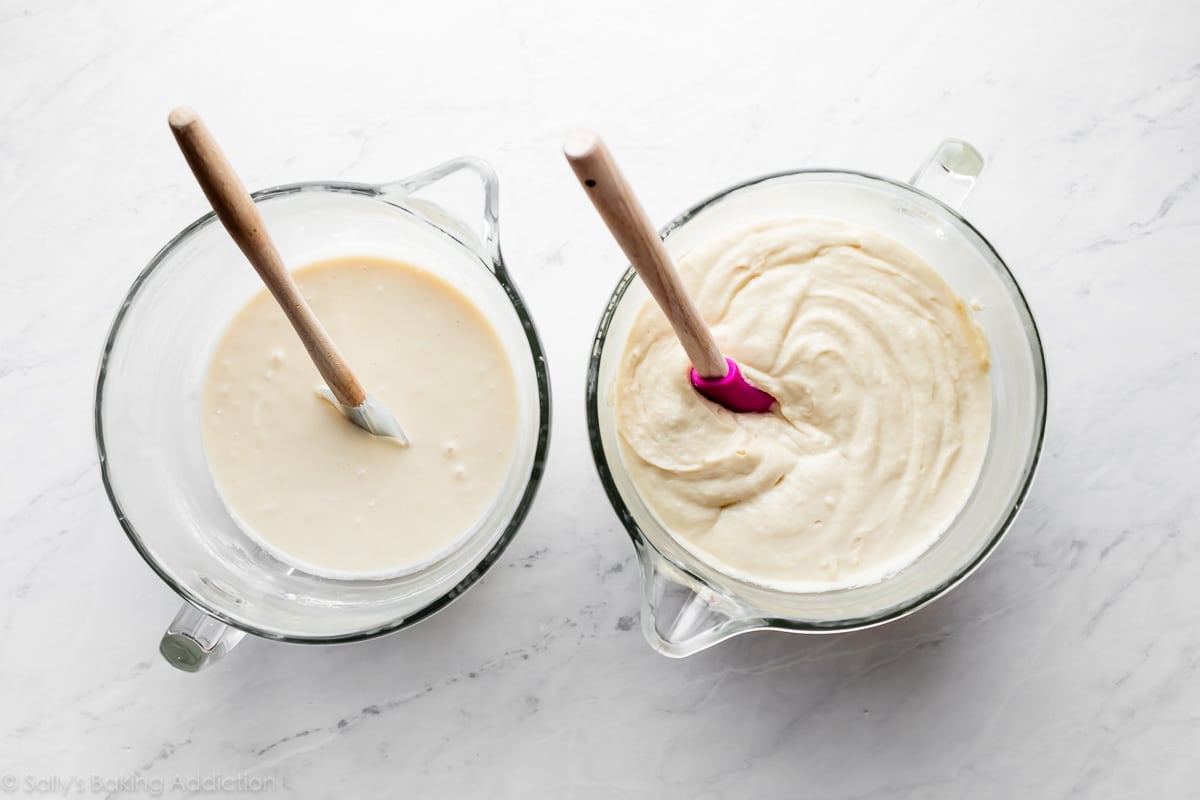
The 6-inch cake batter (left above) is light and creamy. The 9-inch cake batter (right above) is thicker because the bottom tier is a bit denser (for extra support).
Prepare the Wedding Cake Pans
Always line your round pans with parchment paper rounds before adding the batter. Begin by lightly spraying the bottoms and sides of each with nonstick spray or greasing with butter. Add a parchment paper round, then grease the round as well. Parchment paper rounds aren’t something special you need to buy. Simply trace the bottom of your cake pan on regular parchment paper and cut into rounds. Parchment paper rounds guarantee the cooled cakes will seamlessly release from the pans.
See my 10 Cake Baking Tips post for all my advice on baking the BEST cakes.
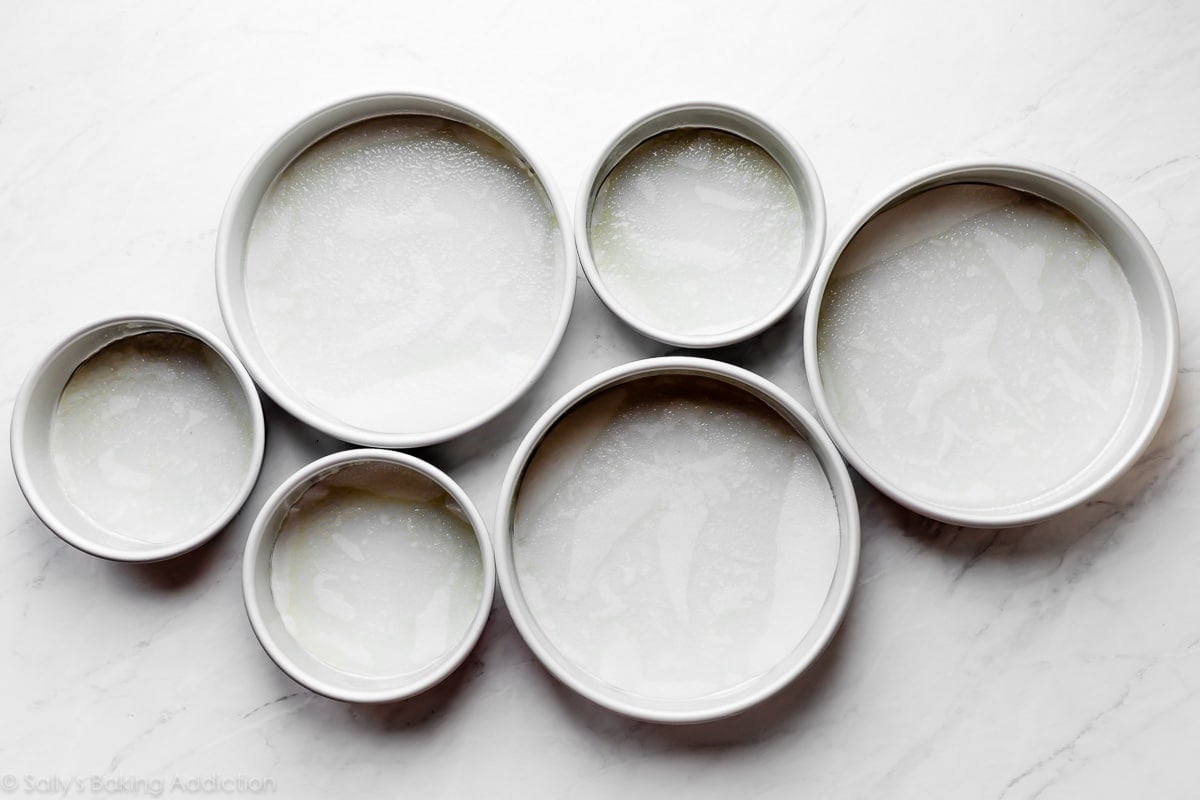
Other Cake Pan Sizes
This recipe uses one 9-inch 3 layer cake and one 6-inch 3 layer cake. The 9-inch cake is 8-9 cups of batter and the 6-inch cake is 4 cups of batter. If you need to substitute other size cake pans, see my Cake Pan Sizes & Conversions post to determine the appropriate amount of batter you need for your desired cake pans.
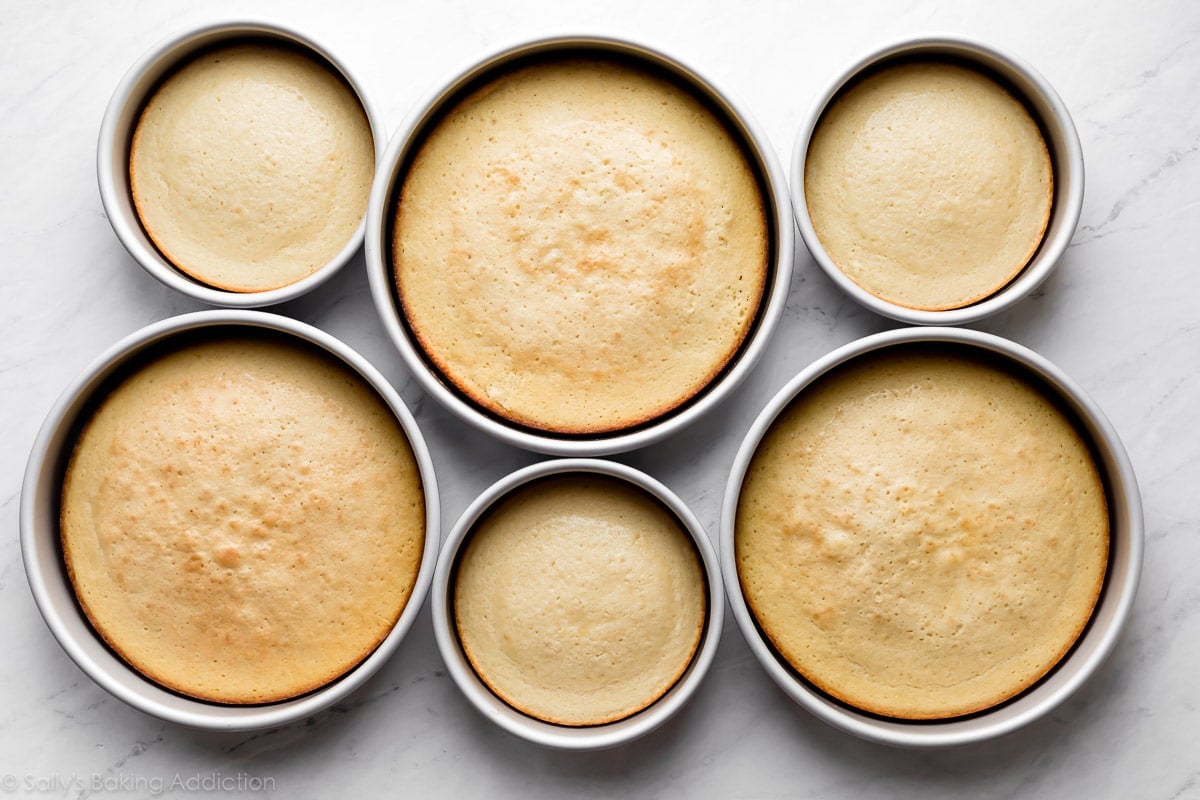
Wedding Cake Video Tutorial (Decorating)
Give the video a few seconds to load right below this text. It’s a faded horizontal image of the cake. Click on the play button in the center to play it. Make sure any ad blockers are temporarily paused on your browser.
How to Assemble & Decorate a Homemade Wedding Cake
Assembling
You are literally making 2 completely separate cakes and placing one on top of the other. For guaranteed support and stability, place 4 cake dowels in the bottom tier. Cake dowels are sticks that will support the top tier. You’ll have to measure and cut the dowels so they are flush with the surface of the bottom cake. Place the small tier on top. A 6-inch cake board, which I describe next, is crucial between the tiers for added support.
*As shown in the video tutorial, crumb coat and decorate both cakes separately before layering the tiers. Decorating instructions are next.
Decorating
Decorate both tiers on cake boards. You can remove the cake board from the bottom tier, if desired, before placing the cake onto a serving platter or cake stand. (This can be tricky!) However, I usually just leave it. A piped frosting border around the bottom of the cake hides it. Do not remove the cake board from the bottom of the top tier. The cake board sits between both tiers for added support and stability and ensures that when you cut into the top tier, the whole cake doesn’t sink down.
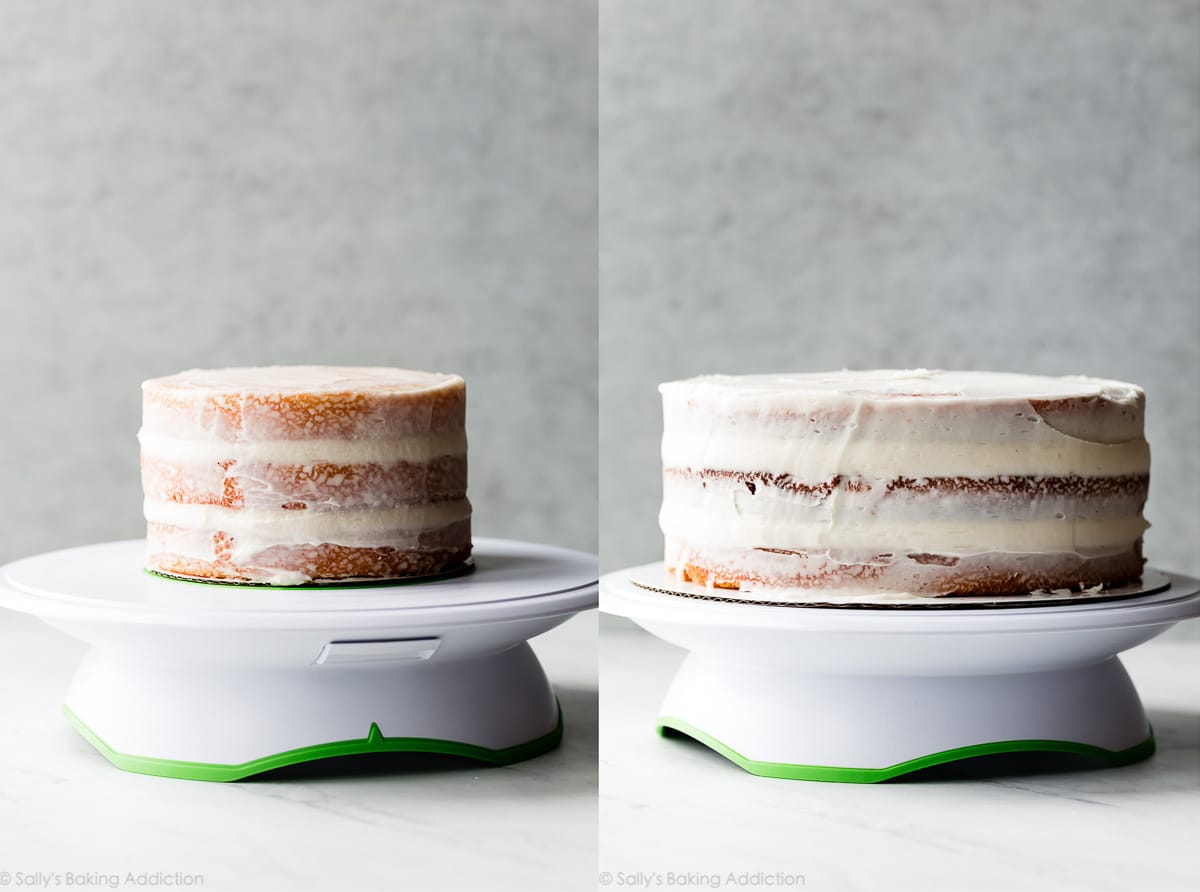
A wedding cake is literally the dessert of a lifetime, so it shouldn’t only taste great—it should look stunning, too. To reduce the possibility of flaws or mistakes, stick with simple decorating. A crumb coat on both tiers is necessary to protect the outer layer of frosting from catching any crumbs.
- What is a crumb coat? It’s basically a very thin layer of frosting around the cake before the beautiful exterior frosting is applied. You can see me crumb coating the cakes (as shown in the video tutorial, photos, and described in the recipe below), refrigerate the cakes to help “set” the crumb coat.
As you can see in the video tutorial above, it’s helpful to use a bench scraper to apply the crumb coat and exterior frosting layer. In fact, I use a bench scraper for decorating all layer cakes. I also like to use an icing spatula for the top of the cakes. (I use a small icing spatula for the small cake and a large icing spatula for the large cake.)
After crumb coating the cakes, they must be refrigerated to help “set” the crumb coat. This is another reason why cake boards are necessary—to help transfer/transport the cakes around.
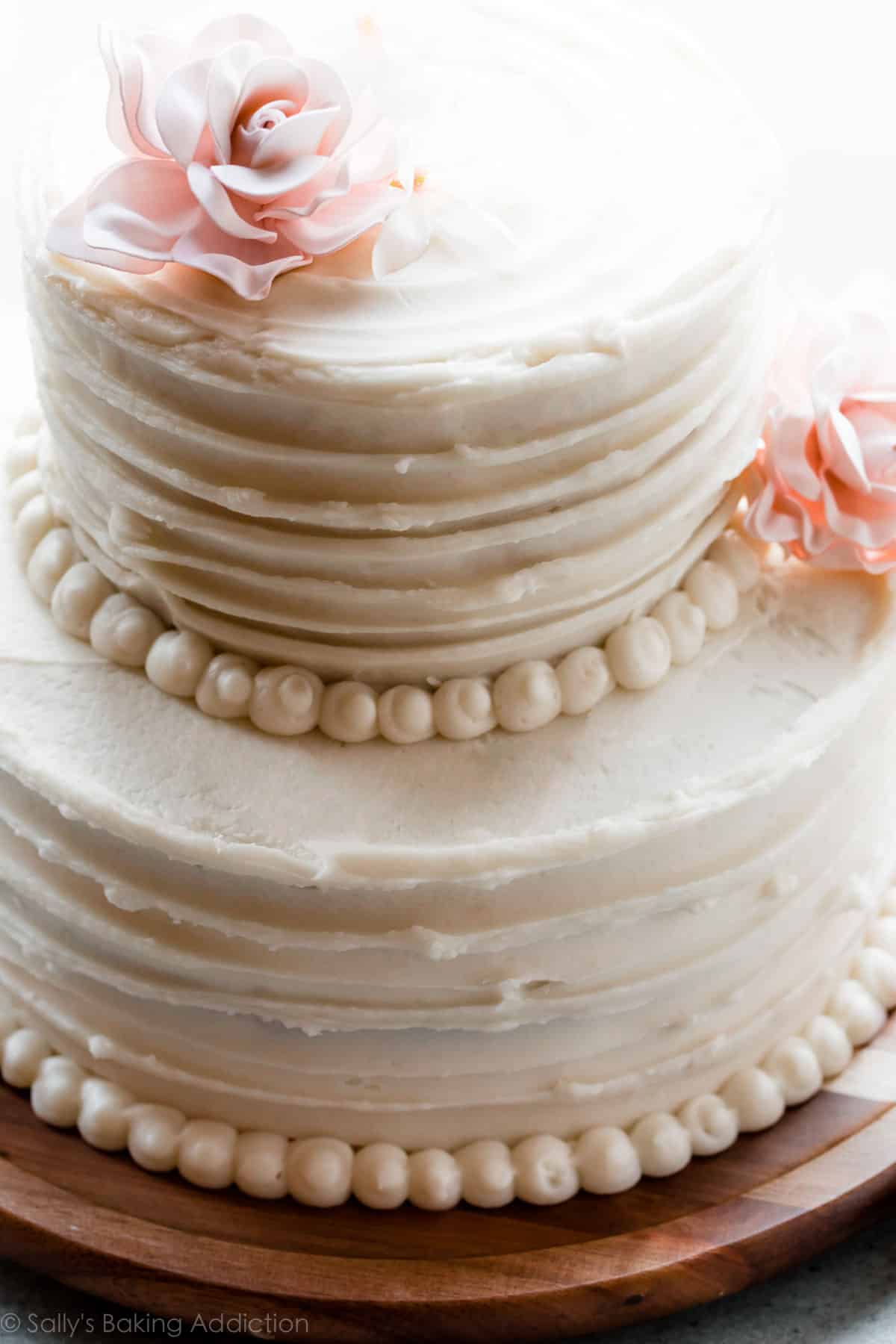
The textured look of the exterior frosting is very easy. (A big shoutout to my assistant, Stephanie, for suggesting this look!) As shown in my video, use a small icing spatula and run it around the cakes while spinning with the cake turner. You will love this look because it’s very easy, but resembles beautiful ruffles.
Piping
After placing the small tier on top, you can pipe frosting around the bottom of it. This covers up any spaces or smears that may have appeared when arranging the top tier. I pipe dots of frosting with a round piping tip between the tiers as well as around the bottom of the whole cake. They resemble pretty pearls. To smooth any peaks on these “pearls,” moisten your fingertip with water and gently press down on the peak.
More Decorating Inspiration
- Naked Cake style with flowers and berries
- Buttercream Flowers
- Two-Toned Frosting Roses
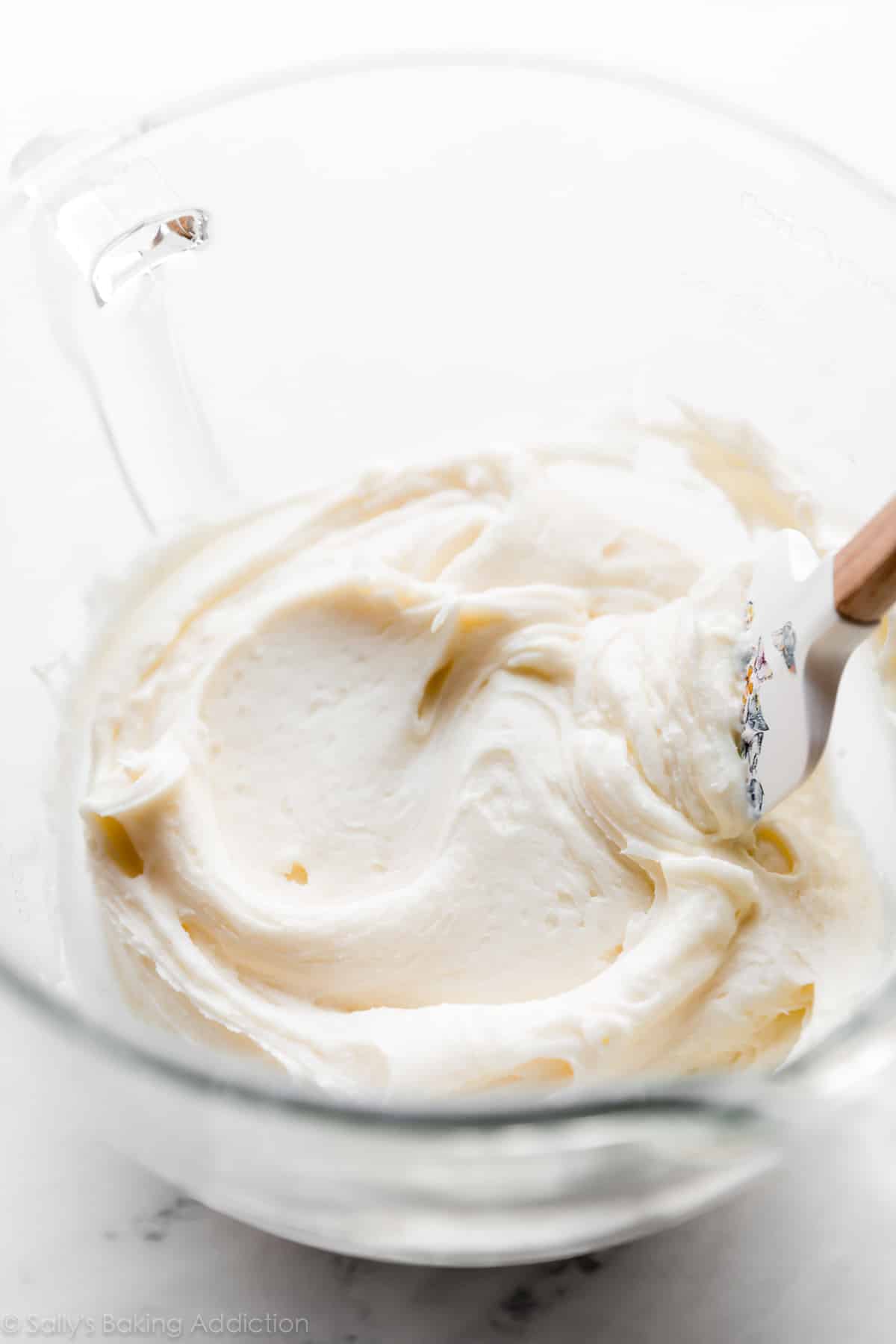
We’ll use my vanilla buttercream recipe (an increased amount, of course) for the decoration. Make two separate batches of frosting, 1 batch for each tier. There’s too much frosting for 1 batch—it will overwhelm your mixer.
You need at least 8-9 cups of frosting total which includes the filling, crumb coat, exterior ruffled frosting, and piping. If you desire other flavors of frosting, be sure to find a recipe that yields or adjust to yield 8-9 cups.
How to Keep Air Bubbles Out of Your Buttercream
Over-whipping vanilla buttercream creates air bubbles. The taste is no different, but the buttercream is no longer smooth and velvety.
Here’s how to get rid of air bubbles in your frosting: Ditch the mixer. Grab a wooden or metal spoon and begin stirring the buttercream by hand. Mash the frosting up against the side of the bowl to “pop” the bubbles. Do this until most of the air bubbles pop, about 1-2 minutes. This trick requires a lot of arm muscle!
Recommended Special Tools
(Affiliate links)
- Mixer (Handheld or Stand Mixer)
- Egg Separator
- 3 9×2 inch Round Cake Pans
- 3 6×2 inch Round Cake Pans
- Cake Boards (I use 1 6 inch and 1 10 inch. A 9 inch board works for the bottom cake, too. Or purchase this set which also includes cake dowels.)
- Cake Dowels (You need 4. You can use plastic cake dowels too. Plastic dowels are easier to cut.)
- Large Icing Spatula (for large cake)
- Small Icing Spatula (for small cake and for ruffled edge)
- Bench Scraper
- Cake Turner
- Piping Bag (disposable or reusable)
- Round Piping Tip
- Artificial Flower Decor (I used “Cozy Blush” color. Love these!)
- Large Serving Platter or Cake Stand (Pictured is a wooden cake stand I found at Target last year. You can see some of my other favorite cake stands in my list of Gift Ideas for Bakers.)
Description
This is a recipe for a completely homemade 2 tier wedding cake. For best taste and texture, and to avoid overwhelming your mixer, make each tier (cake) and each batch of frosting separately.
Ingredients
9-Inch Bottom Tier
- 3 and 2/3 cups (433g) cake flour (spooned & leveled)
- 1 teaspoon salt
- 1 teaspoon baking powder
- 3/4 teaspoon baking soda
- 1 and 1/2 cups (340g) unsalted butter, softened to room temperature
- 2 cups (400g) granulated sugar
- 3 large eggs + 2 additional egg whites, at room temperature
- 1 Tablespoon pure vanilla extract (yes, Tbsp!)
- 3/4 cup (180g) full-fat sour cream, at room temperature
- 3/4 cup (180ml) whole milk, at room temperature
6-Inch Top Tier
- 1 and 3/4 cups (207g) cake flour (spooned & leveled)
- 1/4 teaspoon salt
- 3/4 teaspoon baking powder
- 1/4 teaspoon baking soda
- 1/2 cup (8 Tbsp; 113g) unsalted butter, softened to room temperature
- 1 cup (200g) granulated sugar
- 1 large egg + 1 additional egg white, at room temperature
- 2 teaspoons pure vanilla extract
- 1/2 cup (120g) full-fat sour cream, at room temperature
- 1/2 cup (120ml) whole milk, at room temperature
Frosting for 9 inch cake & piping
- 2 cups (452g) unsalted butter, softened to room temperature
- 8 cups (960g) confectioners’ sugar
- 6 Tablespoons (90ml) whole milk or heavy cream
- 1 and 1/2 teaspoons pure vanilla extract
- 1/8 teaspoon salt
Frosting for 6 inch cake
- 1 cup (16 Tbsp; 226g) unsalted butter, softened to room temperature
- 4 – 5 cups (480-600g) confectioners’ sugar
- 1/4 cup (60ml) heavy cream or whole milk
- 1 teaspoon pure vanilla extract
- salt, to taste
Instructions
- Before beginning this recipe, watch the video tutorial above, read the entire blog post, read the recipe instructions, and review the recipe notes. Make sure you’re prepared with the recommended special tools, which are listed right above this recipe and in the recipe Notes section.
- Make each cake separately. Start with the bottom tier (9-inch cake). Preheat oven to 350°F (177°C). Grease three 9×2 inch round cake pans, line with parchment paper rounds, then grease the parchment paper. Parchment paper helps the cakes seamlessly release from the pans. (If it’s helpful, see this parchment paper rounds for cakes video & post.)
- Whisk the cake flour, salt, baking powder, and baking soda together. Set aside. Using a handheld or stand mixer fitted with a paddle or whisk attachment, beat the butter and sugar together on high speed until smooth and creamy, about 3 minutes. Scrape down the sides and up the bottom of the bowl with a silicone spatula as needed. Beat in the 3 eggs, 2 egg whites, and vanilla extract on high speed until combined, about 2 minutes. (Mixture will look curdled as a result of the egg liquid and solid butter combining.) Beat in the sour cream. Scrape down the sides and up the bottom of the bowl as needed. With the mixer on low speed, add the dry ingredients until just incorporated. With the mixer still running on low, slowly pour in the milk until combined. Do not over-mix. Whisk it all by hand a few times to make sure there are no lumps at the bottom of the bowl. The batter will be slightly thick. You’ll have 8-9 cups of cake batter. Pour batter evenly into cake pans. Weigh them to ensure accuracy, if desired. Bake for around 23-26 minutes or until the cakes are baked through. To test for doneness, insert a toothpick into the center of the cake. If it comes out clean, it’s done. Allow cakes to cool completely in the pans set on a wire cooling rack. The cakes must be completely cool before frosting and assembling.
- Keep the oven on.
- For the top tier (6-inch cake) prepare three 6×2 inch round cake pans just as you did with the 9-inch cake pans in step 2. (Greasing with parchment paper rounds.)
- Prepare the 6-inch cake batter the same exact way as the bottom tier. You’ll have about 4 cups of cake batter. The batter will be thinner than the bottom tier’s cake batter. Pour batter evenly into cake pans. Weigh them to ensure accuracy, if desired. Bake for around 18-22 minutes or until the cakes are baked through. To test for doneness, insert a toothpick into the center of the cake. If it comes out clean, it’s done. Allow cakes to cool completely in the pans set on a wire rack. The cakes must be completely cool before frosting and assembling.
- Using a large serrated knife, slice a thin layer off the tops of all the cakes to create a flat surface. This is called leveling off the cakes. Discard the leveled off piece (or crumble over ice cream!).
- Make the frosting for the 9-inch cake (which is enough for the piping detail, too): In a large bowl using a handheld mixer or stand mixer fitted with a paddle attachment, beat the butter on medium speed until creamy, about 2 minutes. Add confectioners’ sugar, milk, vanilla extract, and salt with the mixer running on low. Increase to high speed and beat for 2 minutes. Add more confectioners’ sugar if frosting is too thin, more milk if frosting is too thick, or an extra pinch of salt if frosting is too sweet.
- You can prepare the rest of the frosting now (step 11), if desired, or begin decorating the 9-inch tier. Place your 9-10 inch cake board on your cake turner. Place 1 cake layer on your cake board. Using a large icing spatula, evenly cover the top with a scant 1 and 1/2 cups of frosting. Top with 2nd cake layer and evenly cover the top with a scant 1 and 1/2 cups of frosting. Top with the third cake layer. Using about 1-1 and 1/4 cups of frosting, spread it all over the top and sides in a thin layer, also called a crumb coat. A large icing spatula and bench scraper are helpful for applying the crumb coat. Set leftover frosting aside at room temperature. If you are decorating this cake in stages over 1-2 days, cover and refrigerate this leftover frosting.
- Using the cake board to pick up the cake (be careful, it’s heavy), place the cake in the refrigerator to help set the crumb coat as you work on the top tier.
- Make the frosting for the 6-inch cake, just as you prepared the 1st batch of frosting. (Step 8.) Before adding any salt, taste the frosting, then add a pinch if desired. I always add a small pinch.
- Place your 6-inch cake board on your cake turner. Place 1 6-inch cake layer on your cake board. Using a small icing spatula, evenly cover the top with a scant 3/4 cup of frosting. Top with 2nd cake layer and evenly cover the top with a scant 3/4 cup of frosting. Top with the third cake layer. Using about 3/4 cup of frosting, spread it all over the top and sides in a thin layer, also called a crumb coat. A small icing spatula and bench scraper are helpful for applying the crumb coat. Set leftover frosting aside at room temperature. If you are decorating this cake in stages over 1-2 days, cover and refrigerate this leftover frosting.
- Using the cake board to pick up the 6-inch cake, carefully place the cake in the refrigerator to help set the crumb coat as you work on the exterior frosting on the top tier.
- Remove the bottom tier from the refrigerator (along with the cake board) and place on the cake turner. Apply the remaining frosting for the bottom tier on the cake, reserving about 6-8 Tablespoons for piping detail. I recommend a large icing spatula and bench scraper to apply the outer layer of frosting. For the decorative textured frosting as pictured, see my video above. As shown in the video, use a small icing spatula and run it around the cake while spinning with the cake turner. You will love this look because it’s very easy, but resembles beautiful ruffles. Carefully lift the cake (with the cake board) and place on your serving platter or cake stand.
- Wash and dry 4 cake dowels. Measure the height of the bottom cake. Measure and cut the cake dowels to match. Staying within a 6 inch circle diameter (you can use another 6 inch cake board to “imprint” a 6-inch circle in the very center of the top of the 9-inch cake), insert the dowels into the cake, spacing them about 2 inches apart to form 4 corners of a square. Push the dowels straight down until each touches the bottom cake board. Set aside.
- Remove the top tier from the refrigerator (along with the cake board) and place on the cake turner. Decorate just as you did the bottom tier, including the ruffled textured frosting. I also turn the cake on the cake turner and apply this ruffled look on top of the 6-inch cake, too. This is optional. Along with the cake board, carefully lift the small cake and gently place it in the very center of the bottom tier.
- Piping: After placing the small tier on top, you can pipe leftover frosting around the bottom of it. This covers up any spaces or smears that may have appeared when arranging the top tier. I pipe dots of frosting with Wilton piping tip #12 between the tiers as well as around the bottom of the whole cake. They resemble pretty pearls. To smooth down pointy peaks on these “pearls,” moisten your fingertip with water and gently press down on the peak.
- Add any decorative pieces, such as artificial flowers.
- Cake is best enjoyed within 3 days. Refrigerate cake until ready to serve. After a few hours, the frosting will “set” and you can lightly cover with plastic wrap.
- Cover any leftover cake tightly and refrigerate for up to 1 week.
Notes
- Make Ahead & Freezing Instructions: Assembled cake is best enjoyed within 3 days. Refrigerate assembled cake until ready to serve. After a few hours, the frosting will “set” and you can lightly cover with plastic wrap until ready to display and serve. You can make the cake ahead of time before assembling it, too. The cake layers can be baked, cooled, and covered tightly at room temperature overnight. Likewise, the frosting can be prepared then covered and refrigerated overnight. Let the frosting sit at room temperature to slightly soften for 20 minutes before assembling and frosting. (You may need to beat the refrigerated frosting in the mixer for 1-2 minutes if it’s particularly solid. Feel free to add a Tablespoon of milk or heavy cream to soften it up as it mixes, too.) Crumb-coated cakes can be frozen up to 2-3 months. Cover with 2 layers of plastic wrap and 1 layer of aluminum foil. Freeze. When ready, thaw overnight in the refrigerator. Unfrosted cake layers can also be frozen up to 2-3 months. Thaw overnight in the refrigerator and bring to room temperature before decorating/serving. See how to freeze cakes for detailed instructions on freezing cake layers.
- Special Tools (affiliate links): 9-inch Round Cake Pans | 6-inch Round Cake Pans | Glass Mixing Bowls | Whisk | Electric Mixer (Handheld or Stand) | Silicone Spatula | Egg Separator | Kitchen Scale (optional) | Cooling Rack | Cake Boards (1 6 inch and 1 10 inch, or this set which also includes cake dowels) | Wooden Cake Dowels or Plastic Cake Dowels | Cake Turner | Large Icing Spatula | Small Icing Spatula | Bench Scraper | Piping Bag (Disposable or Reusable) | Wilton #12 Round Piping Tip | Artificial Flower Decor
- Cake Flour: If you can’t get your hands on cake flour, use this cake flour substitute.
- More flavors, fillings, sizes, decoration ideas, and special tools: See blog post above.
- Why is everything at room temperature? All refrigerated items should be at room temperature so the batters mix together easily and evenly. Read here for more information about the importance of room temperature ingredients.











Reader Comments and Reviews
Hi Sally! Your site is always my go-to and I was so happy to see this well-written primer for Wedding Cake, as I need to make my first one for an October wedding. I did a test run of this recipe for the 6″ pans and my cakes came out with lots of air pockets in them. When I trimmed the tops off, the cakes looked like sponges. I know this can’t be right. They also tasted like pancakes to me. Help! I know this isn’t what you intended!
Hi Susan, we’re happy to help! It sounds like the batter may have been over mixed. Over-mixing adds too much air to the mixture, which will expand when baked leaving air pockets. An easy fix for next time!
I have one question. You say this is modification of your Best Vanilla Cake, except for sour cream and milk in place of buttermilk. However the recipe for the wedding cake uses only 1 teapsoon of baking poweder and your other vanilla cake uses 2 teaspoons. Is this a typo or is it really only 1 teaspoon?
Hi Debbie, It’s only 1 teaspoon here.
Hi ! I’m wanting a smaller version of this – tell me please , if I only use the recipe for the 3 -9” and make 2 – 8” can I get 2 short 6” out of the recipe ?
Hi Cindy, refer to the section of this post called: Other Cake Pan Sizes. Enjoy!
Can I use full fat yogurt instead of sour cream?
Hi Dezi, plain, full-fat Greek yogurt will work as a substitute for the sour cream. Hope you enjoy the cake!
This cake got rave reviews! I used this recipe to make a 3 layer 8″ cake plus cupcakes for my brother’s 40th birthday party. I did make the entire recipe all at once instead of splitting it up as the recipe states, and the cake turned out perfectly. I did not use this buttercream recipe.
Looking forward to making this cake! Can I add almond extract to the cake batter? I love the taste of almond in a white cake! Thank you.
Hi Cindy! You can absolutely add almond extract. I recommend starting by replacing half of the vanilla extract with almond extract. You can also add almond extract to the buttercream for an even more pronounced almond flavor — I’d start with a teaspoon, taste, and then add more to your liking.
I made this and the cake was very dense. When comparing to the vanilla cake recipe, this has 1 tsp of baking powder vs 2 tsps, and this is likely why. Is this an error? Unfortunately it was for a special event so the outcome was disappointing.
Hi Cathy, the recipes as written are correct. The vanilla cake, with 2 teaspoons of baking powder, is slightly lighter than this one, which is a bit sturdier to help support a top tier. However, you can certainly use the vanilla cake recipe (with 2 teaspoons of baking powder) in the future. Although this one is slightly sturdier, it shouldn’t be overly dense. Was the batter over mixed by chance? This post on how to prevent dry and dense cakes may be helpful to review. Thank you for giving this one a try!
Hi Sally, my son’s fiancé has asked me to make a wedding cake for her. That is a sponge cake. I have made cakes for years and deserts, but not a wedding cake and the thought of making a spongecake scares me as I know it would need to be made right near the wedding time and also could file as they quite finicky things. Can you tell me would your cake be very similar to a sponge? Also how many days before could I make it before the wedding that is. Would I be able to use the fridge to keep it a few days before the wedding ? I just don’t want to have to do this on the day or close to the day of the Wedding.
Hi Peta, this cake may be denser than what many may consider a “sponge” cake (so that it can properly hold up the layers and tiers), but it’s still wonderfully soft and fluffy. Perhaps you could try just the 6-inch top tier as a test? See recipe Notes section below the written recipe for our recommended make ahead options. Hope the cake is a hit!
Hello! I used this recipe for a wedding cake and it turned out beautifully! I have another bride wanting white cake with colored sprinkles incorporated into the batter. Can I add sprinkles to this cake recipe or do you recommend your funfetti cake recipe? Would that cake hold multiple layers and 2 tiers like this cake does? (With dowels and such of course too.) Thanks so much!
Hi Bonnie, you can definitely add sprinkles. We would add 1/2 cup to the top tier and 1 cup to the bottom tier. So glad this recipe was a hit!
I was looking for the traditional almond flavor wedding cake, do I just substitute almond extract for the vanilla?
Hi Francine, you could absolutely try adding almond extract to the batters for this tiered cake. We’d recommend starting by replacing half the called for vanilla extract with almond extract. You can also add almond extract to the buttercream for an even more pronounced almond flavor — we’d start with a teaspoon, taste, and then add more to your liking. We’d love to know how it turns out for you!
Hi Sally,
I am considering making this for my daughter’s wedding. She lives near Denver so it will be high altitude baking. Do you have any suggestions to adjust for high altitude.
Thank you
Hi Susan, we wish we could help, but we have no experience baking at high altitude. Some readers have found this chart helpful: https://www.kingarthurflour.com/learn/high-altitude-baking.html
Im making a wedding cake and my pans are 3-inches high. Should I lower the oven temperature and bake them longer?
Hi Dori, that’s not necessary if it’s the same amount of batter going into the cake pans. It’s just a taller pan, but the same amount of cake batter assuming you are making 3-layer cakes.
I made this cake for a spur of the moment elopement and thought I would share my experience for anyone figuring out the feasibility. Sally is always awesome about details so make sure you read through everything first. As someone who has made many cakes but never a tiered cake I would absolutely recommend purchasing a cake leveler as one uneven layer can quickly make the whole cake look wonky. I ended up trimming the cardboard under the first tier as there was a pretty significant amount showing. I ended up needing to make When it came to decorating I used some leftover flowers from the brides bouquet which really made it look sweet and cohesive with the wedding. Finally, I know there is a lot of talk about buttercream melting but learn from my mistake: Out of fear of the icing melting I waited until it was time to cut the cake to bring it out. The buttercream was rock hard and very difficult to cut through! Whoops! So just know that there is a happy medium between keeping the cake cold and giving the frosting just a little bit of time to soften (it is mostly butter after all!) All in all, everyone loved the cake and I got many compliments
Everything of yours I’ve tried I’ve loved so I’m excited for this. Do you have a formula or quick way to figure out how to cut it down to 2 layers each (vs 3)? Thanks!
Hi Eme, you can make only 2 layers, but there will still be a bit too much batter. Make sure you only fill your pans half way (otherwise you risk overflowing and uneven baking). You can use any leftover batter for a few cupcakes on the side. We’re unsure of the exact bake time, but it will be slightly longer to accommodate for the thicker layers. Keep a close eye on them and use a toothpick to test for doneness. Hope it’s a hit!
This may be a silly question, but which layer are the bride and groom meant to cut and eat? With different recipes for each layer, do they have different tastes?
Hi Becky, you can really cut into either, although many people choose to cut into the top tier for ease. The written recipe is the same flavor for each tier, just different ratios. Of course that will change if you decide to do different flavors for each tier. Hope this helps!
I used the lemon cake alternative you suggested for my friends’ wedding and it turned out amazing! Thank you so much for the detailed instructions on assembling a tiered cake and fabulous recipe. The cake was a hit!
Thank you so much for this recipe and your clear instructions. Though I over creamed the butter and sugar, the cake was still called “awesome” and “amazing” by the guests. This generous amount of frosting made each tier almost 4” high, making the cake look well proportioned. As a Frozen-themed birthday cake it worked well with the plastic figurines I had bought and the archway cake topper I had ma
I would love to make a wedding cake but I would like to make the traditional almond flavor. How much almond flavoring should I substitute? I know almond flavoring can get overwhelming.
Hi Francine, you could absolutely try adding almond extract to the batters for this tiered cake. We’d recommend starting by replacing half the called for vanilla extract with almond extract. You can also add almond extract to the buttercream for an even more pronounced almond flavor — we’d start with a teaspoon, taste, and then add more to your liking. We’d love to know how it turns out for you!
Sally, please…last question I’m baking for a wedding June 22nd, I’m planning to baker your beautiful wedding cake and two of your lemon coconut cakes, my fear is if bake and decorate too soon it will dry out or if I wait until Saturday something may come up wrong, this is my first time baking your wedding cake( I hope makes sense!)thank so much, I love so much your recipes!
Hi Yendi! We generally recommend that you decorate a cake one day ahead of time. It is fine to sit at room temperature overnight until serving. For a longer make-ahead option, we recommend making the cake layers ahead of time, freezing them, then assembling/decorating the cake the day or day before serving.
Thank you so much!!
Hi Sally, I love all your recipes! I’m going to bake the wedding cake for June 22nd, is on Saturday, for my aunt 50th anniversary. Do you think the buttercream will hold up in a humid hot weather? I also was thinking if your swiss buttercream will be better? Thank you!
Hi Yendi! Both American Buttercream and Swiss Meringue Buttercream are butter-heavy and will melt in very hot weather. We recommend keeping the cake in a cooled place (inside, in air conditioning, or even chilled, if necessary) until close to serving.
I would love to make this cake for my daughter’s wedding, but it needs to be dairy free. Is it possible to amend the recipe?
Hi Maureen, we haven’t tested a dairy-free version of this recipe, but let us know if you do give it a try with any plant-based alternatives.
Thank you for the detailed instructions for each tier. I was looking for a wedding cake recipe and this saved me. Your recipes are always my go to for any occasion.
Is it normal for each layer to be only about 1 inch high? I used a Fat Daddio on the 6″ and a springform 9 x 2″, weighed all the ingredients. The 6″ layers were each 283 grams of batter and the 9″ were 569. I’m worried that the cake is going to be dense. Thank you for letting me know if I should start over. I have it all frozen.
Hi Sharon, the layers are about 1 inch to 1.5 inches tall. Be sure your baking powder and baking soda are fresh for optimal rise, and be cautious not to over mix the batter which can result in dense cakes. Hope the cake is a hit!
Any recommendations for making this a 3 tiered cake 12 9 6 ? Vanilla raspberry, lemon lemon curd and carrot on top? Or will this not stand up? Assuming dowels go all the way through all layers or should you only make each layer 2 layers versus 3 any recommendations?
Hi Gesa, we haven’t tried this particular recipe as a 3 tier cake, but with the proper support, it should hold up well. This cake pan sizes and conversions guide will be helpful for scaling the vanilla recipe to a 12-inch cake. You can use this lemon cake for the 9-inch round (see recipe Notes for 9-inch pans, or use the batter as is for thinner layers). And here is our carrot cake cupcake batter, which will work well as a 6-inch cake. Hope this helps!
i made this cake (top layer). im just a home baker, so just not familiar with much. the crumb The cake was moist yet super soft. is that how the cake crumb should be? (kind of just melts in your mout.) I just had a piece of the cake top (dome ) so i don’t know if thats how a slice would be. the flavor was great.
Hi Lori, sounds just about right!
With only 1 pan of each size, the batter will have to sit a long time while the cakes bake and then cool completely. Will this be OK, or should I measure a third of the dry and a third of the wet ingredients for each layer?
Hi Sharon, we would let the batter sit at room temperature, covered, while you wait to use the pan.
i haven’t baked this yet, but could i substitute some oil for some butter to make sure its not dry? its for my daughters wedding, i’ll have to freeze it and i’m worried it will be dry. i don’t use symple syrup.
Hi Lori, we recommend sticking with the recipe for best results. This cake freezes beautifully!
Thank you for this lovely recipe. It worked beautifully and your assembly instructions were so helpful. I used your vanilla cake/cupcake recipe with a strawberry curd filling. I used your Swiss meringue butter cream recipe for the frosting (couple’s request!)and fresh roses on top. Beautiful
Hi! I was wondering if you have a recipe for a 12” cake to add as a bottom layer?
Hi Haley, we do not have a written recipe for 12-inch pans, but here is everything you need to know about cake pan sizes and conversions.
Thank you! Do you think I could double the 6in recipe?
Would this be the best go to recipe for a three layer, two tiered cake option?
Hi Jeanne, yes, or one of the flavor options listed in the post above!
Hi Sally I’m wanting to make this cake but I’ve no sour cream just milk how will I go about that?
Hi Mags, In a pinch, plain, full-fat Greek yogurt will work as a substitute for the sour cream. Hope you enjoy the cake!
Hi I was hoping to make this cake for my daughter’s birthday. Is it okay to add food gel to change the colour of the icing to pink.
Absolutely!